Loading video…
All breakouts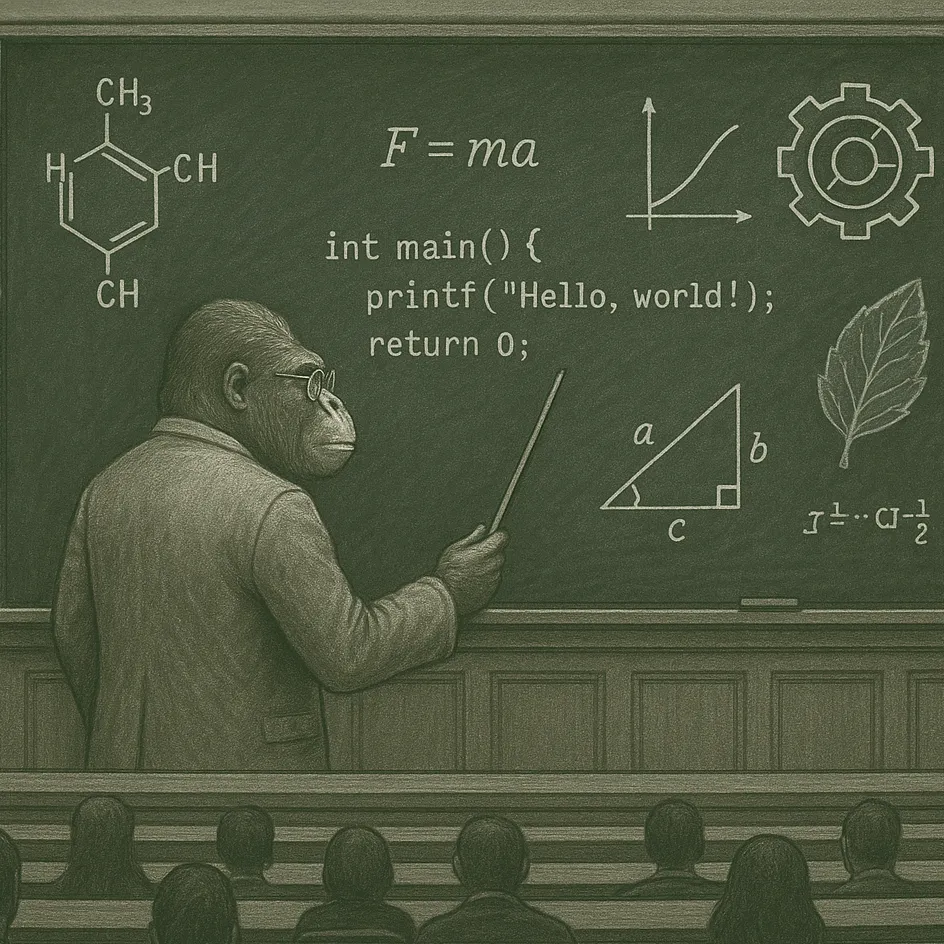
6.1Talking HeadHow-To hookEducation
Hook
Intro to programming.
@officialprofessorgorilla
15.8K followers · usually 286 views a post
Views
2.7K
Likes
162
Comments
2
Shares
4
Summary
This video provides an overview of various computer science courses, covering programming fundamentals, discrete mathematics, calculus, linear algebra, databases, networking, theory of computation, probability and statistics, machine learning, computer graphics and game development, embedded systems and IoT, and cybersecurity. It highlights key concepts, tools, and applications within each field, emphasizing the practical skills gained for future careers.
Transcript
Intro to programming. Typically, one of the first classes a computer science major takes. It teaches the basics of coding, problem solving and computational thinking. The most commonly used programming languages for this class are Java, C++ and Python. It covers basic syntax, structures, variables, data types, basic input, output, conditions, loops, functions, basic algorithms and debugging. Many of the first programs that students create are Hello World to do or calculators. But one of the main skill you get in this class is translating logic into code. Also, being able to solve problems and breaking them down into smaller steps, algorithms and data structures. A cornerstone in computer science is having your programs work as efficiently as possible. Key topics covered in this course are time complexity or how long does it take for a program to run, measured in big O, big Omega or big beta data structures such as errays, linked to lists, and cubes, trees, or graphs. You also learn fundamental algorithms such as sorting algorithms such as quick sort, merge sort and bubble sort, searching algorithms such as binary search and dictionary and recursion such as the tower of, the Fibonacci sequence and Y combinator. This course mainly teaches you how to write efficient and scalable code, which is key to many coding interviews. It allows you to tackle lead code style problems and really think about tradeoffs when creating programs, discrete math This is a course that really goes into the foundation of computer science. Just like the name, it's a type of math that focuses on countable whole and discrete items. So you never work with any decimal or complex numbers. It's not like calculus, which is a type of continuous math. As calculus deals with rates of change, growth or decay. Some key topics covered are formal logic, which is basically the same type of prop logic you usually see in philosophy courses. Predicate logic, which is a type of logic that deals with absolute or non-absolute states, basic mathematical proofs such as direct proof, proof by contradiction, proof by cases or mathematical induction. It also goes over rigid mathematical definitions of certain terms such as what does it mean for a number to be even or odd? You also go over functions such as subjective, inductive and bijective functions, elementary graph theory, elementary set theory and set operations such as union, intersection and complement, elementary number theory such as modular arithmetic or encryption. and basic combinatorial. The script math is a class that really goes over the pure logic of computers. It allows the students to really learn the language of computers and really fleshes out how to build programs and really think more logically and computationally. Computer architecture, a course that bridges the gap between hardware and software. In this course, you learn how a CPU processes instructions, memory, input, output, and learn how a high-level code translates into machine language. It also goes into bullyan algebra and logic gates. Combination versus sequential circuits, you'll also learn how to write with the assembly language. You'll also touch into CPU design such as arithmetic logic units, memory hierarchy, like S-RAM versus DDR, GPU architecture, input output systems such as storage devices or hard drives versus solid state drive. You'll also use the C programming language in this class. You even might touch into the basics of quantum computing. The main means skills that you get is that you learn operating system or coronary development, be able to visualize data flows from CPUs and work with embedded systems, calculus, a math class mainly about rates of change and finding the area and volume of very irregular shapes. calculus can be divided into two sections, differential calculus and integral calculus. Differential calculus deals with concepts such as limits and derivatives. Basically, what does a value do as it gets closer and closer to another value? You'll learn different techniques for finding derivatives such as the power rule, the product rule, the quadratic rule, or the chain rule. Integral calculus deals with finding the volume or area under the curve. You'll learn integration techniques such as substitution, integration by parts and many more. You'll also learn techniques to find out if a series, which is a sequence of repeated addition or multiplication, converges or diverges. Converging, meaning it gets closer and closer to a certain value or number or diverges, meaning the answer is infinity. You'll also learn the basics of differential equations, which is a type of problem where the answer is a function. Calculus is extremely useful for machine learning, graphics and physics engines and tracking the growth and speed of algorithms. Linear algebra, a mathematics course given to computer science, physics and engineering majors. Linear algebra is about vectors, matrices and linear transformations. Vectors are objects in mathematics that instead of representing a singular point, represents a direction and magnitude. direction meaning which way and magnitude meaning how long. A matrix is a grid of numbers or values and it allows you to solve big and complicated problems by doing math to multiple numbers at once. Linear transformations are about transposing 2D planes. It's like if you had a drawing of a smiley face if you were to stretch, squish and turn it, but you preserve any straight lines and you transform around a central middle point. Linear algebra is used for computer graphics and 3D space, machine learning and even Google's page rank algorithm databases, a course that teaches students how to interact with, manage and structure data. This course goes over relational databases with tables, rows and keys, you learn the SQL or structured query language and learn how to select, insert, update and delete entries in a database. You also go over database design such as binary trees and hash tables, you'll even learn to use databases that require no SQL like Redist or Mongo In this course, you'll learn to use tools like my SQL, SQL Lite, Firebase and AWS learning about databases is crucial for creating records for businesses, managing the back ends of website and data science, networking. This course explores how devices communicate over the internet and the structure of networks. You learn about different protocols like HTTP, TCP, IP, DNS, analyzed packets with tools like Wireshark, different network types like WAN, and VPN, network topologies such as star, mesh and bus. You'll also learn about the OSI model and work with cloud platforms such as AWS and Azure. A computer networking class gives students the tools for cyber security, cloud engineering, backend and devops, theory of computation. A course that touches on more of the theoretical or philosophical aspects of computer science. It explores the limits of what's even possible to compute. It covers topics like finite state automata, which is about diagramming the possible actions of machines given certain inputs, regular languages for spline state automata, which is about all the possible input. We'll also explore the concept of a Turing machine, which is a theoretical computer that can loop, do conditional and hold state, we'll dive very deep into the topic of algorithm complexity and explore open questions in computer science such as P versus NP, which is a problem that tries to figure out. If computational problems that are easy to verify, also easy to solve. You'll probably also touch on to the hunting problem, which is a thought experiment that answers the question if it's possible for a program to check if another program runs infinitely or not. Theory of computation teaches students the limits of computing, security and hardware design, probability and statistics. This course focuses on quantifying and analyzing data and also how to make data driven decisions. You learn the fundamental of probability, basic set theory, you also learn about base theorem, which is a type of conditional probability in which it calculates the probability of something happening given the fact that something else has already happened. You'll likely delve into probability distributions such as the normal distribution or the Poisson distribution. You'll work with data visualization tools such as histograms, box plots or scatter plots. Students often work with statistical concepts such as the central limit theorem, confidence intervals, P values or effect sizes. Students often use software such as pandas, CSV, that plot lib which are pipe on libraries. You'll likely learn how to code in the R programming language. You'll also use Microsoft Excel a lot. A class in probability and statistics is crucial for computer science majors because it's essential if you want to go into machine learning, use algorithms or data science, machine learning, a class that teaches students how to work with or create AI. It teaches students how computers can learn from information given to them. It focuses on neural networks and how they work, touching on topics such as proposition, activation functions, natural language processing and deep learning. Machine learning tends to be Python dominant, but you can also use other languages as well. You make use of many Python libraries such as Python learn, tensor flow and python torch. A class in machine learning is quite advanced. So your prerequisites are usually other programming courses, linear algebra and calculus. A class in machine learning prepares computer science majors for AI careers or even other fields like health care for diagnosis and finance for fraud detection, cyber security, a course that gives students the tools to protect computer systems from digital attacks. It goes over vulnerability, defenses and white hat hacking. Students will understand different types of cyber attacks such as DDoS, fishing or cross site scripting, different types of defenses such as firewall and encryption go over legal and ethical issues of privacy and disclosure go over threat modeling like the stride model, which is a system designed to identify the type of security threat to a system. Students learn to use tools such as exploit and end-map for penetration testing. Penetration testing being what it sounds like, hiring someone to intentionally hack a system to see how vulnerable it is. Cyber security not only relies a knowledge of security flaws involving computers, but the type of security risk that don't involve computers such as social engineering. A class in cyber security is important for computer science makers because it is a field in high demand having jobs in healthcare, government, and finance, computer graphics and game development. Often an electic, it teaches students how to build and develop 2D and 3D games. Students learn to build using game engines such as Git, Unity and Unreal. You also learn how to use graphics APIs such as OpenGL or the Open Graphics Library. You go over key concepts in gaming such as game loops, physics such as collision detection and AI such as pathfinding and behavior trees. You'll also use 3D modeling tools such as Blender and Maya. and do animations such as skeletal rigging, key framing and even motion capture. This class is not only good for getting into the gaming industry, but also getting into filmmaking, virtual or augmented reality and even in the medical field for creating simulations, embedded systems and the internet of things. A course that mergers hardware and software to design and program embedded systems such as microcontrollers and sensors. You'll learn to understand IoT architecture such as edge computing and cloud integration. You'll going to different wireless protocols such as Wi-Fi and Bluetooth use tools like the Arduino or platform IO. This is a field in growing demand with its applications in smart homes, wearable, IoT developing and robotic big data and data science and interdisciplinary blend of statistics, programming and machine learning and you use all of these to learn how to get insights from data. The goal is for students to learn the data science pipeline which is collection, cleaning, analysis, visualization and storytelling. You mostly use the Python, R and SQL language and use big data tools such as Spark and Hadoop. This course gives students the skills to seek high demand job in tech, finance and in healthcare. Be sure to share this video and thanks for watching.
Original caption
Every Computer Science Course Explained #ComputerScience #CSTok #TechTok #ProgrammingTok #CodingLife #DeveloperTok #LearnToCode #CodeNewbie #ProgrammerLife #SoftwareEngineering #STEMTok #TechEducation #TechExplained #CodingTips #LearnOnTikTok #EducationTok #StudyTok #AcademicTok #CSStudent #CSMajors #ComputerScienceStudents #TechFacts #CodeLife #NerdTok #GeekTok #TechMindset #StudyHacks #SmartIsCool #EngineerTok #ForYou #FYP #ForYouPage #Viral #Trending #TechMotivation #DailyCoding #StudentLife #FutureEngineer #ComputerScienceMajor #CSCommunity #STEMCommunity
More from @officialprofessorgorilla
More breakout videos from this creator.