Loading video…
All breakouts

7.9Talking HeadBefore / After hookEntertainment
Hook
When thermodynamics goes from this..
@mackharrisonn
646.2K followers · usually 57.1K views a post
Views
487.5K
Likes
54.6K
Comments
291
Shares
7.9K
Why it worked
The video uses a relatable "expectation vs. reality" format common in student-focused content, contrasting the perceived ease of introductory concepts with the overwhelming complexity of advanced thermodynamics. The humor derived from student reactions to difficult material likely contributed to its shareability.
Summary
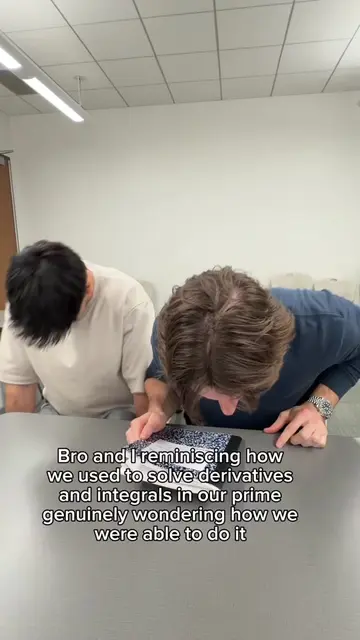
The video contrasts the perceived simplicity of introductory thermodynamics concepts with the overwhelming complexity of advanced topics, using student reactions to illustrate the difficulty. It culminates in the professor announcing a dismal class average on an exam and the beginning of a complex derivation.
Structure
- 1Introduction to basic thermodynamics
- 2Students' initial positive reaction to perceived ease
- 3Transition to complex diagrams and equations
- 4Students' despair at the difficulty
- 5Professor announces poor exam results and begins complex derivation
Product placement
The video shows slides with complex equations and diagrams related to thermodynamics, including P-V and T-S diagrams, heat of fusion measurement, Gibbs-Helmholtz equation, and problems involving ideal gases and turbines. The Cal Poly Pomona logo is visible on a slide at the beginning.
On-screen text
When thermodynamics
goes from this..
Cal Poly
Pomona
Thermodynamics: Branch of Physics
Heat Transfer (Q, Qout)
Mechanical Work (W, Wout)
Other energy changes due to changes in:
Specific Volume, v
Internal Energy, u
Enthalpy, h
Entropy, s
-> Temperature
-> Pressure
-> Volume
First Law of Thermodynamics
Definition:
First Law of Thermodynamics is a fundamental concept in physics that forms the
cornerstone of the laws of thermodynamics. It states that energy cannot be created or
destroyed, but can only change form.
Energy remains constant; it transforms
but cannot be created or destroyed.
Total Energy
Equal
To THIS:
To THIS:
To THIS:
To THIS:
To THIS:
And finally
THIS 💔:
Problem 3. Consider the fourth order differential equation:
y'''' - k^2 y'' = g(x)
1. Find the general solution to the homogeneous equation.
2. Show that a particular solution to Eq. (1) can be written in the form
Φp(x) = 1/k^2 ∫ xg(x)dx - x/k^3 ∫ g(x)dx + e^kx/2k^3 ∫ g(x)e^-kx dx - e^-kx/2k^3 ∫ g(x)e^kx dx
And that
ln Γ(x) = (x - 1/2) ln x - x + 1/2 ln(2π)
x > 1
3. Show that the general solution in part (b) can be rewritten in the form
Φp(x) = ∫ g(s)G(x-s) ds,
where
G(ξ) = 1/k^3 (sinh kξ - kξ)
4. Determine the simplest form of the general solution to Eq. (1) in the case
g(x) = 1.
1. TURBINES
POTENTIAL ENERGY
(TEMPERATURE & PRESSURE)
(CAN INCLUDE GRAVITATIONAL)
MECHANICAL WORK
(SHAFT WORK)
Turbine Schematic
P1
V1
Wout
P2
V2
T1
T2
Z
(NOT ALWAYS PRESENT)
DETAILS OF THIS CONVEN-
TION AND MECH WORK -> ELECTRICITY
O = dE/dt - Q - W + m_i(h_i + v_i^2/2 + gz_i) - m_e(h_e + v_e^2/2 + gz_e)
W = m(h_i - h_e + v_i^2/2 - v_e^2/2 + g(z_i - z_e))
W = m(h_i - h_e) when ΔKE & ΔPE = 0
z = "HEAD"
And finally
THIS 💔:
Original caption
You either love this class or HATE it😂😭 @Juiceditup #college #student #studentlife #collegelife #university
More from @mackharrisonn
Their other posts in the index, biggest breakout first.