Loading video…
All breakouts
19.4Text-HeavyOther hookSaaS
Hook
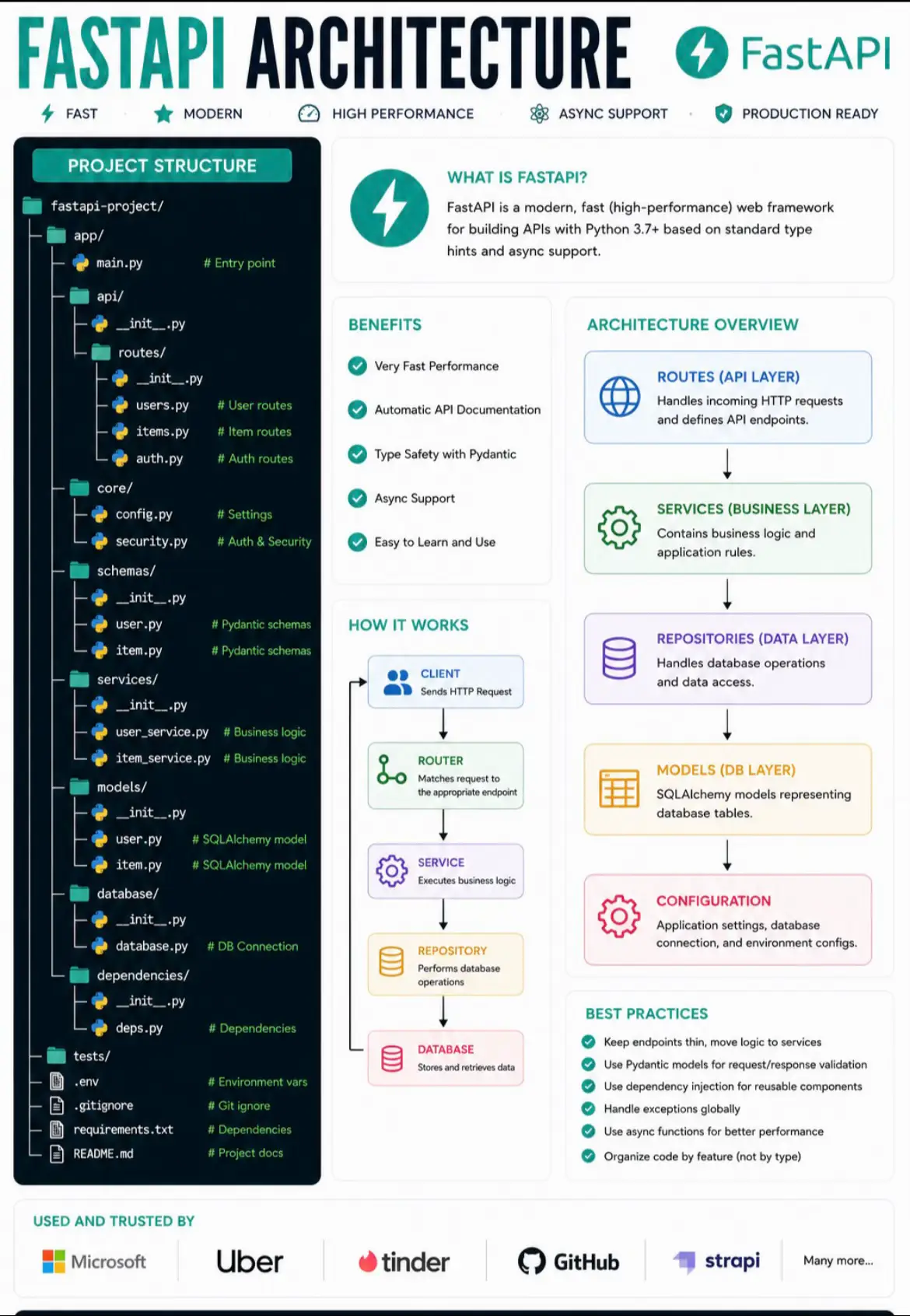
FASTAPI ARCHITECTURE
@stephenakembom
8.9K followers · usually 1.4K views a post
Views
21.9K
Likes
898
Comments
1
Shares
54
Why it worked
The post provides a comprehensive and visually organized overview of FastAPI, a popular developer tool. Its clear structure, detailed breakdown of components, and inclusion of best practices make it a valuable resource for developers looking to understand or implement FastAPI.
Summary
This is a visual guide to FastAPI architecture, detailing its project structure, benefits, and how it works. It breaks down the architecture into layers including routes, services, repositories, models, and configuration, while also offering best practices for its use.
Structure
- 1Introduction to FastAPI Architecture
- 2Project Structure Breakdown
- 3What is FastAPI and its Benefits
- 4How FastAPI Works (Workflow)
- 5Architectural Overview (Layers)
- 6Best Practices
Product placement
FastAPI ACTS - it is a web framework for building APIs. Removing it would change what happens in the video because the entire video is about FastAPI. Microsoft APPEARS - it is a company logo. Removing it would not change what happens in the video. Uber APPEARS - it is a company logo. Removing it would not change what happens in the video. Tinder APPEARS - it is a company logo. Removing it would not change what happens in the video. GitHub APPEARS - it is a company logo. Removing it would not change what happens in the video. Strapi APPEARS - it is a company logo. Removing it would not change what happens in the video.
Original caption
FastAPI has quickly become one of the most popular frameworks for building modern Python APIs. It’s designed for speed, scalability, and developer productivity while maintaining clean, enterprise-grade architecture. A well-structured FastAPI application typically includes: ✅ Routes (API Layer) ✅ Services (Business Logic) ✅ Models (Database Layer) ✅ Schemas (Validation Layer) ✅ Dependencies ✅ Configuration ✅ Database Connections Why is this important? As applications grow, separating responsibilities into dedicated layers makes systems easier to scale, maintain, and understand. Benefits of a proper FastAPI architecture: • Faster development • Cleaner code organization • Better testing and maintenance • Easier team collaboration • Improved scalability • Production-ready APIs FastAPI also provides: ⚡ High Performance ⚡ Automatic API Documentation ⚡ Type Safety with Pydantic ⚡ Async Support ⚡ Modern Python Standards Common use cases: • SaaS Platforms • AI & Machine Learning APIs • Microservices • FinTech Applications • E-Commerce Backends • Enterprise Systems Great APIs aren’t built by accident. They start with a solid architecture. SAVE THIS You’ll need it later. FOLLOW FOR MORE #FastAPI #Python #SoftwareArchitecture #SystemDesign #BackendDevelopment
More from @stephenakembom
More breakout videos from this creator.