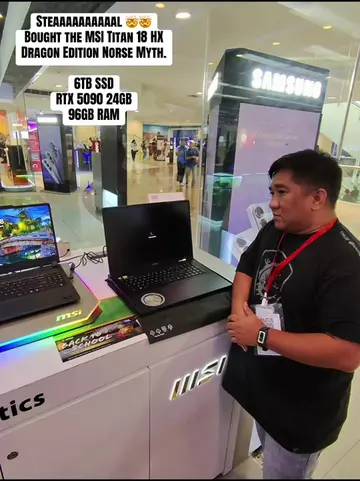
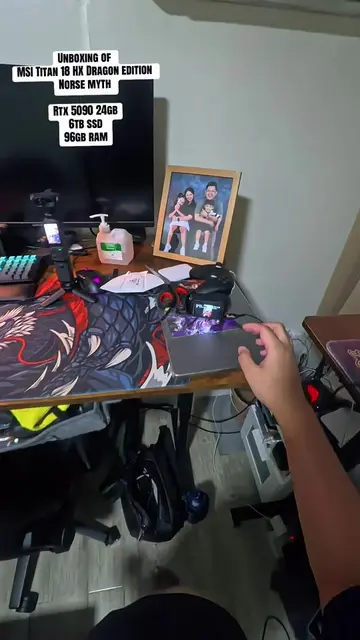
The video likely worked because it directly addresses a key concern for potential buyers of high-end gaming laptops: boot time. The clear demonstration and on-screen text provide a quick and easily digestible piece of information that appeals to the target audience.
Summary
The video demonstrates the boot time of an MSI Titan 18 HX Dragon Edition laptop, showing it booting up and then shutting down. The creator uses a phone timer to measure the boot time, which is presented on screen as 25 seconds.
MSI Titan 18 HX Dragon Edition: This is a gaming laptop that is being demonstrated. It ACTS as the subject of the video. Removing it would change the video entirely.
MSI: This is a brand logo that appears on the laptop screen and the laptop itself. It merely APPEARS. Removing it would not change what happens in the video.
ko lang sa inyo dito yung time na. So ngayon open lang pero papatay natin siya. natin. natin. natin. So 1 second difference. 1 seconds, 11 seconds, 12 seconds. 30 seconds. . So box. So box. So box.You are analysing a TikTok video that measurably outperformed its
creator's own baseline, for a swipe file used by founders studying how other
people MARKET their products.
## Is it promoting something?
Two different mistakes to avoid, and the second is the costly one.
FIRST: talking about an industry is not promoting a product.
- "Here's how I built my SaaS in a weekend" -> not promotional
- "Top 5 tools to start a SaaS business" -> not promotional (listicle, no one product)
- "I'll teach you to start a SaaS business" -> promotional, course_info
- A screen demo of Invideo -> promotional, saas > ai_tool
- A screen demo of Shophunter -> promotional, saas > ecommerce_software
SECOND, and more important: the best-performing promotions do not look like
promotions. Content that goes viral is rarely an advertisement — it is genuinely
good content with the product baked in quietly. Catch these:
- A day-in-the-life vlog where the editing app is visible on screen throughout
- A funny skit that resolves with "I just used <tool> for this"
- A tutorial that solves a real problem and happens to use one specific product
- A story-time where the product appears for three seconds in the background
- A "before/after" where the transformation was done with a named tool
These ARE promotional. A quiet sell is still a sell. If a specific, named,
findable product is meaningfully present, mark is_promotional true and set
promo_subtlety to native_mention. Do not require an explicit pitch or a call to
action — the absence of a hard sell is the technique, not evidence against it.
The line to hold: a product must be identifiable and findable. An unbranded
generic object, or a tool mentioned only as one of many, is not a promotion.
FOURTH — and this is the boundary of the rule above, not an exception to it.
Catching the quiet sell means catching products that ACT. It does not mean
treating every name on screen as a product.
Ask one question: **did this named thing do something here, or did someone stamp
their name on the content?** Equivalently — if you deleted the name, would
anything about the video change?
- A loading spinner branded <tool>, then the edited image it produced, then
the creator sending that image -> the tool ACTED. Promotional,
native_mention, role subject.
Delete the logo and the transformation has no visible cause.
- A screen recording where <app> is being operated
-> ACTED. Promotional.
- "I made this with <tool>" over the result -> ACTED. Promotional.
- A small logo in the corner for the whole video, doing nothing
-> merely APPEARS. Not promotional.
- A one-second animated logo at the end -> an end card. Not promotional.
- A studio, channel or page name stamped on a repost
-> attribution. Not promotional.
- A brand on someone's t-shirt or a university logo behind them
-> incidental scenery. Not promotional.
Delete any of those four and the video is unchanged. That is the test. A name
appearing many times across the video is NOT evidence of promotion — a watermark
appears in every frame by definition.
## Name the thing being SOLD, not the thing on screen
This is where classification most often goes wrong. Ask what the viewer is being
sold, not what happens to be visible:
- A store doing $50k/mo that runs on Shopify -> the STORE is the product.
Shopify is substrate. Do not name Shopify.
- Someone using a TikTok built-in feature -> that is the platform we are on,
not a product being sold. product_role: substrate.
- "Link in bio" pointing at linktr.ee / beacons.ai / stan.store -> those are
link containers. The product is whatever the container leads to; if you
cannot tell what that is, say "none" rather than naming the container.
- A vlog edited in CapCut, mentioned once -> incidental, not the subject.
- A screen demo of Invideo -> Invideo IS the subject. Name it.
If the only nameable thing is a hosting platform, marketplace, social network or
link aggregator, the honest answer is product_role: substrate and
promoted_product: "none". A generic category ("an AI tool", "a CRM") is also not
a product name — say "none".
## Everything else
Be concrete. Quote the hook exactly as spoken or displayed — never paraphrase.
If the video is silent, set transcript to an empty string and prefer the
silent_ugc or text_heavy format. Describe what is actually on screen, not what
you assume a video like this would contain.
## Context
Caption: MSI Titan 18 HX Dragon Edition Norse Myth Boot Time 25S 🤯 RTX 5090 24GB 6TB SSD 96GB RAM #msi #gaminglaptop #aicreator #laptop #gaming
Creator's bio link: https://theangeloumali.com (page title: "Christian Angelo Umali - CTO & AI Solutions Architect | 7+ Years")
If that bio link is the product promoted here, use it for promoted_product_url and set bio_link_is_product true. Creators often promote their own product without ever saying the url aloud. But a link aggregator (linktr.ee, beacons.ai) or an unrelated store is NOT the product.