Loading video…
All breakouts
55.5Text-HeavyBefore / After hookAI Tools
Hook
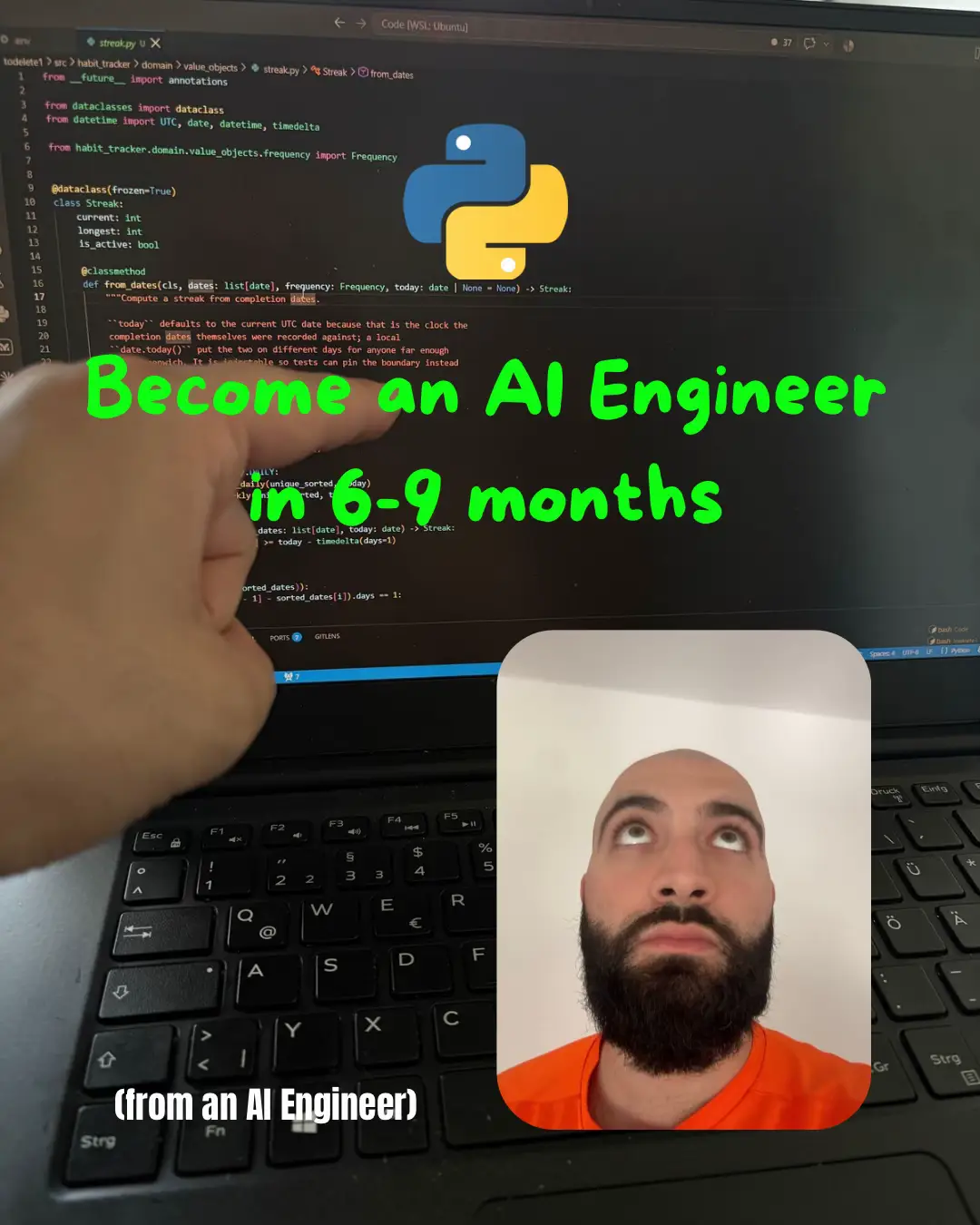
Become an AI Engineer in 6-9 months
@baniascodes
3.3K followers · usually 1.2K views a post
Views
66.8K
Likes
4.3K
Comments
21
Shares
368
Why it worked
The content provides a clear, actionable roadmap for a highly in-demand career path, breaking down complex skills into manageable steps with resource suggestions. The emphasis on practical building and project deployment resonates with aspiring engineers.
Summary
This slideshow outlines a 5-step roadmap for becoming an AI/ML Engineer in 6-9 months, focusing on building foundational software engineering skills, math, algorithms, production deployment (MLOps), and LLMs/GenAI. It emphasizes practical application and project building over theoretical knowledge alone.
Structure
- 1Introduction: Become an AI Engineer in 6-9 months
- 2Step 1: Build foundational CS skills (Python, Git, Docker, etc.)
- 3Step 2: Learn essential math (Linear Algebra, Calculus, Probability)
- 4Step 3: Master ML/DL algorithms and build pipelines
- 5Step 4: Learn MLOps for production deployment
- 6Step 5: Specialize in LLMs and GenAI
- 7Call to action: Follow for more AI & Coding content
Call to action
Follow For More AI & Coding Content
On-screen text
AI ENGINEER IN 6-9 MONTHS
01 STEP
Your Missing
CS Degree
• Python is the backbone. Every ML framework, every data pipeline, every automation script.
• Git, SQL, Docker, Linux, testing, CI/CD. Not ML topics, but every ML job requires them.
• Spend 2-3 months on this groundwork before you touch any models.
RESOURCES
"Python Crash Course" by Eric Matthes
"Clean Code in Python" by Mariano Anaya
"The Missing Semester" MIT (missing.csail.mit.edu)
"Pro Git" by Scott Chacon (free)
01 BUILD
Foundations:
Skills to Build
Build a Python ETL script: API to database
Containerize an app with Docker and deploy it
Set up CI/CD with GitHub Actions
Write SQL queries: joins, aggregations, window functions
Get comfortable with Linux, shell scripting, logging, and testing
Put everything on GitHub. Even the ugly stuff.
AI ENGINEER IN 6-9 MONTHS
02 STEP
Learn Enough
Math
• Linear algebra, probability, basic calculus. That's the core list.
• You don't need a degree. You need to know what a gradient does and why it matters.
• If you can't explain your model's loss function, you don't understand your model.
RESOURCES
"Mathematics for Machine Learning" by Deisenroth, Faisal &
Bruce
"Practical Statistics for Data Scientists" by Bruce &
Bruce
3Blue1Brown Essence of Linear Algebra
02 BUILD
Math:
Skills to Build
Code linear regression from scratch, no sklearn
Derive backprop on paper, then implement it
Know when to use Bayesian vs. frequentist approaches
Design and run a proper A/B test with significance
Plot everything. Understanding starts with visualization.
If you can code it from scratch, you understand it.
AI ENGINEER IN 6-9 MONTHS
03 STEP
Learn the
Algorithms
• Trees, SVMs, gradient boosting, k-
means, PCA. Know these cold.
• Then go deeper: CNNs, RNNs,
attention, transformers.
• Don't just call model.fit().
Understand what happens inside.
RESOURCES
ML & DL Specializations by Andrew Ng (Coursera)
"ML with PyTorch & Scikit-Learn" by Raschka
"Hands-On ML" by Géron
03 BUILD
ML/DL:
Skills to Build
Code a neural net from scratch: forward pass,
backprop, updates
Train an image classifier on your own data, not MNIST
Build a full pipeline: raw data -> clean -> train ->
evaluate -> serve
Enter a Kaggle competition and actually submit
Pick one paper. Reproduce the results.
Kaggle teaches what courses skip: messy data and real scoring.
AI ENGINEER IN 6-9 MONTHS
04 STEP
Ship to
Production
• Most ML models die in a Jupyter
notebook. MLOps is why they shouldn't.
• If you can train it but can't
deploy it, it's a school project.
• Companies hire people who
ship, not people who only train.
RESOURCES
"Designing ML Systems" by Chip Huyen
Made With ML madewithml.com
deep-learning-blogs.vercel.app
04 BUILD
MLOps:
Skills to Build
Deploy a model behind an API on AWS, Azure, or GCP
Track experiments with MLflow or Weights & Biases
Version your data and models with DVC
Build a CI/CD pipeline that retrains on new data
Set up drift detection so you know when your model
goes stale
Pick one cloud platform and go deep. The skills transfer.
AI ENGINEER IN 6-9 MONTHS
05 STEP
Learn LLMs
& GenAI
• This is where the hiring is. Every
company is building with LLMs right now.
• Calling an API isn't engineering. Understand
tokenization, attention, fine-tuning.
• RAG, agents, MCP, A2A, evaluation.
These are the real engineering problems.
RESOURCES
"LLM Engineer's Handbook" by Paul lusztin
"AI Engineering" by Chip Huyen
"Build a Large Language Model from Scratch" by
Raschka
05 BUILD
LLMs:
Skills to Build
Fine-tune Llama or Mistral on a custom dataset
Build a RAG pipeline with chunking, embeddings, and retrieval
Ship an LLM app that real people use, not a Gradio demo
Set up LLM evaluation and observability (Langfuse, Opik)
Build an MCP-powered agent with tool use and multi-
step reasoning
A deployed app beats ten notebooks in any interview.
Follow For More
AI & Coding Content
Original caption
Become an AI/ML Engineer in 6-9 months with this roadmap! I didn‘t want to add 100 resources because the most important thing is to build projects along your way but these are the skills I would focus on. Building Software Engineering skills is the most important one! [ai engineering, data science, python, machine learning, docker, kubernetew, cicd, software engineering, software development, deep learning]
More from @baniascodes
More breakout videos from this creator.