Loading video…
All breakouts
1.0KText-HeavyOther hookEducation
Hook
Space Verse
@interstellarspac
2.8K followers · usually 537 views a post
Views
470.7K
Likes
11.9K
Comments
2.1K
Shares
1.7K
Why it worked
The post leverages the high public interest in Elon Musk and the pressing issue of climate change, presenting a futuristic and potentially controversial solution in a visually engaging format.
Summary
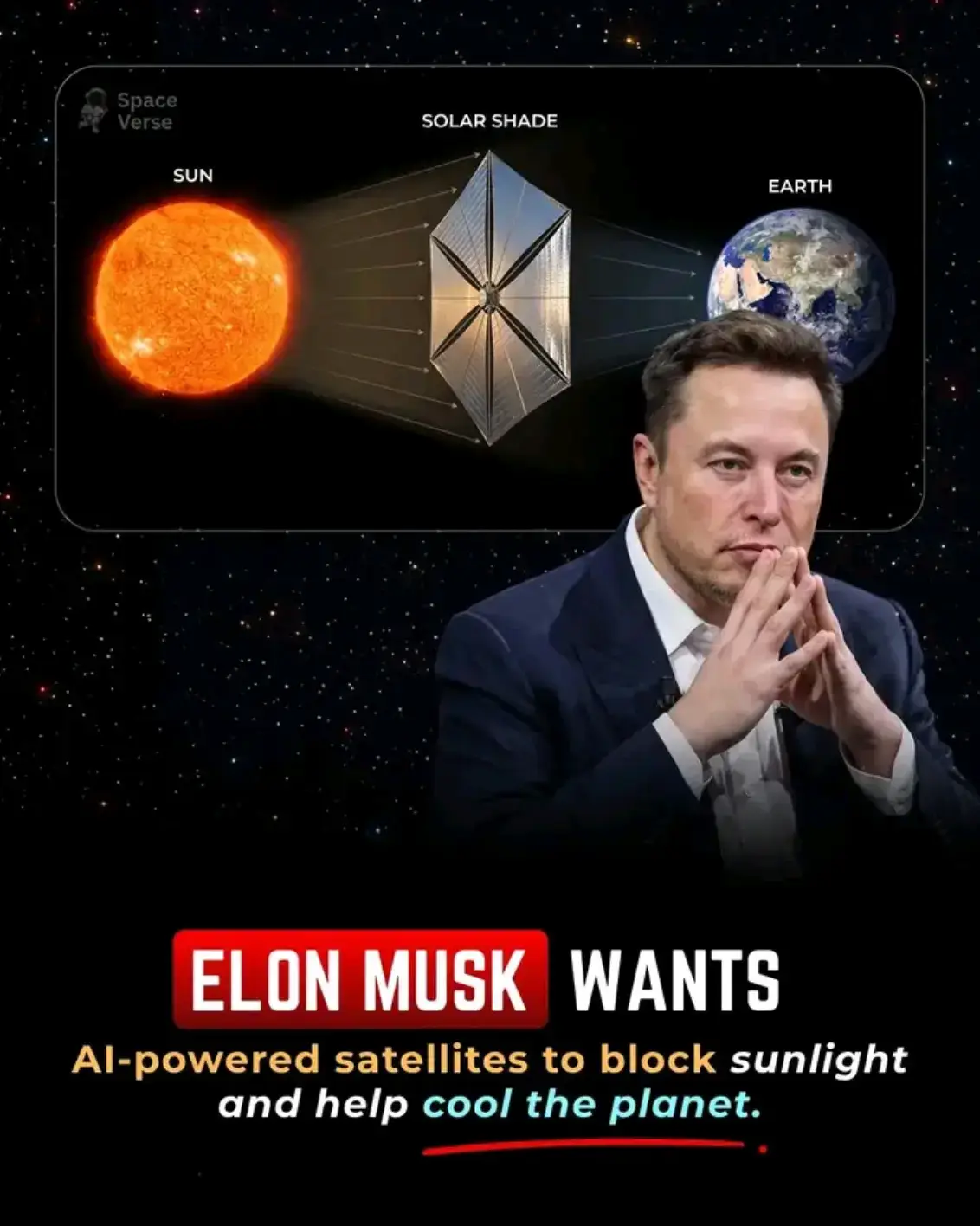
This post presents Elon Musk's idea of using AI-powered satellites to block sunlight and cool the planet. It illustrates the concept with a diagram showing the sun, a solar shade, and Earth, alongside a picture of Elon Musk.
Structure
- 1Introduction of "Space Verse" and the concept of solar shade
- 2Illustration of the sun, solar shade, and Earth
- 3Elon Musk's image
- 4Headline: "Elon Musk Wants"
- 5Explanation: AI-powered satellites to block sunlight and cool the planet
On-screen text
Space
Verse
SUN
SOLAR SHADE
EARTH
ELON MUSK WANTS
AI-powered satellites to block sunlight
and help cool the planet.
Original caption
🚨Elon Musk has suggested that AI-controlled satellites could one day help regulate Earth’s temperature by slightly reducing the amount of sunlight reaching the planet. The concept involves using a large constellation of solar-powered satellites to make tiny, continuous adjustments to incoming sunlight. 🛰️ The idea falls under solar geoengineering, a controversial approach to slowing global warming by reflecting a small fraction of sunlight back into space. In theory, even a very small change in incoming solar energy could influence Earth’s global temperature. 🌍 But controlling sunlight at a planetary scale would come with major uncertainties. Changes in solar radiation could potentially affect rainfall patterns, regional climates, agriculture, and atmospheric chemistry, including the ozone layer. 🔬 Scientists emphasize that these effects are not fully understood and that large-scale solar geoengineering has never been tested at the level required to alter Earth’s climate. That makes governance and international oversight just as important as the technology itself. 🤖 AI could potentially help model and adjust such a system, but it would not eliminate the underlying risks. Any decision to deliberately alter the amount of sunlight reaching Earth would raise a much bigger question: who gets to decide how much is enough?
More from @interstellarspac
More breakout videos from this creator.