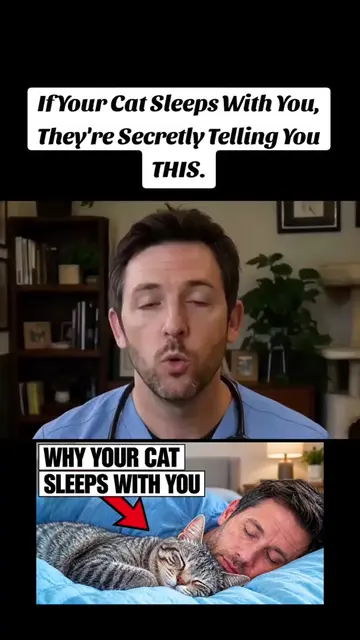
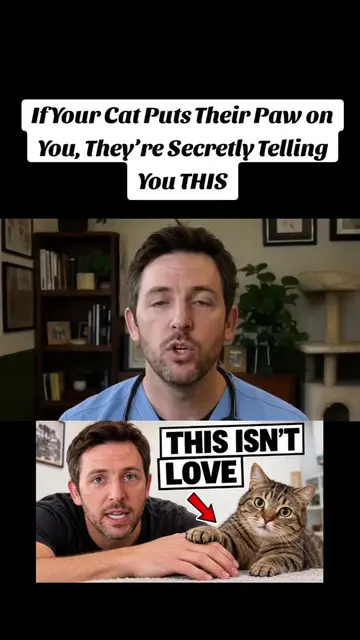
The video uses a strong, counter-intuitive hook that challenges a common belief held by pet owners, immediately establishing authority and curiosity before transitioning into a soft-sell promotion.
Summary
The creator explains that cats view their owners as fellow colony members rather than providers, which can lead to behavioral issues when cats are free-fed. He promotes his book, The Happy Cat Manual, as a guide to understanding feline instincts and improving cat-owner relationships.
Structure
1Identify the misconception about feeding cats
2Explain the evolutionary history of cats and humans
3Contrast cat instincts with dog domestication
4Introduce the concept of the social colony
Original caption
Your Cat Doesn’t Think You’re Feeding Them (They Think THIS Instead) #CatPsychology #CatBehavior #CatLovers #CatFacts #PetPsychology
More from @aliuskjfaz6
More breakout videos from this creator.
5Present the book as the solution to behavioral issues
Product placement
The Happy Cat Manual (a) ACTS — the creator explains he wrote it to help owners understand their cats, shows the book on screen, and directs viewers to a website to purchase it. Removing it would change the video from a promotional pitch to a generic educational video.
Call to action
Go take a look if you want more happy years with your cat.
On-screen text
Your Cat Doesn't Think You're Feeding Them (They Think THIS Instead)
WHAT CATS ACTUALLY THINK
THE HAPPY CAT MANUAL
Everything your cat is trying to tell you.
SEE THE MANUAL
READ THE WAYS
Trending
10,000
7-Day
One manual. Ninety signals. A cat you finally understand.
$29
ADD YEARS TO YOUR CAT'S LIFE
The Happy Cat Manual
Transcript
You put food in the bowl, your cat comes over and eats it. And you assume, reasonably enough, that you both just had the same experience. You fed them, they got fed. Everyone understands what happened here. But your cat processed that moment through a set of instincts so old and so specific that what went on inside their head may be nothing like what you think. Because in their framework, you didn't feed them. Something else happened entirely. And the gap between those two versions is why so many well-loved, well-fed cats end up restless, mouthy, ambushing ankles at 11 at night while looking on the surface completely fine. Hi everyone, I'm Leo Bennett, your neighborhood cat guy. Today we're getting into what your cat actually thinks is happening at mealtime. The ancient deal still running in their head after 10,000 years. Why the always full bowl can quietly work against a cat you're only trying to be generous with, and a five-minute fix that changes the entire thing without costing you a penny. Because here's the truth underneath all of it. Your cat is experiencing your home very differently to how you are, and almost nobody ever hands you the translation. That's exactly why I wrote The Happy Cat Manual. Everything I've learned about reading cats, all in one place, over at leobenettsecrets.com. Go take a look if you want more happy years with your cat. That's all. Now let's start with the deal that's still running your cat's brain. Cats showed up in our world about 10,000 years ago. But here's the part people get wrong. They didn't come because we invited them. When early humans began farming in the Fertile Crescent and storing grain, those stores attracted rodents. And the rodents attracted wild cats. According to research published in PNAS, cats entered what scientists call a commensal relationship with humans, meaning both sides benefited without either one being in charge. Sit with that for a second. Neither side in charge. The cats got easy prey near the grain, we got free pest control. It was, essentially, a business arrangement between equals. Now compare that to dogs. Dogs went through thousands of years of selective breeding, where humans decided which dogs got to reproduce based on traits like obedience, loyalty, and working ability. Cats went through almost none of that. And as a 2017 study by O'Tony and colleagues confirmed, the domestic cat's genome has changed remarkably little since those first wild cats wandered into human settlements. So the brain your cat is using tonight is running on many of the same instincts as those early farm cats, which matters enormously at mealtime. Because in wild and feral cat colonies, cats who share a territory sometimes bring prey back to a common area. So here's what your cat most likely thinks you are. Not a provider, not an owner, a member of their social group, someone who leaves, comes back, and brings food into the shared space. In their framework, that's not I'm being fed. It's the territory is productive, the partnership is working, which is honestly a lovely thing to be. Not staff, but a colony member who's good at bringing things home. But it also explains exactly what goes wrong, because a partnership has two halves, and in most modern homes, your cat has quietly been relieved of theirs. Let me tell you about a cat I'll call Mabel, because this became a case study in the behavior forums a few years back. Mabel was about a year old. Her family free-fed her from day one. Bowl of kibble out around the clock, never empty. She was healthy, she was very much loved. She was also increasingly impossible, knocking things off counters deliberately while making eye contact, ambushing ankles, yowling at odd hours for no reason anyone in that house could identify. When a behaviorist suggested adding play sessions before meals and switching to scheduled feeding, the family was skeptical. Understandably, nothing was actually wrong.
 2 videos