On-screen text
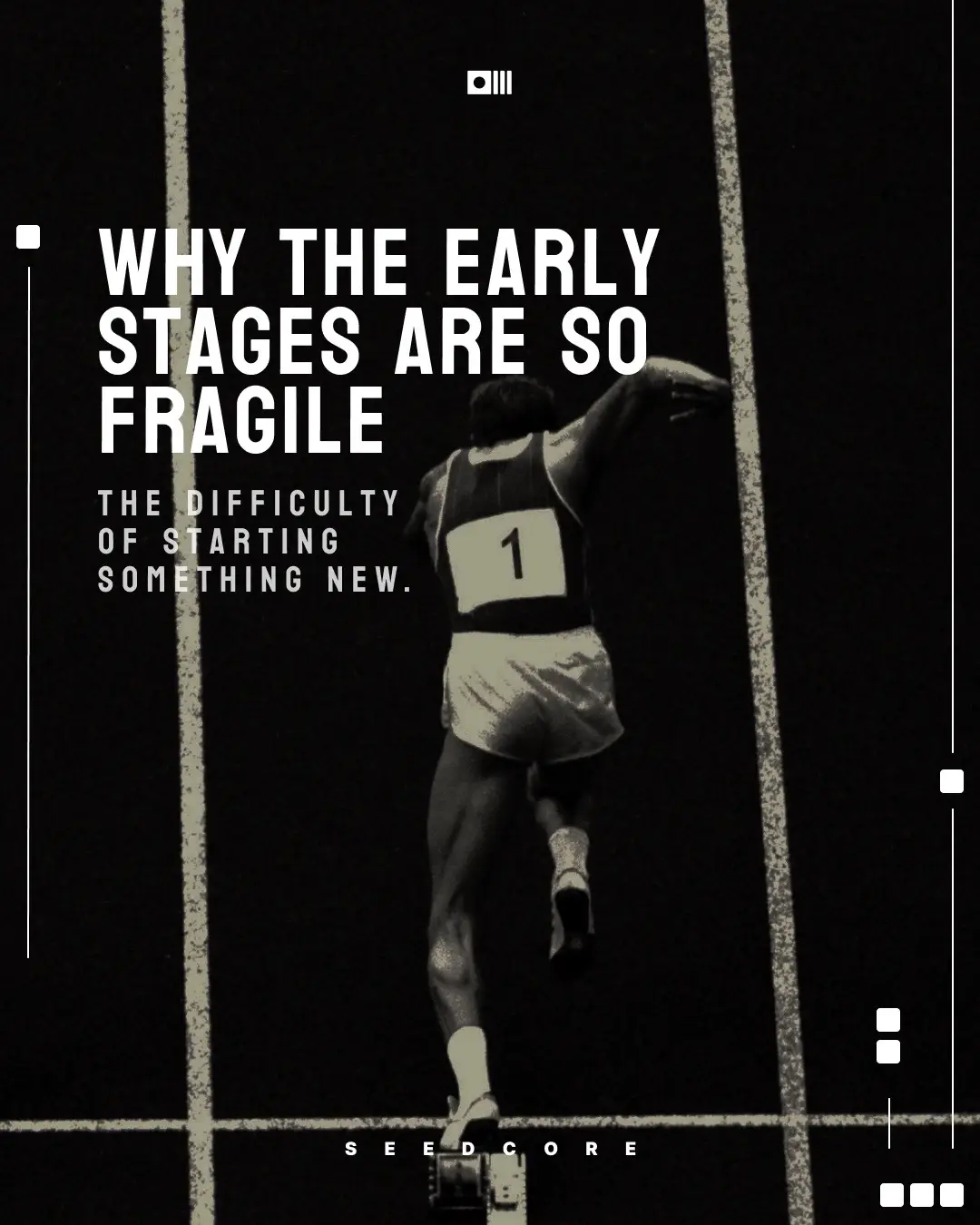
WHY THE EARLY
STAGES ARE SO
FRAGILE
THE DIFFICULTY
OF STARTING
SOMETHING NEW.
SEEDCORE
THE EARLY STAGE IS WHERE
IMAGINATION MEETS RESISTANCE.
Most ideas feel strongest before they touch the world. They are clean in the founder's head because nothing has tested them yet.
Then reality pushes back. The market does not care about the intention, the effort, or the story behind the idea. It only reacts to what is clear, useful, trustworthy, and worth paying for.
• The founder sees potential
• The market sees risk
• The gap is where ideas break
SEEDCORE
STARTING IS NOT A SEQUENCE. IT IS A WEB.
People talk about starting like it is a staircase: idea, product, brand, launch, customers.
In reality, everything affects everything at once. The offer changes the marketing. The pricing changes the customer. The founder's ability changes what can actually be delivered.
• Strong idea, weak positioning: ignored
• Good product, weak trust: risky
• Useful service, unclear value: expensive
• Smart founder, no rhythm: stalled
SEEDCORE
THE FIRST REAL ASK IS BRUTAL.
At some point, the founder has to stop explaining the vision and ask for money. That is when the idea becomes a business problem.
You are asking someone to spend hard-earned money on your version of the world.
That is a harder ask than most founders understand.
SEEDCORE
THE MARKET IS NOT WAITING FOR
ANOTHER THING TO BUY.
Every new business enters a market already full of noise. People are being sold products, services, courses, upgrades, and status all day.
The founder is not only competing against similar businesses. They are competing against distraction, skepticism, inertia, and the customer's instinct to do nothing.
The default outcome is not purchase.
The default outcome is silence.
SEEDCORE
MOST EARLY FAILURE LOOKS LIKE
NOTHING HAPPENING.
Failure usually does not arrive as one obvious event or moment. It arrives as a blank screen.
No replies. No sales. No comments. No useful feedback. No clean reason why people are not buying. The founder is left trying to interpret absence.
• Is the idea bad?
• Is the offer unclear?
• Is the audience wrong?
• Is the price off?
• Is trust missing?
• Is it just too early?
The market often gives the punishment before the explanation.
SEEDCORE
THE FIRST VERSION IS USUALLY
WEAKER THAN THE FOUNDER
THINKS.
The product is underdeveloped. The service is loose. The website is unclear. The marketing is vague. The positioning sounds generic.
The founder thinks the market is seeing the full potential. The market is only seeing the current version.
That does not mean the idea is dead. It means the idea has not earned strength yet.
SEEDCORE
FRAGILITY COMES FROM NEEDING
STRENGTH BEFORE PROOF.
Established companies can survive weakness. They have customers, revenue, reputation, process, trust, and margin.
Early-stage companies do not. They need to look serious before they have a track record. They need to sell before they have demand. They need to earn trust before anyone has a reason to trust them.
That is the fragility: the company needs mature behavior while it is still immature.
SEEDCORE
THE FOUNDER HAS TO IMPROVE
WHILE EXPOSED.
Building early is not private practice. You are learning in public, selling while imperfect, adjusting while being judged, and making decisions with incomplete information.
The founder has to admit the current version is weak without abandoning the larger direction. Keep moving, but not blindly. Stay committed, but not attached.
Protect the core belief.
Destroy the weak execution around it.
SEEDCORE
THE EARLY STAGE IS AN
ENDURANCE TEST OF JUDGMENT.
Grit alone is not enough. A founder can work hard in the wrong direction for years.
The real test is whether the founder can keep improving without losing the thread. Separate bad feedback from useful feedback. Tell the difference between temporary rejection and structural weakness.
• Conviction to keep moving
• Humility to keep changing
• Taste to see what is weak
• Discipline to make it sharper
SEEDCORE
EVENTUALLY, THE SCALES CAN
TIP.
For a long time, the work feels heavier than the results. The founder is pushing, revising, explaining, rebuilding, and trying again while the market barely reacts.
Then the pieces start connecting. The offer gets clearer. The product gets stronger. The message gets sharper. The customer becomes more obvious. Trust starts to build.
What looked like nothing was not always nothing. This is a non-linear path. Do not expect linear returns or progress that follows a straight line.
SEEDCORE
SEEDCORE.CO
Helping solo founders at
the earliest stages.
SEEDCORE