Loading video…
All breakouts
11.1Text-HeavyEntertainment
Post
Post by @blake.wedding3
@blake.wedding3
1.9K followers · usually 2.7K views a post
Views
28.9K
Likes
1.2K
Comments
156
Shares
174
On-screen text
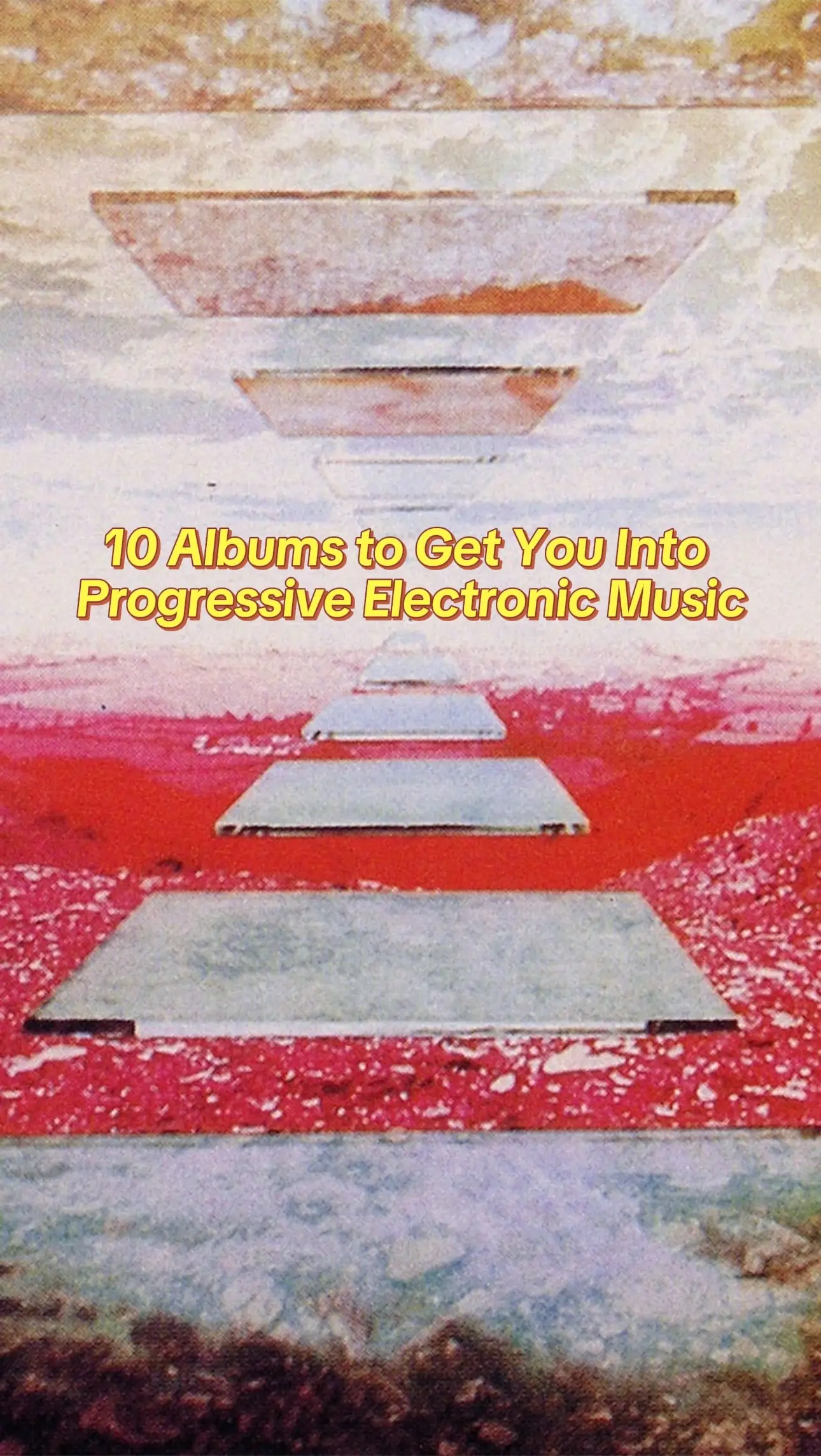
10 Albums to Get You Into Progressive Electronic Musicnnphaeorann1. Tangerine Dream nPhædra (1974)nnThe Moog sequencer was barely tameable in 1974, drifting out of tune as the studio warmed, and Tangerine Dream folded that instability into the work music itself. The title track unfurls over seventeen minutes, bass pulses surfacing and dissolving beneath slow tides of Mellotron. Nothing resolves the way a song would; the piece simply travels, drifting soundscapes that reflect the tides of consciousness. This is the Berlin School's founding document, the moment electronic music learned to think in vivid landscapes instead of mere verses.nnMICHEL JARREnn2. Jean-Michel Jarre nOxygène (1976)nnRecorded in a makeshift home studio on a modest collection of machines, Oxygène made cosmic electronics friendly without making them shallow. Its six parts breathe in and out on warm analog pads, and "Oxygène IV" carries one of the most recognizable melodies the genre ever produced. Before the days of DAWs and MIDI controllers, Jarre proved this music could reach millions of living rooms, not just heads in headphones. It's the genre's great popularizer, and it still sounds like drifting high above the earth, orbiting something greater.nnKRAFTWERKnn3. Kraftwerk nTrans Europa Express (1977)nnA train ride rendered in circuitry: the title suite locks into a steel-on-steel rhythm and rides it across the continent, elegant and unhurried. "Europe Endless" glides on arpeggios that seem to stretch to the horizon, romance and machinery in perfect agreement. Where their later work compressed into pop and helped define the incoming omnibus of synth pop, here instead Kraftwerk still thought in long forms and slow scenery. Its rhythmic chassis would be sampled into hip-hop history, but on its own terms this is progressive electronics at its most poised.nn4. Ryuichi Sakamoto nThousand Knives of Ryuichi Sakamoto (1978)nnA bonafide musical genius and artistic polymath, Ryuichi Sakamoto's long and influential career began in the evocative sonic halls of progressive electronic music. His debut opens with a vocodered recitation of a Mao poem and then spends the record refusing to ask the listener to pay. Classical training, fusion chops, and brand-new microprocessors tangle together; "The End of Asia" turns a folk-like melody into gleaming technopop before the term existed. Where his YMO bandmates aimed for the charts, this is more searching, psychedelic, and strange. It showed the synthesizer could hold a composer's full intelligence, East and West at once.nnKlaus Schulzenn5. Klaus Schulze n"X" (1978)nnOne of my all-time favorite albums, and perhaps the Crown Jewel of the Berlin School, "X" is a complex, epic, and monumental concept album. Six "musical biographies" spread across two LPs, each portrait built from sequencers, strings, and enormous patience. "Ludwig II. von Bayern" runs nearly half an hour, a real string section sawing darkly over motorik pulse, madness and majesty in slow orbit. Schulze composed like the machines had given him geological time to work with. This is the Berlin School at its most symphonic, the moment where progressive electronic began to resemble the massiveness of classical music past.nnSUZANNE CIANInn6. Suzanne Ciani nSeven Waves (1982)nnCiani was the great virtuoso of the Buchla synthesizer, and Seven Waves is her instrument singing at its most graceful. Seven pieces rise and recede like the tide; they're named for, genius melodies gliding on quadraphonic washes she designed with an engineer's precision and a composer's touch. Dismissed by some at the time as mere prettiness, "Seven Waves" has aged into a landmark moment for electronic music. It widened the genre's emotional range toward tenderness, and stands as a founding text for ambient's gentler lineage. A meditative, tranquil, aquatic, atmospheric masterpiece.nnMANUEL GÖTTSCHINGnnE2-E4nn7. Manuel Göttsching nE2-E4 (1984)nnOne take, one hour, one December evening in 1981: Göttsching set a two-chord sequencer pattern running and played weightless guitar over it, naming the result after a chess opening. "E2-E4" is hypnosis achieved through daring, complex minimalism. The groove never breaks, it only shifts its light. Balearic DJs and Detroit producers found it years later and heard the future of dance music inside it. It's the bridge between kosmische patience and techno's pulse, and one of the most quietly influential hours of music ever recorded.nn8. Vangelis nBlade Runner (1994 - Official Album Release)nnOne of my all-time favorite electronic works; a daring, oneiric, atmospheric sonic odyssey that works just as well on its own as it does with its accompanying film. Composed for Ridley Scott's 1982 film but unreleased in full for twelve years, it is the sound of neon rain laid to tape. The CS-80 synthesizer breathes and swells under Vangelis's hands like something alive, mourning and luminous at once; "Blade Runner Blues" is pure grief in electric blue. Few records have so completely defined how the future sounds. It carried progressive electronics into cinema and gave the genre its most enduring atmosphere. A truly groundbreaking, revolutionary approach to composition for film soundtracks, one whose influence is still felt today.nn9. Oneohtrix Point Never nRifts (2009)nnOneohtrix Point Never, aka Daniel Lopatin, is one of my all-time favorite artists: a true genius of the synthesizer and beyond, perhaps the greatest progressive electronic artist of the current era. He is the only current artist who so eloquently blends the past with the future, marrying the influences of progressive electronic past with the IDM and vapor-adjacent future. He has so many records that could fit this list, but to me, his 2009 compilation of his early albums is the best introduction to his uncompromised genius. Here, Lopatin resurrected the June arpeggio in a Brooklyn apartment and aimed it inward, toward memory instead of the cosmos. "Rifts" compiles his early albums into a sprawling mix of drones and dissolving loops, nostalgia treated as raw material rather than comfort. It rewird a new generation's ear toward the old synths overnight. This is the genre's hauntological turn, kosmische music about the futures we were promised and never got.nn10. Patrick Cowley nSchool Daze (2013)nnRecorded between 1973 and 1981 as scores for adult films, unearthed three decades after Cowley's death, these tracks reveal a hidden master of slow-motion synthesis. The man who built hi-NRG disco worked here at half speed, all humid pads and patient, murky grooves saturated in reverb and drenched in evocative and surreal space synth sounds that never get hold. That the genre's history could still surrender secrets this rich was a revelation in itself. It stands as a testament that progressive electronic's greatness lived in the margins too, waiting to be found.nnSome Other Picks:nnTim Follin & Geoff Follin nSilver SurfernTangerine Dream nZeitnMichael Stearns nPlanetary UnfoldingnOneohtrix Point Never nTranquilizernKlaus Schulze nMiragenSensations' Fix nFragments of LightnNala Sinephro nEndlessnessnHeldon nStand BynVangelis nBlade Runner: Esper EditionnTristan Perich n1-Bit SymphonynSusumu Hirasawa nICE-9nTangerine Dream nThiefnOneohtrix Point Never nGarden of DeletenTerry Riley nA Rainbow in Curved AirnLCD Soundsystem n45:33nMort Garson nMother Earth's PlantasianTangerine Dream nRubyconnMark Isham nVapor DrawingsnHarmonia nDeluxenOneohtrix Point Never nR Plus SevennKlaus Schulze nTimewindnnSome Other Picks Pt. 2:nnCluster nSowiesosonVangelis nDirectnAshra nNew Age of EarthnHarald Grosskopf nSynthesistnTangerine Dream nForce MajeurenJean Michel Jarre nEquinoxenKlaus Schulze nMoondawnnSaori Kobayashi nPanzer Dragoon OrtanBattiato nSulle corde di AriesnKraftwerk nAutobahnnDaniel Pemberton nSpider-Man: Across the Spider-VersenTangerine Dream nPoland: The Warsaw ConcertnKlaus Schulze nBody LovenLa Dusseldorf nVivanHeldon nInterfacenCacolla nThe Angel, The DemonnnSome Other Picks Pt. 3:nn1000 Eyes nSignalis: Memories (Side A)nCluster nCluster IInDaniel Lopatin nMarty SupremenJames Ferraro nTroll (EP)nMother Mallard's Portable Masterpiece Co. nLike a Duck to WaternFloating Points nElaenianOskar Sala nElectronic Virtuosity by Oskar SalanKlaus Schulze nIrrllichtnHans Zimmer nThe Dune SketchbooknTangerine Dream nStratosfearnDisasterpiece nRise of the Obsidian InterstellarnNew Order nElegia / 5-8-6 / The Him (EP)nSteve Roach nEmpetusnConrad Schnitzler nBlaunSid Studio nNorthern JourneynKaitlyn Aurelia Smith nEARSnNekropolis nThrough Time and Mystery nEndingnLaurie Spiegel nThe Expanding Universenndeath's dynamic shroud.wmv n4k God Projected on the Smoldering Ashes
Original caption
Progressive electronic emerged in the late 1960s and early 1970s with the advent of synthesizers and other technological advancements in music production. It is defined by extensive compositional use of electronic instruments like synthesizers, experimentation with diverse sounds and influences, and an emphasis on progression within a piece. It commonly features layered soundscapes, intricate rhythms, varied effects and textures, and improvisation, with musicians creating new sounds rather than relying on presets. Compositions are often lengthy, with multiple sections and mood changes, frequently exceeding 10 minutes. The genre's roots trace to late 1960s progressive rock experimentation, with bands like Pink Floyd and King Crimson among the first to incorporate electronic elements into their music. Germany's krautrock movement, influenced by earlier avant-garde electronic styles like electroacoustic, was another major precursor, particularly to the Berlin School. In the early 1970s, acts like Tangerine Dream, Klaus Schulze and Kraftwerk experimented exclusively with electronic instruments, expanding on developments made in the progressive rock and krautrock genres. These acts pushed the limits of what was technologically feasible at the time, like recontextualizing the use of the moog synth in moogsploitation. /// These are the albums whose influence is still felt today. The albums whose importance cannot be overstated in the genre. The albums whose sonic worlds crafted yielded results unheard before. They are all excellent starting points for newcomers to the genre. #musictok #electronicmusic #progressiveelectronic #albumreccomendations #synthesizer
More from @blake.wedding3
More breakout videos from this creator.