Last March, while I was walking down the street,
right by a drainage pipe next to a wall,
I stumbled upon this plant struggling to grow in a crack.
I couldn't tell for sure at first,
but it looked a lot like a young papaya tree.
So, I pulled it right out of the crack and took it home.
I wanted to try growing it, so I grabbed a small black seedling pot.
Even though I wasn't sure if it was actually a papaya tree,
I figured I'd know for sure once it grew a bit.
I filled the pot with a mix of garden soil, rice hulls, and compost.
Then, I planted the little guy in the cup.
Since the plant was still so young,
it was bound to grow pretty fast.
That meant we'd find out what it was pretty quickly.
Most importantly, I gave it a thorough watering to settle the roots.
17 days later, it looked completely different.
Now I could tell for sure: it was definitely a papaya tree.
Since I decided to keep it, I had to take good care of it.
First, a scoop of pure organic fertilizer.
Just one scoop was enough to give it the nutrients it needed.
A month later, the tree was doing great.
The stem was already thicker than a chopstick.
And the whole thing was over 30 centimeters tall.
But if you looked closely,
you'd see tiny yellow spots on the leaves.
That meant the soil in the pot was running out of nutrients.
So, it was time to move it to a bigger pot.
I found a plastic pot at home that was four or five times bigger.
I filled it with the same nutrient-rich soil mix as before.
Then, I pulled the sapling out of the small pot.
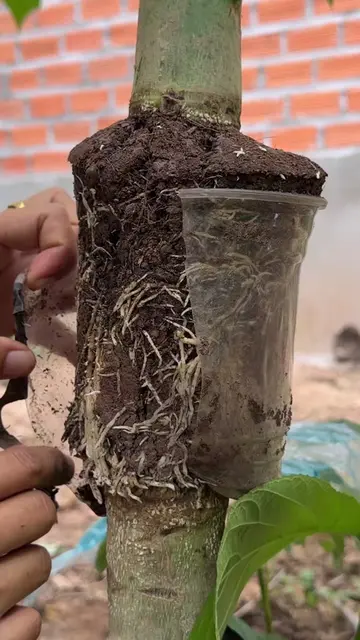
Check this out: the roots weren't just holding soil anymore,
the roots were wrapping around the soil.
Now we could plant it in the new, larger pot.
With enough space,
the papaya seedling could get back to growing fast.
Again, watering it thoroughly after transplanting is key.
I saw it again half a month later.
By now, the stem was thicker than my thumb.
It was growing insanely fast.
Lifting the pot, look,
the roots had already crawled out of the drainage holes.
To keep it healthy and growing fast,
I had to move it to an even bigger container.
This time, I found a large foam box.
Perfect for planting the papaya tree.
I punched a few holes in the bottom for drainage.
It looked pretty big, but honestly, it was just barely big enough.
I filled the box with garden soil.
Once it was half full, I sprinkled in a handful of chicken manure pellets.
That would be the tree's nutrient supply.
I placed the pot right into the foam box.
Then, I used scissors to cut off the bottom of the pot.
Once the bottom half was gone,
the roots below could fully spread out.
Now they can stretch out.
We can keep the top half of the pot for now.
It keeps the upper roots contained for a bit.
I'll remove it when I add more soil later.
I kept filling the foam box with garden soil,
making sure to bury the roots at the bottom completely.
Finally, just give it a good soak.
I really hope this is a female papaya tree
so I can actually taste the papayas I'm growing.
90 days later, the seedling I pulled from that wall crack
was already over two meters tall.
And the leaves were growing really dense.
Luckily, it had already started flowering.
I could see some young fruit too, which meant
I'd get to eat homegrown papayas this year.
By now, the roots at the bottom had fully grown.
So,
it was time to take off that top half of the pot.
Next, I needed to add more soil to the foam box.
But first, I threw in some fruit peels I'd been saving,
to compost right there in the box.
Then, I covered them with a layer of soil.
Thanks to microbes in the soil,
the peels will break down into organic matter.
This improves the soil structure,
and releases nutrients like carbon, nitrogen, and potassium,
boosting the soil's fertility
and helping the roots grow.
105 days in, the papaya tree
already had four ping-pong-ball-sized papayas on it.
Plus, more flowers were blooming at the top.
Here they are at day 135.
The tiny papayas were now about the size of a fist.
The color was turning a deeper, vibrant green.
New little papayas kept popping up at the top.
I was getting close to eating my own homegrown papayas.
The countdown was on.
The foam box at the bottom was getting too small,
so I used some bucket lids to raise the height of the box.
I added more chicken manure pellets to feed the plant.
Then, I added the final layer of soil.
After all, the next time you see it, I'll be picking the fruit.
Day 180. The papayas on the tree were starting to turn yellow.
It took six whole months. The tiny seedling I dug out of a wall crack
had turned into a fruit-bearing tree.
That sense of achievement was even better than the fruit itself.