Loading video…
All breakouts
3.4Text-HeavyDirect Question hookAI Tools
Hook
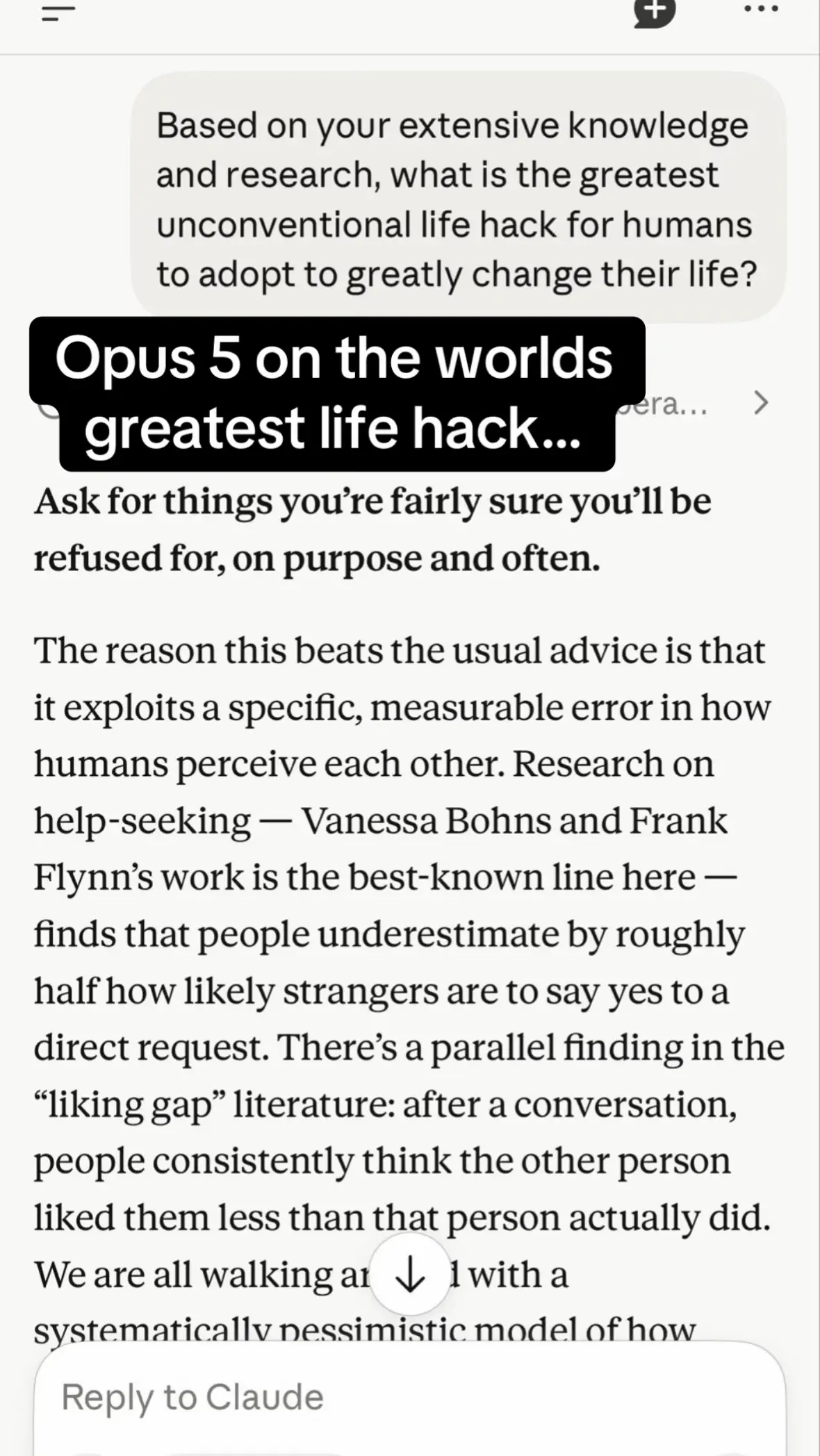
Based on your extensive knowledge and research, what is the greatest unconventional life hack for humans to adopt to greatly change their life?
@jamieshuell.ai
4.1K followers · usually 813 views a post
Views
2.6K
Likes
26
Comments
2
Shares
1
Why it worked
The post offers a counter-intuitive and actionable life hack backed by psychological research, making it relatable and shareable.
Summary
The post presents an unconventional life hack: asking for things you're likely to be refused for. It explains that this strategy exploits a human tendency to underestimate how likely strangers are to agree to requests and to overestimate negative social perceptions after interactions.
Structure
- 1Introduction of the question about the greatest life hack.
- 2Presentation of the life hack: asking for things you'll likely be refused for.
- 3Explanation of why this hack works, citing research on help-seeking and the 'liking gap'.
- 4Description of the underlying psychological error: a systematically pessimistic model of social perception.
On-screen text
Based on your extensive knowledge and research, what is the greatest unconventional life hack for humans to adopt to greatly change their life?
Opus 5 on the worlds greatest life hack...
Ask for things you're fairly sure you'll be refused for, on purpose and often.
The reason this beats the usual advice is that it exploits a specific, measurable error in how humans perceive each other. Research on help-seeking — Vanessa Bohns and Frank Flynn's work is the best-known line here — finds that people underestimate by roughly half how likely strangers are to say yes to a direct request. There's a parallel finding in the "liking gap" literature: after a conversation, people consistently think the other person liked them less than that person actually did.
We are all walking ar 1 with a systematically pessimistic model of how
Reply to Claude
Original caption
#claude #opus5 #claudecode
More from @jamieshuell.ai
More breakout videos from this creator.