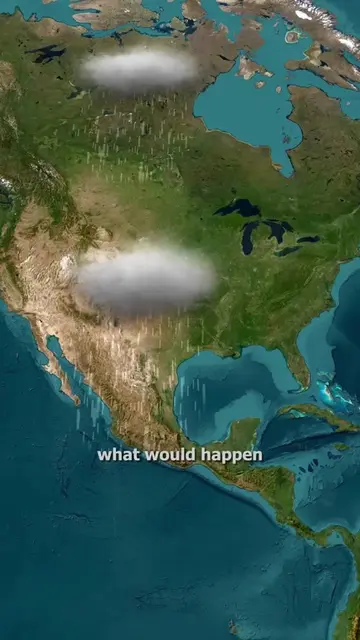
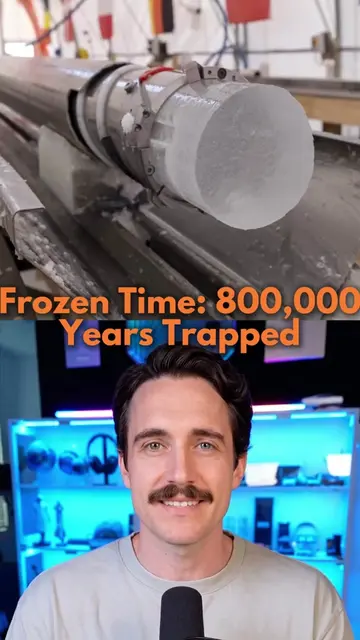
Number 5, the flash freeze. Imagine you're living 12,000 years ago. The Ice Age is finally ending. Things are warming up. And then, in the blink of an eye, everything freezes again. Not slowly, fast. Temperatures plummeted by 10 to 15 degrees Fahrenheit in just a single decade. As the Ice Age ended, melting ice collected into a massive North American lake called Lake Agassiz, bigger than all the modern Great Lakes combined. Suddenly, that lake burst open, dumping trillions of gallons of ice-cold freshwater straight into the North Atlantic Ocean all at once. The ocean has a current system that works like a giant conveyor belt, moving warm water north and keeping large parts of the planet livable. But that current runs on salt. Saltwater sinks, driving the system. When Lake Agassiz dumped all that freshwater in, it diluted the salt. The water stopped sinking. The conveyor belt shut down, and the warmth stopped arriving. Within years, the planet froze over again. Ice cores in Greenland show temperatures dropped by 27 degrees Fahrenheit in less than a decade. Imagine growing up in warmth, hearing stories of the Ice Age ending, only for the world to freeze again in your lifetime. No explanation, no warning, just cold. This new Ice Age lasted 1,200 years. The ocean conveyor belt that shut down? Scientists have been tracking it for years. It's slowing down again right now. Number 4, the Earth that ate planets. The Earth you're standing on right now is a murderer. About 4.5 billion years ago, our planet was on a rampage, smashing into other worlds and absorbing them. One victim was a Mars-sized planet called Theia, which had the misfortune of sharing Earth's neighborhood. When these two planets collided, it wasn't a gentle bump. It was a full-on apocalypse. The impact was so violent that both planets partially vaporized, turning into superheated gas and molten rock flying in every direction at tens of thousands of degrees. But all that blast debris didn't just float away. Gravity pulled it together, piece by piece, until it clumped into a glowing ball in orbit. That ball is what we now call the Moon. When you look up at the night sky, you're literally looking at the graveyard of a planet Earth destroyed. And scientists think Theia wasn't the only victim. Earth likely absorbed several smaller planets during its chaotic early years. A recent study found strange, continent-sized blobs deep inside Earth's mantle. Scientists believe these massive structures might be the remains of Theia, still sitting inside Earth after all this time. Number 3, the two-year rain. About 232 million years ago, it started raining. And it didn't stop for two million years. That single storm lasted longer than humans have existed on Earth. The Carnian Pluvial episode was triggered by a massive chain of volcanic eruptions. They pumped so much carbon and water vapor into the sky that the global climate flipped. The planet went from dry and hot to wet and miserable. Rivers flooded, deserts turned to deep mud, and forests rotted away. Anything that relied on dry land to survive was out of luck. Most things died. It was one of the biggest mass extinctions you've never heard of, wiping out the huge reptiles that previously dominated the land. Dinosaurs were not the apex predators. They were just small, insignificant underdogs. But they figured out how to adapt. When the rain finally stopped, two million years later, they realized there was nobody left to compete with. Dinosaurs didn't conquer the Earth. They just showed up after the flood and found the keys on the doorstep. Number 2, the oxygen apocalypse. The air you're breathing right now is slowly killing you. But about 2.4 billion years ago, Earth was run by tiny bacteria, living in a world with zero oxygen. To them, oxygen was like bleach, pure poison. Then, one type of bacteria, cyanobacteria, made a mistake that changed everything. They figured out how to eat sunlight through photosynthesis. The problem: photosynthesis has a highly toxic waste product: oxygen. So these little guys just sat there, eating sunlight and quietly pumping poison into the atmosphere. The bacteria that didn't know what they were doing, the ones that were killed by oxygen, they died off. There was no villain, no asteroid, no volcano, just a tiny organism doing its tiny thing and accidentally ending all life on Earth. The few survivors of this catastrophe adapted to use oxygen. They figured out how to breathe the poison. Those survivors eventually evolved into us. You are alive right now because your ancient ancestors survived a planet-wide poisoning event. Number 1, the school bus snake. About 60 million years ago, after the dinosaurs were wiped out, something else took over: Titanoboa. This monster stretched over 40 feet long, longer than a T-Rex, and weighed over 2,500 pounds. The reason it got so massive? The Paleocene epoch was incredibly hot. Because snakes are cold-blooded, the hotter the world gets, the bigger they grow. The planet basically cranked up the thermostat. The swamps of ancient Colombia were like a giant greenhouse, thick jungle, steaming water, and massive trees blocking the sky. Somewhere in that water, a 2,000-pound snake was waiting. Titanoboa didn't bother with small prey. It ate full-grown crocodiles. It would wrap around them, crush every bone in their body, and swallow them whole like a light snack. Scientists found so many fossils in a single Colombian coal mine that they realized these snakes weren't even rare. If you time-traveled back to this jungle, you wouldn't last a day. One second you're walking, the next, something heavier than a car has you in its grip. Titanoboa is gone now, but only because the planet cooled down. If Earth heats up enough again, the math starts working. The giant snakes could come back.