Product placement
Node.js: a JavaScript runtime environment that allows developers to build server-side applications. It acts by providing a runtime environment. It appears. Removing it would not change what happens in the video.
Python: a high-level programming language. It acts by being listed as a language option. It appears. Removing it would not change what happens in the video.
Java: a high-level programming language. It acts by being listed as a language option. It appears. Removing it would not change what happens in the video.
Go: a programming language. It acts by being listed as a language option. It appears. Removing it would not change what happens in the video.
Express.js: a web application framework for Node.js. It acts by being listed as a framework option. It appears. Removing it would not change what happens in the video.
NestJS: a progressive Node.js framework for building efficient and scalable server-side applications. It acts by being listed as a framework option. It appears. Removing it would not change what happens in the video.
FastAPI: a modern, fast (high-performance) web framework for building APIs with Python. It acts by being listed as a framework option. It appears. Removing it would not change what happens in the video.
Django: a high-level Python web framework that encourages rapid development and clean, pragmatic design. It acts by being listed as a framework option. It appears. Removing it would not change what happens in the video.
Spring Boot: an open-source Java-based framework. It acts by being listed as a framework option. It appears. Removing it would not change what happens in the video.
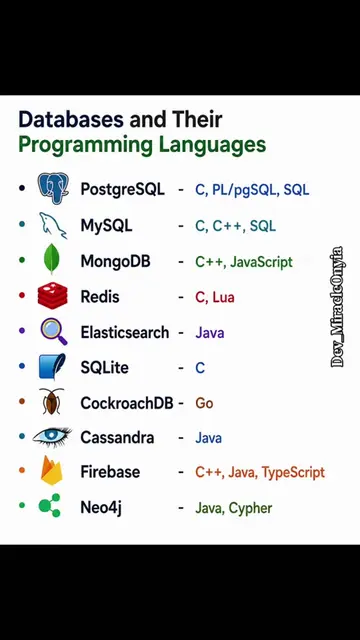
PostgreSQL: an open-source relational database management system. It acts by being listed as a database option. It appears. Removing it would not change what happens in the video.
MySQL: an open-source relational database management system. It acts by being listed as a database option. It appears. Removing it would not change what happens in the video.
MongoDB: a NoSQL document database. It acts by being listed as a database option. It appears. Removing it would not change what happens in the video.
SQLite: a C-language library that implements a small, fast, self-contained, high-reliability, full-featured, SQL database engine. It acts by being listed as a database option. It appears. Removing it would not change what happens in the video.
Docker: a platform for developing, shipping, and running applications in containers. It acts by being listed as a DevOps tool. It appears. Removing it would not change what happens in the video.
Kubernetes: an open-source system for automating deployment, scaling, and management of containerized applications. It acts by being listed as a DevOps tool. It appears. Removing it would not change what happens in the video.
AWS: Amazon Web Services, a cloud computing platform. It acts by being listed as a DevOps tool. It appears. Removing it would not change what happens in the video.
Azure: Microsoft's cloud computing service. It acts by being listed as a DevOps tool. It appears. Removing it would not change what happens in the video.
Google Cloud: Google's cloud computing service. It acts by being listed as a DevOps tool. It appears. Removing it would not change what happens in the video.
GitHub: a web-based platform for version control using Git. It acts by being listed as an 'other tool'. It appears. Removing it would not change what happens in the video.
Git: a distributed version control system. It acts by being listed as an 'other tool'. It appears. Removing it would not change what happens in the video.
Postman: an API platform for building and using APIs. It acts by being listed as an 'other tool'. It appears. Removing it would not change what happens in the video.
Kafka: a distributed event streaming platform. It acts by being listed as an 'other tool'. It appears. Removing it would not change what happens in the video.
Telegram: a cloud-based instant messaging service. It acts by providing a channel for users to join for learning programming. It appears. Removing it would not change what happens in the video.
@devboost1: a Telegram channel handle. It acts by being the identifier for the Telegram channel. It appears. Removing it would not change what happens in the video.