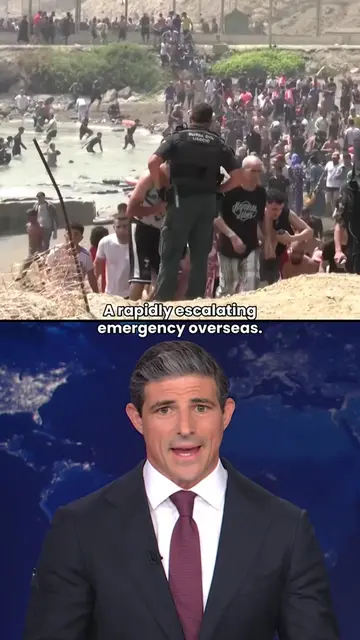
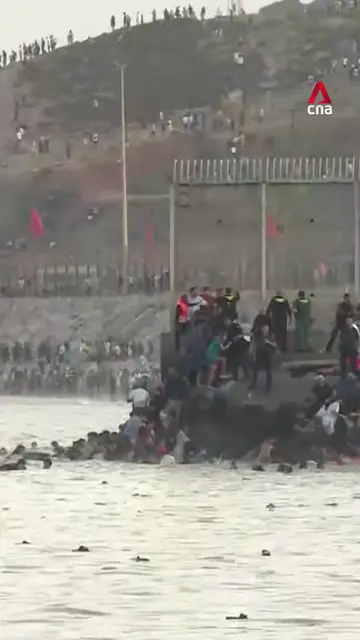
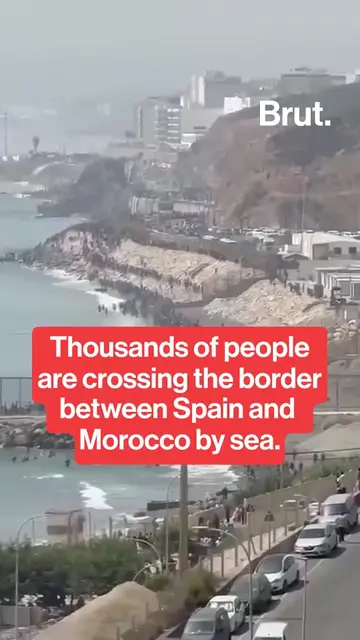
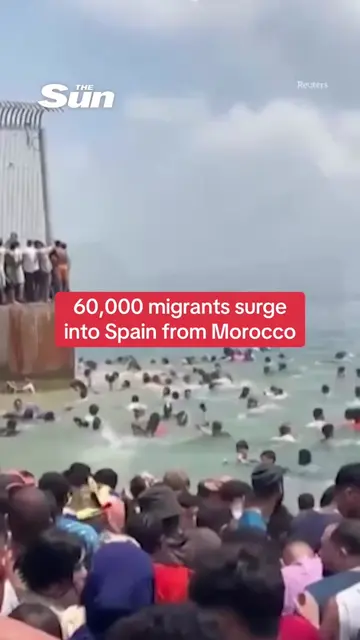
On the shores of Ceuta, Spain's enclave in North Africa, wave after wave of migrants swam ashore Thursday, overwhelming the city, filling the streets, charging the fences — some dropping to their knees in the sand, grateful to reach dry land. In roughly 48 hours, more than 60,000 migrants have entered Ceuta, equal to roughly 70 percent of its entire population. Ceuta sits on the northern tip of Africa, bordered by Morocco and separated from mainland Spain by about 11 miles of sea. Many say they made the journey in search of a better life. "I came here to seek a better future. I work as a waitress, but the salary I get is not enough. As I take care of my parents and I have a daughter, I have to find better opportunities. May God help us." "I came from Casablanca this morning. Today, like all young people, find an opportunity, find a good future for myself." One possible factor for the wave of migrants, according to a top Spanish official, a Spanish court ruling this month that migrants stopped at sea can't be immediately turned away, though they can still be deported. Meanwhile, the city is at a breaking point. Spain has deployed its military, and with food and water running short, the Spanish government says three-quarters of the migrants have already turned back towards Morocco. Among them, this man, with a warning for anyone thinking of following. "What we were doing, it's not good at all. And it's not funny either. What's more, people are dying here. I beg you, please, if you haven't come yet, don't come." At least 57 people have died attempting the crossing. Spain's Prime Minister Pedro Sanchez rushed to the enclave today, calling the surge an attack on Spain's territorial integrity. Ceuta is a Spanish city, and what happened yesterday deserves all of our review, all of our condemnation, in the strongest possible way. The fallout is spreading across Europe. Italy's Prime Minister Giorgia Meloni said the country would temporarily suspend a border-sharing agreement with Spain. In France, Emmanuel Macron said it would reinforce its Spanish border. The crisis is echoing here at home. At Camp David today, President Trump seized on the images, casting them as a warning ahead of the midterm elections. "It looks like an invasion of a country by hundreds of thousands of people. And that same thing's going to happen to us if the Republicans don't get elected. It's going to be worse." Back in Ceuta, soldiers patrolled the beaches, and thousands wait on both sides of the fence. Some for a way into Europe, others for a way home.