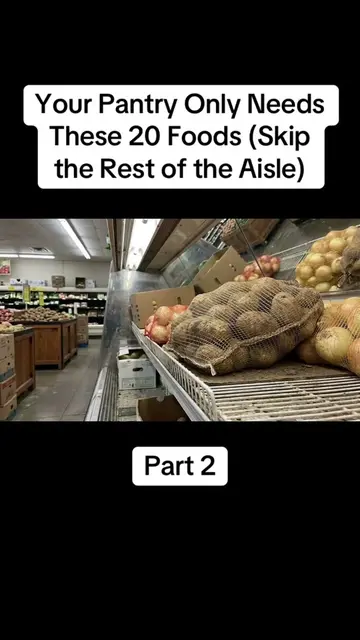
You know that feeling at the checkout when the total comes up and you do a little flinch. $180 and you're standing there thinking, what did I even buy? You get home, you unload it all, and three days later you're staring into a full pantry saying, there's nothing to eat. I'm going to tell you something that took me years of feeding seven people on one income to figure out. The grocery store carries about 40,000 different items. A house runs on about 20. Everything past that is mostly the same food taken apart and sold back to you at three times the price. So today I'm going to give you my list. 20 things. This is what actually comes into my house every week or two. It's what I've raised five kids on, on one income. And I'll tell you as we go which expensive thing each one replaces. Number one on this list is the single best deal in the entire store and almost nobody buys it anymore. Let's go. Number one, dried beans. Not canned, dried, in the bag. A pound of dried beans costs about $0.80. It turns into $1.50 and then turns into 6-7 cups cooked. That's the cheapest protein in the building and it's not close. Canned beans are fine in a pinch, but you're paying triple for somebody to add water and put it in a can. You soak them overnight, you simmer them while you're doing something else. It is not hard. People act like cooking a bean is an lost art. It's a pot and some water. Number two, rice. A big bag, not the little pouches you microwave. Those pouches run about 10 times the price per serving of the bag. What's in them? Rice, your own brown sugar and cinnamon. Same breakfast, you keep the difference. Number four, flour. Plain flour, all-purpose flour. One item replaces more products than anything else on the list. Pancake mix is flour with baking powder in it. Biscuit mix is flour plus fat. Gravy packets, bread, pizza dough, thickener for soup, it's all just flour. A 5-pound bag costs $3. And quietly replaces a whole shelf of boxes with cartoon characters on them. Number five, eggs. Even when the price jumps and everybody panics about it, eggs are still about 25 cents an egg. Complete protein. You can buy. Breakfast, lunch, dinner, baking. Egg on top of leftover rice and vegetables is a real supper. When people tell me they can't afford protein, I ask them if they've been buying protein bars. Those are $4 each. An egg does the same job for a quarter. Number six, a whole chicken. Not the boneless, skinless breasts. I know, I know. The whole bird makes people nervous. But here's the arithmetic. Boneless, skinless breast is $4.50 a pound. Whole chicken is often under $2 a pound. You roast it once, you eat dinner off it, you pull the rest of the meat for two more meals. Then you throw the bones in a pot with an onion and simmer it. That's broth. Store-bought broth is $3 to $4 a carton. It's water with a chicken memory. You were about to throw the real thing in the trash. Number seven, potatoes. The 10-pound bag, not the 5-pound. Cheapest filling food in the store. Keeps for weeks in a cool dark spot. And it becomes a hundred different suppers. Frozen fries, instant mashed, hash browns, those little hash browns that are all just potatoes with a markup for cutting them up for you. Your hands work. Cut your own. You roast it once, you eat dinner off it, you pull the rest of the meat for two more meals. Then you throw the bones in a pot with an onion and simmer it. That's broth. Store-bought broth is $3 to $4 a carton. It's water with a chicken memory. You were about to throw the real thing in the trash. Number seven, potatoes. The 10-pound bag, not the 5-pound. Cheapest filling food in the store. Keeps for weeks in a cool dark spot. And it becomes a hundred different suppers.