Loading video…
All breakouts
25.3AnimationOther hookEducation
Hook
MASTEREDGE ACADEMY
@masteredgeacademy
11.1K followers · usually 2.8K views a post
Views
68.6K
Likes
5.2K
Comments
25
Shares
443
Why it worked
The video effectively uses animation to visually demonstrate a technical surveying concept, breaking down complex calculations into understandable steps. The clear on-screen text and logical progression make it an accessible educational resource.
Summary
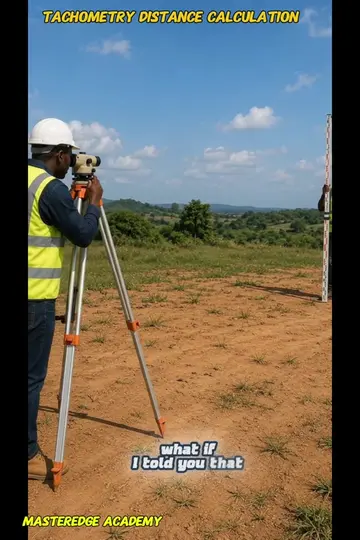
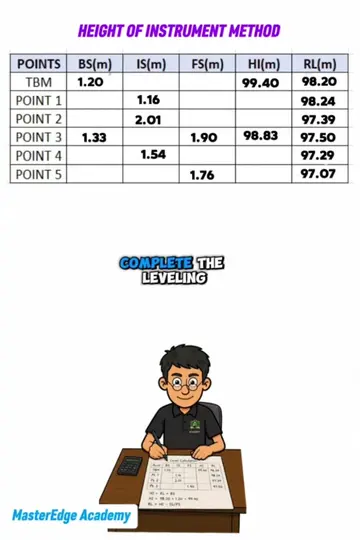
This animated video from MasterEdge Academy explains the process of leveling in surveying, demonstrating how to take Backsight (BS), Intermediate Sight (IS), and Foresight (FS) readings. It then shows how to calculate the Height of Instrument (HI) and Reduced Level (RL) for different points using these readings.
Structure
- 1Introduction to leveling and the role of MasterEdge Academy
- 2Taking a Backsight (BS) reading on a known TBM
- 3Taking Intermediate Sight (IS) readings on new points
- 4
Original caption
Understanding Leveling & Its Calculations - Part 1 How does leveling work in surveying? And how do you calculate HI and RL from your field readings? In this Part 1 tutorial, we go from the field observation to the actual calculations. You’ll see how a surveyor takes: ➡️ BS = 1.20 m on a TBM ➡️ IS = 1.16 m at Point 1 ➡️ IS = 2.01 m at Point 2 ➡️ FS = 1.90 m at Point 3 Then we calculate: HI = RL + BS and RL = HI − IS/FS By the end, you’ll understand why the HI remains constant when the instrument stays in the same position, while different staff readings produce different RLs. #survey #level #student #masteredgeacademy
More from @masteredgeacademy
More breakout videos from this creator.