Loading video…
All breakouts
82.7Text-HeavyHow-To hookAI Tools
Hook
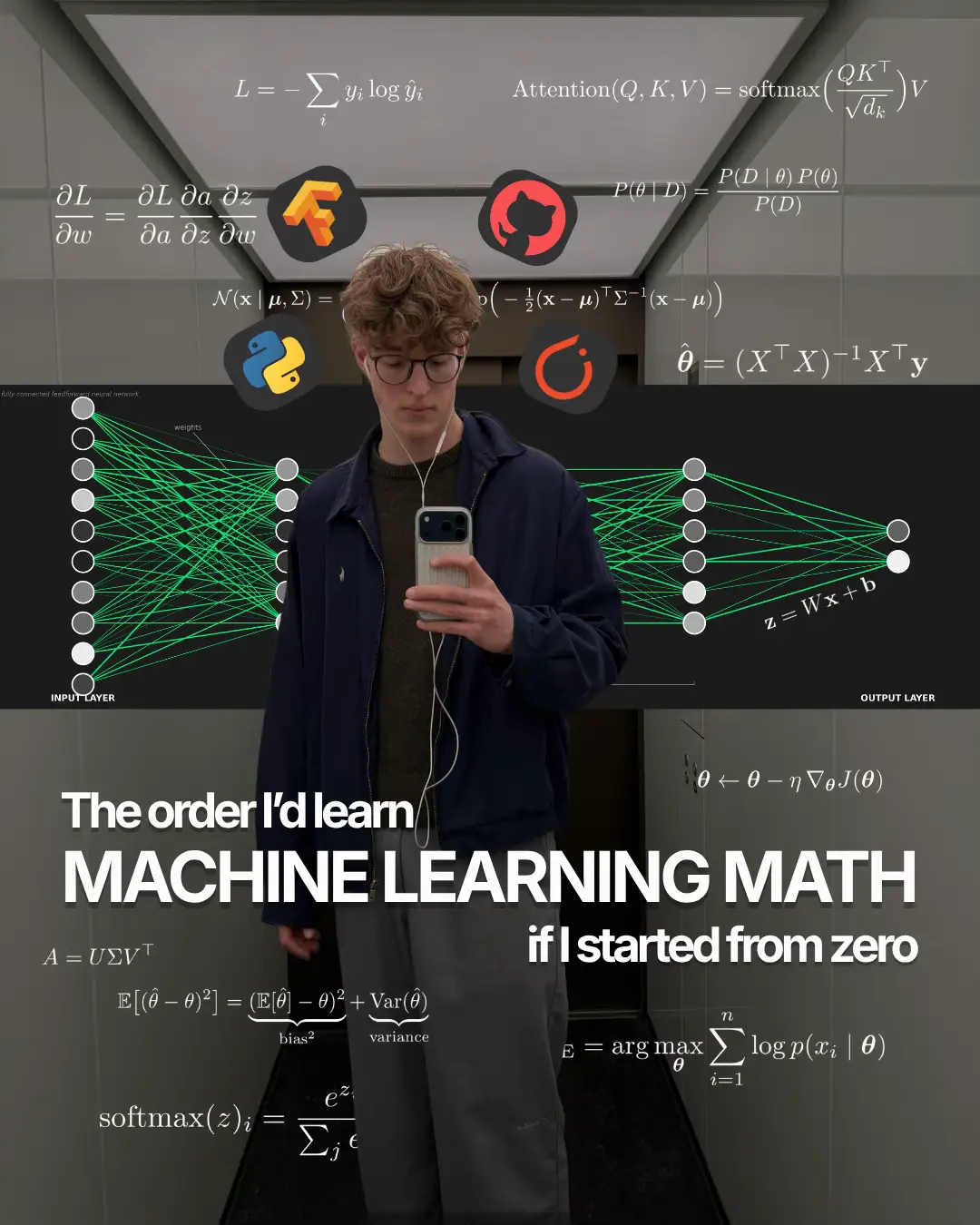
The order I'd learn MACHINE LEARNING MATH if I started from zero
@chrispathway
25.2K followers · usually 4.6K views a post
Views
372.1K
Likes
42.7K
Comments
98
Shares
2.2K
Why it worked
The post provides high-value, dense educational content that is perfectly aligned with the creator's niche, encouraging saves and shares from students and professionals looking for a clear path to learn complex topics.
Summary
The creator outlines a structured five-step learning path for mastering the mathematics required for machine learning. Each slide details a specific subject area, recommending key concepts and specific university courses for study.
Structure
- 1Introduction to the learning roadmap
- 2Linear Algebra curriculum
- 3Calculus curriculum
- 4Probability and Statistics curriculum
- 5Optimization curriculum
- 6Deep Learning curriculum and final CTA
Call to action
Follow for more Free Resources!
On-screen text
The order I'd learn MACHINE LEARNING MATH if I started from zero
1. LINEAR ALGEBRA
Mathematics for Machine Learning Ch. 2-4
Almost everything in machine learning is written in this notation, so it goes first. A single example is a vector, a dataset is a matrix, and a forward pass through a model is a chain of matrix multiplications.
You need vectors and matrices, rank and linear independence, the fundamental subspaces, projections and least squares, eigenvalues and eigenvectors, SVD, and positive definite matrices. Determinants by hand and the proof-heavy vector-space theory can wait. The two results that pay off everywhere later are that least squares is a projection onto a subspace and that PCA is the eigendecomposition of a covariance matrix. One to two months, and it is worth doing before the rest.
MIT OCW 18.06 Linear Algebra
2. CALCULUS
Calculus is what lets a model improve on its own. Training follows the gradient of a loss downhill, and that gradient is a derivative taken in many variables at once.
Do single-variable first: limits, derivatives, the chain rule, a bit of integration. The multivariable part is the one that keeps showing up: partial derivatives, the gradient, the Jacobian, the Hessian, and Taylor approximation. Integration techniques and convergence tests matter far less here than in a standard calculus course.
The chain rule is the piece to know cold, since backpropagation is just the chain rule applied layer by layer. Once your derivatives start involving matrices, keep the Matrix Cookbook open. One to two months if you go straight for the gradient.
MIT OCW 18.02 Multivariable Calculus
3. PROBABILITY & STATS
In machine learning a prediction is usually a probability distribution, and the loss you minimise is almost always a likelihood in disguise, so this part carries more weight than people expect. Probability first: random variables, expectation and variance, the common distributions and when each one appears, conditional probability, Bayes, and covariance.
Then the statistics: estimators, maximum likelihood, the bias-variance tradeoff, confidence intervals and what they do not promise. You can skip memorizing the named hypothesis tests, and two to three months is enough for both halves. Maximum likelihood is the thread that ties it together, since squared error and cross-entropy both fall out of it once you assume a distribution for the noise.
Harvard Stat 110
4. OPTIMIZATION
Optimization is the machinery that turns a loss function into a trained model. Whether it is linear regression or a deep network, the work comes down to minimising an objective, and the method used to do it is a subject of its own.
Convex sets and functions, gradient descent and its stochastic variant, momentum and Adam, Newton's method, and the constrained case with Lagrange multipliers and the KKT conditions. Regularisation belongs here too, as a penalty on the objective rather than a separate idea. One to two months, short and dense. The distinction worth internalising is convex versus non-convex: a convex problem has a single global minimum and a solver will find it, while deep learning gives that up on purpose, which is why training depends so heavily on initialisation and learning rate.
Stanford EE364A Convex Optimization
5. DEEP LEARNING
This is where the first four slides get used. Linear and logistic regression, softmax and cross-entropy, then neural networks, backpropagation, and attention.
A sensible order is regression as maximum likelihood, then classification, then a small neural network built from linear layers with nonlinearities between them. None of it is new mathematics: the forward pass is matrix multiplication, the loss is a likelihood, and backprop is the chain rule in reverse. Skip the catalogue of architectures at first and get one network working end to end.
Deriving a single forward and backward pass by hand once is time well spent, because every larger model is that same loop with more parts. After that a transformer reads as a longer version of the same idea. Two to three months, and most of it only sticks once you write the code.
Stanford CS229 Machine Learning
Follow for more
Free Resources!
Original caption
1. Linear Algebra (Strang + MIT 18.06 + Mathematics for Machine Learning) 2. Calculus (Mathematics for Machine Learning + MIT 18.02 + 3Blue1Brown) 3. Probability & Statistics (Blitzstein + Harvard Stat 110 + All of Statistics) 4. Optimization (Boyd Convex Optimization + Mathematics for Machine Learning + Stanford EE364A) 5. Deep Learning (Bishop + Deep Learning book + Andrew Ng CS229) Follow for more. #machinelearning #ai #math #coding #study
More from @chrispathway
More breakout videos from this creator.