Loading video…
All breakouts
34.7Text-HeavyAI Tools
Post
Post by @openai
@openai
1.0M followers · usually 23.3K views a post
Views
756.6K
Likes
35.7K
Comments
800
Shares
4.3K
On-screen text
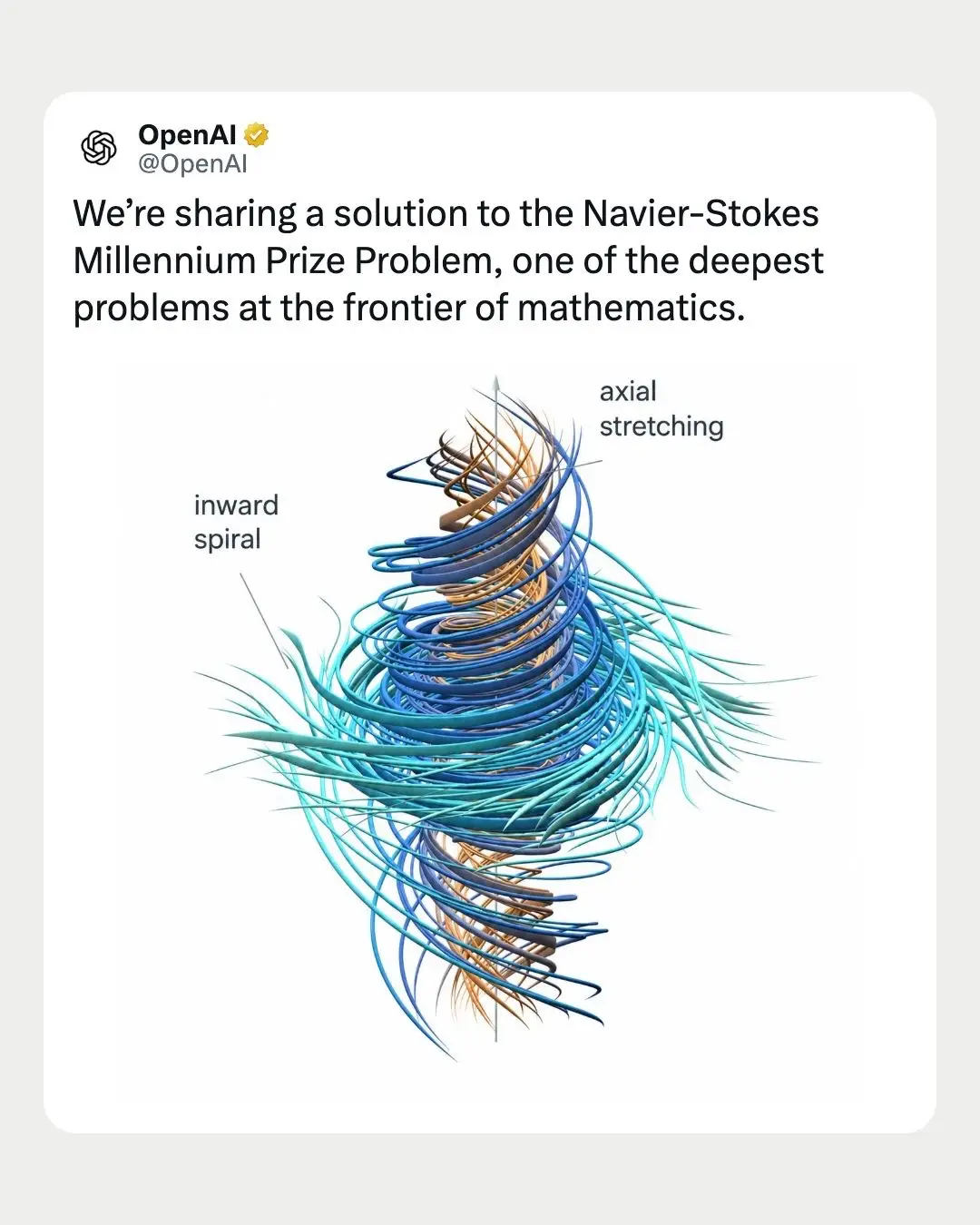
OpenAIn@OpenAInWe're sharing a solution to the Navier-Stokes Millennium Prize Problem, one of the deepest problems at the frontier of mathematics.naxialnstretchingninwardnspiralnOpenAIn@OpenAInThe proof was produced by a group of agents, using an OpenAI next-generation model significantly more capable than GPT-6 Astra.nThe problem concerns whether the description of smooth three-dimensional fluid motion modeled by the Navier-Stokes equations can break down. It has remained unresolved for roughly 90 years.nOpenAIn@OpenAInThis model represents a step-function improvement on many benchmarks, and its training is ongoing.nPerformance of GPT-6 Astra and our Internal Model on a curated set of open math problemsnGPT-6 AstranInternal Modeln0.5n0.4nPass raten0.3n0.2n0.1n0nTest-time compute (log scale)nOpenAIn@OpenAInOur internal model group arrived at the Navier-Stokes solution in 88 hours, using around 10,000 coordinating AI agents.nThroughout the effort, we maintained the strict safeguards—including monitoring and isolation—that we apply to all our frontier evaluations.nOpenAIn@OpenAInThe group produced an analytical proof and Lean formalization that via Navier-Stokes dynamics a fluid can develop a singularity in finite time.nThe solution is a vortex, a spinning swirl of fluid, that spirals inward and gets increasingly elongated, like spaghetti.nOpenAIn@OpenAInWe are focusing on understanding this model, and using what we learn to help us guide and pace how we pursue further advances in capability.nOur goal is to build AI systems which are steerable, accountable, and connected to people, which may require more deliberate choices about the pace of progress, as we continue our mission to ensure AGI benefits all of humanity.
Original caption
We’re sharing a solution to the Navier–Stokes existence and smoothness problem, one of the Millennium Prize Problems. This proof, produced by an internal OpenAI system, shows that the dynamics of the Navier-Stokes equations for fluid motion can develop a singularity in finite time. We’re sharing both a writeup of the proof and a formalization in Lean. The Millennium Prize Problems represent some of the deepest questions at the frontier of mathematics. The question of whether smooth three-dimensional fluid motion can break down has remained unresolved for roughly 90 years. A major goal of our work is to empower scientists to advance research and technology that benefits all of humanity. To solve the Navier–Stokes problem, we used an internal model that is significantly more capable than GPT‑6 Astra. We believe it is important to inform the world about the pace of AI progress and what to expect from upcoming models. And we congratulate Levent Alpöge and Tristan Buckmaster on their remarkable mathematical work. We (the researchers and the agents) did not see any of their work through any means until they released it publicly — in particular, no specific user data was accessed in order to solve this problem. While unlikely, we cannot rule out that de-identified data derived from their usage of our products helped improve our models. However, our proofs differ significantly and even the precise results proved are different in the Euler case (forced vs. unforced).
More from @openai
More breakout videos from this creator.