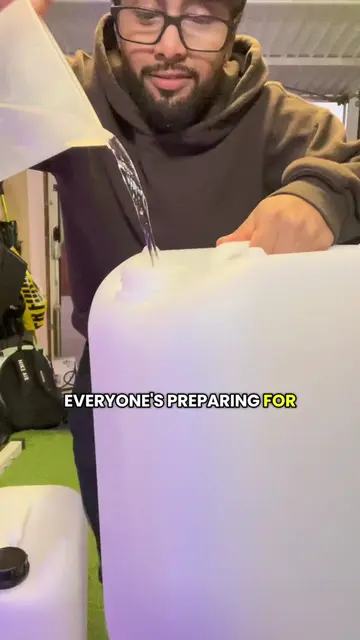
Today I'm gonna show you from start to finish how to store water for emergencies and answer some of the people usually have about water storage. I'm gonna be using these 30 gallon tanks that emergencywatertanks.com sent me, but the same process applies regardless of what container that you use. Now water is probably one of the most important things that you can store for an emergency, but it's also one of the biggest challenges, believe it or not. It takes up a ton of room, it's incredibly heavy, and there are all kinds of questions about how you're supposed to store it. Now I have a few different ways that I store water and these 30 gallon tanks are gonna give me a little bit more flexibility than I currently have, and I'll show you why that matters here in just a second. Just make sure it's HDPE and it's got the number two on it. HDPE #2 containers, safe and reliable choices for storing water. Water, lotes, long-term storage. 55-gallon barrels, 55 gallons, common and easy to store. Other HDPE #2, 5 to 50+ gallons, versatile sizes. Look for the HDPE #2 symbol and make sure it's food safe. A lot of people reuse the food grade buckets, the barrels, the ICB totes and things like that all the time. But if they've had something else in those chemicals, fuels or pesticides, you wouldn't want to use those even though they are rated that HDPE No. 2. Another example of containers that aren't rated for long-term storage that are those HDPE No. 2 is a gallon milk jug. Those just aren't thick enough to be to use as water storage. Now this doesn't mean that you specifically need to go buy water storage containers like these 30 gallon ones or the blue containers, but they are going to make everything just a whole lot easier because you don't have to worry about what was in them in the past and if you've cleaned them enough to get everything out. That's why I tend to stick with containers that are made for water storage specifically. Now the five, like I said, the five gallon ones are really popular in preparedness. They're easy to move around. You can store quite a bit more water than say with the, you know, the water bottles, but a lot of these are made in China. And the ones from Walmart, although they're really cheap, they are really cheap as well. And these other ones just, I don't know if there's many made in the United States today. And that is one thing that really stood out to me about Emergency Water Tanks is because they are a family owned business. They're, they're based in Utah and they manufacture these right here in America. And that is pretty hard to find these days. Anything made in America, I try to support those businesses. Now with these larger tanks, the, the one thing you need to keep in mind is that if anything over 15 gallons, once you fill that up, it's basically where it is at that point. But there are trade-offs, you know, the 5 gallon ones, the 30 gallon ones, they even sell 55 gallon containers up to like 300 gallon containers as well. That is a whole lot of water in one spot. But that's why I've decided that I'm gonna use both in conjunction with each other, actually all three, my well pump, the 5 gallon jugs and these 30 gallon jugs because that gives me a lot of options in an emergency. But these 30 gallon tanks are sort of an interesting middle ground because they are still gonna be heavy. It's 250 or so pounds when they're full. You'll be able to move them, but as far as filling them, moving them around when they're empty and cleaning them out if you need to, these are a whole lot easier to manipulate, move than the really large ones. And it's gonna have less of a footprint than the 5 gallon tanks. And that's why I was interested in checking these out. These are 21 by 21 by 21 and they stack really securely on top of each other. It's a really well thought out design. It's got the large opening on the top to fill this so you don't have to worry about splashing all over the place. It's got a valve on the lid that releases pressure too. Say you've, you're draining the bottom one, you won't be able to open up that lid. So this little valve right there releases that pressure and keeps that flow running. It's also got a three quarter inch lead free brass spigot with a replaceable bulkhead and it's something that's metal. Something you just don't see anymore. Again, family owned business, made in America right here. You just don't see the metal parts. Usually it's the plastic, cheap plastic that's gonna break off. And the reason I mentioned all of this about the design is because that you don't have to worry about putting inside your home. And I'm gonna set it up right now with in this video outside in, but it may move inside into my basement as well. And with a container that's holding this amount of water, you really want to make sure it's well made and it's going to stand up and you're not gonna end up with 50, 100 gallons of water all over your basement floor. With a container this size and any of your containers, it's important you think about where you're gonna put them before you fill them up. Because the 5 gallon tank, sure you can move those around, but you're not gonna want to once those are already full. These ones you definitely have to have a plan in place because once you put 30 gallons of water in here, it's done. It is staying where it is until you drain that water. Some options you have as far as storing waters, you can put it directly on the floor as long as it's not concrete. You can raise it up by fours if you want. With containers like these, it becomes a little bit difficult because the spigots are right at the bottom, but I will go over some options for that. You've also got properly rated heavy duty shelving, the dunnage racks and these would work great, although some of them are only 8 to 12 inches off the ground. So you wouldn't be able to fill a container with it being that high off the ground. You've also got concrete blocks where you could support the platform with some, you know, two by fours. This would be really cheap and simple, although you you've got to make this is pretty sturdy if you're talking 500 pounds of water. What I did was built a load bearing stand which will handle at least 500 pounds. And I'm not gonna go through the build in this video, but I'll leave a link below. I've got another video where I showed you exactly how to build one of these stands. And this stand is 24 by 24, so just a little bit wider than these tanks. Now I mentioned you could put these on the floor, say you prop them up with two by fours or you use those concrete bricks. There's also 12 volt portable RV pumps that you can use to pump the water out of these tanks. Even though I've got this 15 inch high platform, I may end up getting one of these 12 volt pumps because they just make things a whole lot easier and I want to test them out. It's only $60 or so, but you could use that option. So there are other options other than building a shelf yourself or putting it on the ground. You just need to think through all of these things before you fill those water storage containers up. Very large ones to the smaller ones as well. Now one last thing about where to store these, and then we'll move on to cleaning these and filling these up. But you want to make sure it's in a cool, dark place. Mine is not the garage where I'm gonna put these for now is not necessarily ideal because while my garage is insulated and it never gets below freezing and it never gets really hot, it does get to, you know, around 80, 85 degrees and it will get to 40 and really cold snaps, it may even get down less. So I'm gonna be watching how everything does through through the winter and then late summer where we're at right now. But you can also put them inside. I've got a spot inside in my basement where I could take this rack and put these down here, which may be a better spot because this is a cool, dark place. You're not gonna have to worry about temperature fluctuations. So inside your home or inside a temperature controlled area is ideal. And if you are storing it in something like this in your garage, you also want to make sure it's away from gasoline and chemicals and something that could leach those those smells at the very least. And it's away from those in case, you know, there are spills and anything like that. So just make sure you have a good plan going in about where you're going to put these, how you're going to set these up, and how you're going to rotate through them. And I will get into the the shelf life here in just a minute.