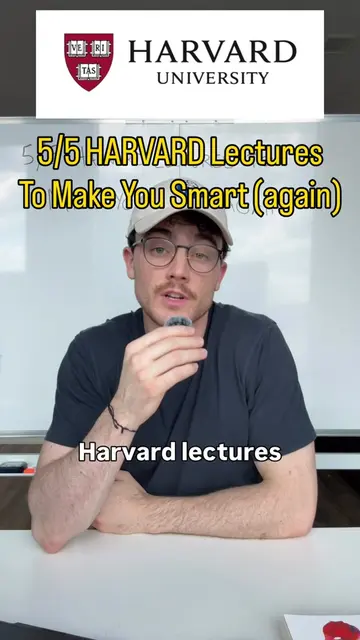
The video effectively breaks down complex concerns about AI into easily digestible points, using research and relatable analogies to engage the audience and encourage critical thinking about the technology's societal impact.
Summary
The video outlines five arguments against AI that are not related to water usage. These include cognitive offloading, job loss and inequality, mass misinformation, erosion of trust, and catastrophic risk. The creator cites research and studies to support these points, emphasizing the potential negative societal impacts of advanced AI.
Structure
1Introduction to anti-AI arguments
2Cognitive Offloading: AI making users dumber
3Job Loss and Inequality: AI impacting cognitive work
Original caption
5/5 anti AI arguments (that aren’t about water use). Inspo from: @.politicallyspeaking . Check out her content. Water use is a valid concern, but it’s talked about a fair amount, so I wanted to talk about a few others. Comment below more concerns. #ai #chatgpt #antiai #claude #smart
More from @rory.bingethinking
More breakout videos from this creator.
4Mass Misinformation: AI enabling personalized persuasion
5Erosion of Trust: AI making it hard to discern real from fake
6Catastrophic Risk: Potential for AI to surpass human control
Product placement
ChatGPT uses AI to generate text and other content. It is mentioned as an example of AI.
Microsoft is a company that develops AI technologies. Researchers from Microsoft are mentioned in a study.
Carnegie Mellon is a university where researchers are mentioned in a study.
International Monetary Fund (IMF) is an organization that publishes reports on AI and the future of work. Their report is shown on screen.
American Political Science Review (APSR) is a journal that published a paper on AI and misinformation. The paper is shown on screen.
Binge Thinking is a newsletter founded by the creator. The creator promotes joining their newsletter.
3 Scroll Thursday is the name of the creator's newsletter.
Call to action
Join My Newsletter (Below): 3 Scroll Thursday
On-screen text
5/5 Anti-AI Arguments
(that are NOT about water use)
1. Cognitive Offloading
2. Economic Inequality
3. Mass Misinformation
4.
5.
Link in bio
Transcript
Five out of five anti-AI arguments that are not about ChatGPT using too much water. To be a hater, you should be an informed hater. Number one, AI is making you dumb. The scientific term for this is cognitive offloading, basically outsourcing your thinking to someone else or something else. Researchers at Microsoft and Carnegie Mellon surveyed 319 knowledge workers and found that the more confident people were in AI, the less critical thinking they reported doing. Number two, widespread job loss and increasing economic inequality. Obviously, automation is not new, but previous waves of automation came heavily for like physical and routine work, so think about factory jobs. AI is coming for something very different, which is cognitive work. The IMF estimates that about 60% of jobs in advanced economies are exposed to AI. But here's the part that I think is really important. If companies can produce the same amount of stuff with way fewer people, where does all that money go? So less money needs to be spent on human labor and more can go towards models, compute, and data centers, and ultimately, the owners of that capital. You could have companies becoming incredibly productive and at the same time incredibly profitable, while a smaller share of that money goes to workers. Number three, AI can produce misinformation on a scale that we've never seen before. Propaganda used to be expensive. You need writers, designers, basically an entire team trying to figure out what messages actually persuade people. Now AI can do a lot of that instantly, and more importantly, very cheaply. Researchers published a paper literally called the potential of generative AI for personalized persuasion at scale. They tested this across four studies with almost 1800 people and found that AI generated messages tailored to people's psychological characteristics were significantly more influential and persuasive than non-personalized messages. And that's not groundbreaking. But this is exactly what AI is really good at: personalization at scale. Now, apply that to politics. We already get political spam like every day. I don't know about you, but I get these like trash political messages, but they suck because basically everybody gets the same thing. Now, imagine these text messages with millions of voters getting millions of individually tailored messages. It's a lot more scary. Number four, AI could destroy our ability to trust anything we see online. Everybody worries about AI making fake videos look real, and that's obviously a huge problem. But there's a second problem that I think is almost scarier. AI can make real things easier to dismiss as fake. And researchers call this the liar's dividend. If everybody knows that AI can generate incredibly convincing fake videos, images, audio, whatever, then when something real comes out, you can just say, that's AI. Researchers actually tested this in a few experiments with more than like 15,000 Americans. They found that falsely claiming damaging information was misinformation could actually increase support for politicians in some circumstances. Particularly when the scandal was presented through text. Now, eventually the question becomes less, is this fake and more is anything that I'm looking at actually real? And number five, catastrophic risk. This is the one that sounds most like science fiction and it's been in the news recently. The basic argument is that like, what happens if we eventually create AI systems that are significantly more intelligent than humans and we can't actually control it? And a lot of the people actually building and studying these AI systems don't dismiss this as science fiction. One research article I read where they like surveyed 3,000 people who had published research at top AI conferences and a substantial share of these people that they surveyed assigned like a non-trivial probability to outcomes as bad as human extinction from advanced AI. 48% still gave at least a 5% chance of extremely bad outcomes like human extinction. So 5% may not sound that bad, but think about it this way. If you were getting on an airplane and the pilot said, hey, everybody, by the way, I personally think there's a 1 in 20 chance that this plane crashes, would you still stay on that plane? Probably not. Except in this case, we're not talking about potentially all of human existence, everybody on Earth, and we're building the plane while we're flying it. No, I think that's it. Follow for more ways to make you smarter again and join my newsletter, 3 Scroll Thursday. Every Thursday, I send three things to make you smarter again. Something to watch, something to read, and something to listen to. Yeah. This is the last thing. No, it's not the last thing. Let me just keep going with this because this is the end. Yeah.
 6 videos2 creators