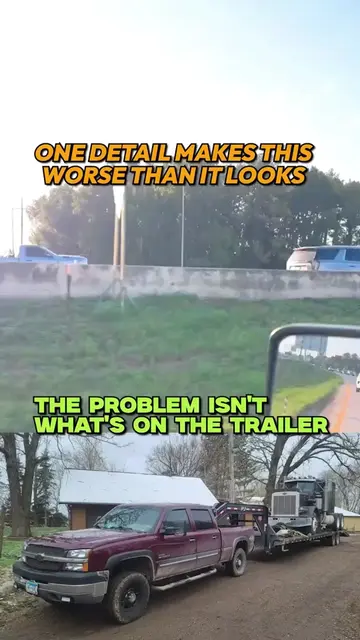
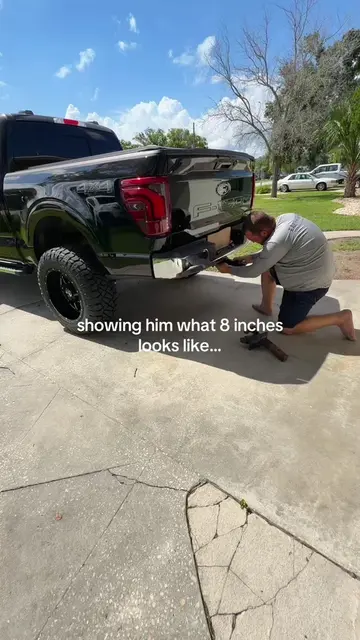
I'm not exaggerating here, we're not mocking this up in any way. We see this every day from experienced people that have been pulling for years, we see it from beginners. When I put this on the truck, I had to use a jack because my tongue jack would not get it high enough to go in there. If we look at this level right here, we have a four-foot level and you can see the bubble on it. The bubble is buried up front. So if we were to raise it to get the bubble, I think it's on the money. Let me hold my tongue just right. We got about two and a quarter, maybe two and a half. So that's not that much, right? Two and a quarter, two and a half. Well, it is if you were to take it back there. So you have a four-foot level and if you're at two and a quarter, two and a half, a four-foot level and 16-foot trailer, that's going to be around a 10-inch difference, I think. I usually don't do math on camera, but 9 to 10 inches is how high this thing is running. We can confirm that with a tape measure. If we were to measure this here, right about 23 inches. And on the tail, we'll come back here. This is actually the bottom of the trailer right here, that angle, about 13 inches. So there's 10 inches worth of discrepancy in there. It's riding way too high in the front. You want a little bit of height, and we're going to talk about that when we show you how to properly measure for your correct ride height, so you make sure you're running the right hitch, whether that be the hitch on your truck or if you have an adjustable style coupler on the trailer itself. You can be one to two inches high on your preload depending on how much weight you're going to be hauling. One inch, you'll be good in most cases. If it's a little heavier, you may have to increase that closer to two inches. So now we're going to lower the tongue of this trailer down closer to where it needs to be. Like I said, it's about a 9 to 10-inch discrepancy, so we're going to cut that in half. We're going to lower it about five. Going to have to use my floor jack because I don't have enough travel in my tongue jack to even get close. We're going to come down a little bit more, then we're going to take a tape to it. Like I said, you can use a level, you don't have to, but if you're running a torsion axle setup, the level is going to be handy, or a tape measure, because you don't have nothing to eyeball when it comes to the equalizer. So you're going to need to tape the front and rear end or put a level on it to get close. Let's see what the level shows. It's showing a little bit high, so let's just measure and see. So now we're about 17 and three-quarter. And we're about 16 and three-quarter. So we're running about one high, which honestly would be a pretty good starting point to preload. Now once you preload, it may sink down and it may be too low in the front, so you would need to come up. You would need to give yourself a little bit more of a buffer, maybe to go to inch and a half, maybe to go to two inches on that. So here is how you know that the tri-ball is not going to work. Huge discrepancy right there. You're not going to make that any lower, unless you had an adjustable coupler on your trailer tongue, which they do make those. More than likely it's not going to have enough adjustment to close the gap on that. So we've measured our trailer, we have it about a one-inch high for preload. That's kind of what we want. The truck is setting where it's going to be at. You can take a tape measure and you can measure the center of the hitch here and the center of the coupler here and see what the difference is. Or if you had a tri-ball and you wanted to see the difference in it, you can measure to the center of that ball. What does that say? 24-ish. Now let's measure to the center of the coupler. 16 and a half-ish. So 16 and a half and 24, do the math on that. It is not going to work. That shows you how much drop you would need from this height. Now with the tri-ball, you're running high on the hitch, you're on the top side of the hitch. If you were running like a two-inch drop, that would put the ball kind of close to center of the coupler. Many of us have two-inch drops, used to be really popular. Four-inch drop used to be super popular, and those two would almost cover you. Anymore, that's just not the case. These trucks are so dang tall, it won't work. But I will tell you, on the tri-ball, there's very few that you can get the right ride height. If I had my son rolling here in his 96 C1500, this tri-ball may work on this trailer because he's got a two-four drop on it. It may be right on the money, and if that's your setup, then rip it, you're great, you're in the very few that it will work. But for the most part, as you can see right here, this is not going to be achieved, it's not going to be safe. This is a paperweight, scrap iron, trotline weight, whatever you want to use it for and call it, just don't use it to hitch your trailer together because it's going to be unsafe. So let's get us a proper setup and give you a few options on that, so that you're safe, so that you can tow, and you're not going to hurt yourself or hurt somebody else. So we'll put an old tried-and-true two-inch drop. See, that still ain't going to get it. Of course, still not going to get it. That would still put you riding way high. It'd be better than the tri-ball, but not where you need to be. One pretty easy way to get you a starting point, you can measure the bottom. Now this has a sleeve, so we need to measure a little higher. About 20 and a half to the bottom of that. And what are we there? I can't see. Is it 15 and a half? 15 and a half, so that's about five inches. So really you need five inches. And if you were to go into buy a hitch, you don't want to go into buy a five-inch drop, that's not, that's not going to get it. This is a four, and it's not even close. I have an eight-inch here. Or you can measure that, so this is an eight-inch overall drop, but your five inches would be from the bottom side of this is going to put you about right here. So the difference between here and here is about five inches. So when you put your ball on, you're going to be right on the money. That's still going to keep you about an inch, a little over an inch high in the front. Like I said, but here's something else to look for. This is a, this is a common mistake that people make, and a lot of times I think it has to do with price. So this drop hitch here, let's compare it to the two-inch. So this two-inch here, we have a tongue weight of 750, a tow weight of 7500. Once we drop eight inches on this hitch, here we go to 500 tongue weight, 5000 gross trailer weight. So this drop hitch right here is not even rated high enough to pull this trailer. This trailer is rated for 7000 GVW, so you could not use this, you would need to go to a solid shank. You still can't get a eight-inch drop, six-inch drop, but you're going to have to buy one that's going to be a little more money that is rated. So don't just go grab the first one off the shelf, don't just, you know, purchase the first one off one of the links we have, make sure it's rated for your proper weight. If you have a lightweight aluminum trailer, something like that that doesn't haul much, this, this may get there, but you need to also make sure you match up. Because again, it's just like the tri-ball, even if this is right height, if it's not safe, it's not safe. It's simple as that.