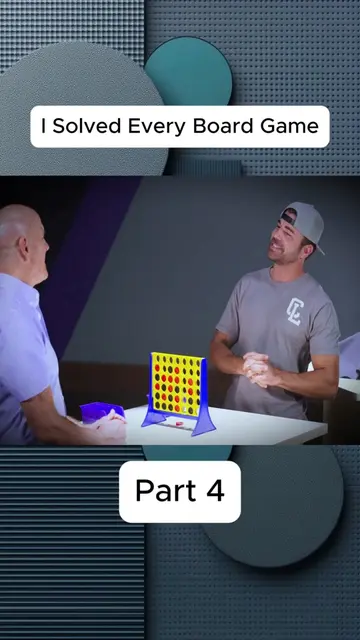
We have Connect 4. I played this a couple times. See who goes first? We're going to play rock, paper, scissors. Ready? Here we go. Rock, paper, scissors, shoot. See what one. Let's go to three. Then beat that one. I go first. All right, here we go. This was the ultimate test to see if my Connect 4 strategies were truly as unpredictable as I thought. I had an idea that was going to happen. I have prepared a lot for this moment. Hard to defensive. Just how I like it. Which involved creating a pattern that we'd seen over and over in our data. No choice there. And over the course of the game, if you successfully create it, your four will connect. Your move, Mr. Molloy. You forced me into there. I know, teach that in AP statistics, do they? Okay, so here's what I did. First thing to know is that the center column is the most important, and you should try to maximize the number of pieces you put there. And that's because every possible four in a row needs at least one piece in that center column. It doesn't matter if you win horizontally or diagonally, they all pass through the center column. The one exception is a vertical win, but those are pretty rare because they're super easy for your opponent to spot. And for trick two, we noticed that a bunch of wins in our data included this shape that looks sort of like a bird's beak. And if you look closely, you can see why this configuration is so unstoppable. Because in the act of blocking your first four in a row, they set you up for a second. And importantly, this beak shape can be upside down, right side up, point to the left, or to the right. These will all result in a win. And you'll find that once you know what to look for, it's not that hard to create it. So for Connect 4, here's what to remember. Stack the center column. Every Connect 4 runs through it. And second, build that beak shape because their block sets up your win. So after my dominant performance at Connect 4, look at news as you have a chance to redeem yourself at Battleship. So we placed our ships and right out of the gate, I was feeling pretty good about my chances. I'm feeling generous, you can go first. Oh wow, thank you. E5. That's a hit. Whoo. That is a terrible start. But I wasn't worried because I had a strategy we discovered called checkerboard hunting. Every ship is at least two squares long. So if you imagine a checkerboard pattern on the board, every ship must touch at least one square of the checkerboard pattern. Hunting only on black squares, for example, means you're guaranteed to eventually find all their ships, and yet you've cut the search space from 100 squares to 50. Then once the two-peg ship is sunk, you can stretch the pattern to every third square, since everything left now is at least three pegs long. Now of course, if you make a hit, you should immediately search the neighboring squares, up, down, left, and right, until you discover the orientation and you sink that ship. We've even created a simulation playing over 1 million games to test this strategy. We discovered random guessing plus neighbor hunting once you get a hit, which is what most people do, will win in an average of 60 turns, whereas our checkerboard strategy plus neighbor hunting drops it down to 50 turns, giving you an average advantage of 10 turns, resulting in an almost certain victory. B2. Miss. What? At least in theory. C4. Miss. A1. Miss. C3. Miss. I really wasted a lot of shots. Mr. Molloy's luck was bound to run out. H3.