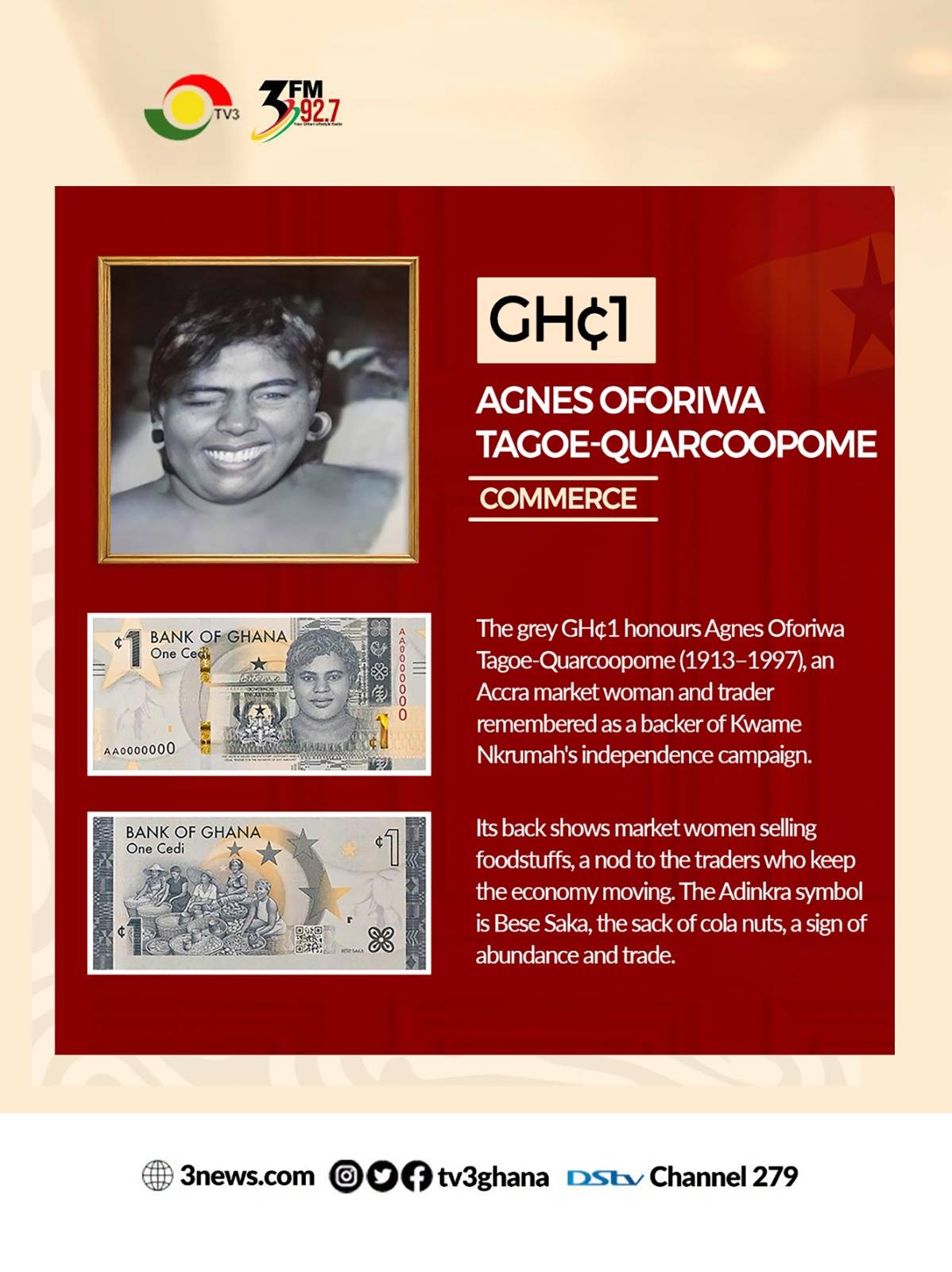
GH¢1 AGNES OFORIWA TAGOE-QUARCOOPOME COMMERCE The grey GH¢1 honours Agnes Oforiwa Tagoe-Quarcoopome (1913-1997), an Accra market woman and trader remembered as a backer of Kwame Nkrumah's independence campaign. Its back shows market women selling foodstuffs, a nod to the traders who keep the economy moving. The Adinkra symbol is Bese Saka, the sack of cola nuts, a sign of abundance and trade. GH¢2 CARDINAL PETER DERY RELIGIOUS FREEDOM The orange-and-gold GH¢2 carries Cardinal Peter Poreku Dery (1918-2008), the long-serving Catholic Archbishop of Tamale who was made a cardinal in 2006. On its back is the Larabanga Mosque in the Savannah Region, the mud-and-timber mosque often described as one of the oldest in West Africa. Pairing a Catholic cardinal with a historic mosque fits the note's theme. Its symbol, Nyame Dua, the "tree of God", stands for God's presence and protection. GH¢5 DR J.E.K. AGGREY EDUCATION The blue GH¢5 features James Emman Kwegyir Aggrey (1875-1927), the educator remembered for his piano-keys lesson that harmony needs both the black and the white keys. Its back shows the clock-tower building of Achimota School in Accra, which Aggrey helped to found. Its symbol, Nea Onnim No Sua A, Ohu, means "one who does not know can know by learning". GH¢10 JUSTICE ANNIE JIAGGE JUSTICE & EQUALITY The green GH¢10 honours Annie Jiagge (1918-1996), a pioneering judge and women's rights campaigner who helped draft the United Nations Declaration on the Elimination of Discrimination against Women. Its back shows the Supreme Court of Ghana, with the Martyrs of the Rule of Law monument in front. The symbol is Epa, the handcuffs, which stands for law and justice. GH¢20 DR EPHRAIM AMU ARTS & ENTERTAINMENT The purple GH¢20 carries Dr Ephraim Amu (1899-1995), the composer of the patriotic song "Yɛn Ara Asaase Ni" and a founding figure of Ghanaian choral music. Its back shows the National Theatre in Accra, with its sweeping, ship-like roof. The symbol is Dono, the talking drum, a sign of praise, goodwill and rhythm. GH¢50 THEODOSIA OKOH NATIONALISM The red-orange GH¢50 honours Theodosia Okoh (1922-2015), who designed Ghana's red, gold and green flag with its black. Its back shows Jubilee House, the seat of the presidency, whose shape echoes a traditional stool. The symbol is Fawohodie, which means independence and freedom. GH¢100 KOFI ANNAN PEACE The turquoise GH¢100 features Kofi Annan (1938-2018), the seventh Secretary-General of the United Nations and a winner of the 2001 Nobel Peace Prize. Its back shows the Kofi Annan International Peacekeeping Training Centre (KAIPTC) in Accra, which trains soldiers, police officers and civilians for peace operations. The symbol is Bi Nka Bi, "no one should bite another", a call for peace and harmony. GH¢200 DR KWAME NKRUMAH SOVEREIGNTY The pink-and-red GH¢200 carries Dr Kwame Nkrumah (1909-1972), who led the Gold Coast to independence as Ghana in 1957 and became the country's first President. Its back shows the Kwame Nkrumah Memorial Park in Accra, home to his mausoleum and statue. The symbol is Adinkrahene, the "chief" of all Adinkra symbols, which stands for greatness and leadership.