On-screen text
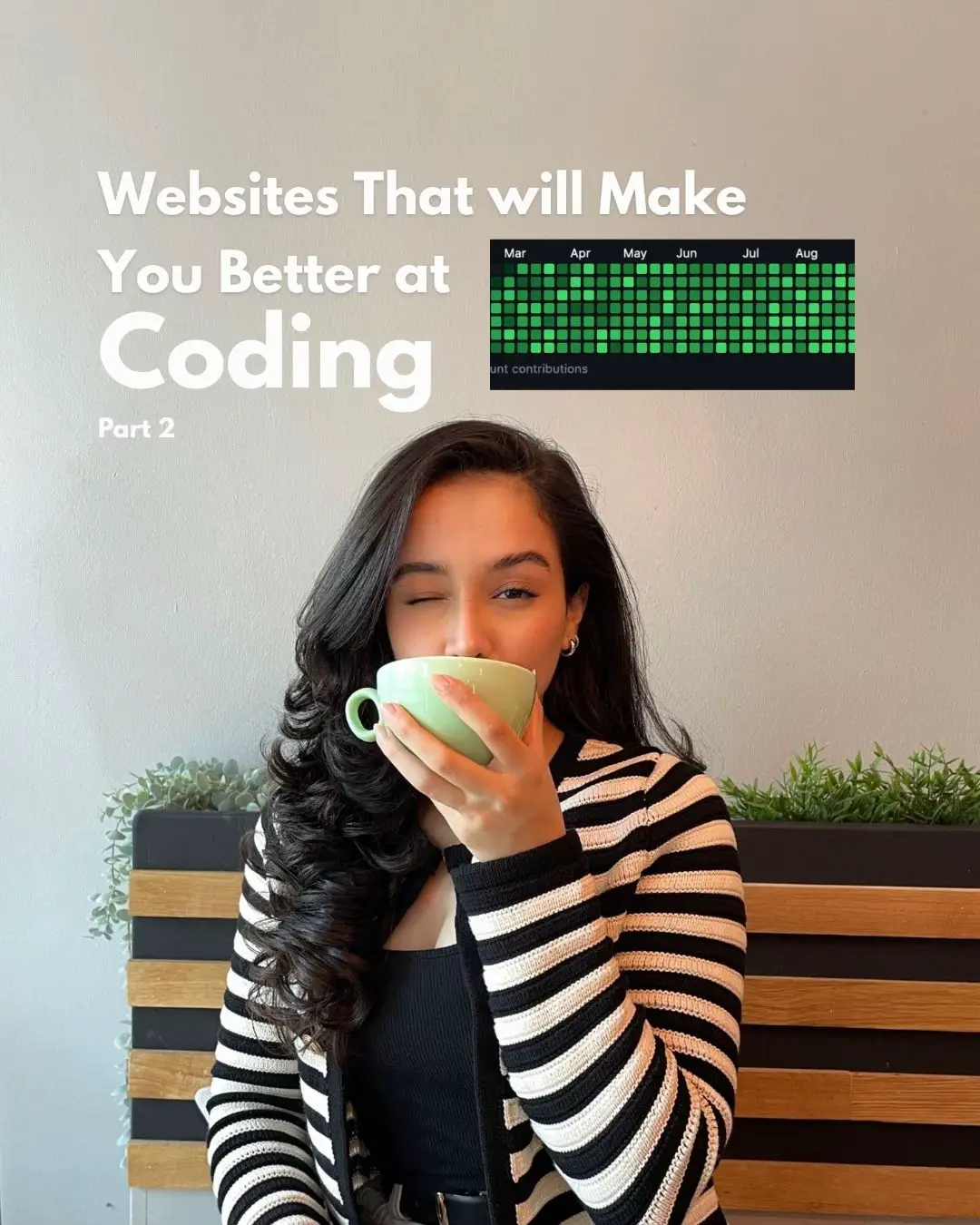
Websites That will Make You Better at Coding
Part 2
Mar Apr May Jun Jul Aug
count contributions
CodeCrafters.io
About Pricing Gifts
Log In
Try a challenge
Backed by Y Combinator
Train your engineering skills like a pro athlete
Recreate tools like Git, Redis, and SQLite from scratch.
Practice debugging and refactoring code under constraints.
Become the engineer others trust with their hardest problems.
August 2024
Built Redis from scratch
Build Expert
Built SQLite from scratch
Built BitTorrent from scratch
Built Git from scratch
Built Intermediate
July 2024
A hands-on learning site where you rebuild real-world
tools like Git or Redis, making it ideal for deeply
understanding how production systems actually work.
Rosetta Code
Search Rosetta Code
rosietacode.org
Join our Discord to discuss Rosetta Code!
Contents
hide
Beginning
Places to start
Recently-Updated Tasks
Ways to Contribute
Places to start
See Recent Changes
Ways to Contribute
Village Pump/Suggest a programming task
Village Pump/Suggest a language
Add a Language
Add a Task
Adding a new programming example
Examples needing attention
Unimplemented tasks by language
Rosetta Code is a programming chrestomathy site. The idea is to present solutions to the same task in as many different languages as possible, to
demonstrate how languages are similar and different, and to add a person with a programming approach to a problem in learning another. Rosetta
Code currently has 1,338 tasks, 598 code tasks, and is aware of 882 languages, though we do not (and cannot) have solutions to every task in every
language.
This page was last edited on 17 December 2023, at 18:16.
Content is available under GNU Free Documentation License. Cookies help us deliver our services. By using our services, you agree to our use of cookies. More Information
OK
A multi-language code comparison site that shows
how the same problem is solved in different
languages, helping you learn new paradigms and
write more idiomatic code.
Project Euler
net
About Archives Recent News Register Sign In
About Project Euler
What is Project Euler?
Project Euler is a series of challenging mathematical/computer programming problems that will require more than
just mathematical insights. Although mathematical skills are not elegant and efficient mathematics,
the use of a computer and programming skills will be required to solve most problems.
The motivation for starting Project Euler, and its continuation, is to provide a platform for the inquiring mind to
delve into unfamiliar areas and learn new concepts in a fun and recreational context.
Who are the problems aimed at?
The intended audience include students for whom the basic curriculum is not feeding their hunger to learn, adults
whose programming does not primarily mathematics but has a strong interest in mathematical, and professionals
who want to keep their programming and mathematics on the cutting edge.
Currently we have 1370597 registered members, who have solved at least one problem, representing 220 locations throughout the world, and
collectively using 113 different programming languages to solve the problems.
Can anyone solve the problems?
The problems range in difficulty and for many the experience is inductive chain learning. That is, by solving one problem it will expose you to a
new concept that may allow you to undertake a previously inaccessible problem. So determined participants will be able to slowly but surely work
their way through the problems.
What next?
In order to track your progress it is necessary to setup an account and have Cookies enabled.
If you already have an account, then Sign In. Otherwise, please Register - it's completely free!
However, as the problems are challenging, you may wish to view the Problems before registering.
"Project Euler exists to encourage, challenge, and develop the skills and enjoyment of anyone with an interest in the
fascinating world of mathematics."
A problem-solving platform combining math and
programming that strengthens algorithmic thinking and
sharpens your ability to solve complex problems
efficiently.
exercism
Learn
Discover
Contribute
More
exercism.org
Learning to code? Check out our Coding Fundamentals course for beginners!
Get really good at programming.
Develop fluency in 78 programming languages with our unique
blend of learning, practice and mentoring. Exercism is fun, effective
and 100% free, forever.
Sign up for free
Explore languages
exercism
is an independent, community funded,
not-for-profit organisation.
Learn more
Explore and get fluent in
78 programming languages
A mentor-reviewed coding practice platform that helps
you write clean, idiomatic code while getting real human
feedback instead of just pass/fail results.
overapi.com
Python
jQuery
node.js
FOPAP
Java
JS
/*AS*/
CSS
RegEx
HTML
HTML
express
Developer Tools >>
About and Comments >>
Get Chrome Extension >>
A curated collection of concise cheat sheets that lets you
quickly reference syntax and core concepts across many
languages to code faster and with fewer mistakes.
Teach Yourself Computer Science
teachyourselves.com
Note: this guide was extensively updated in May 2020. For the prior version, see here.
If you're a self-taught engineer or bootcamp grad, you owe it to yourself to learn computer science.
Thankfully, you can give yourself a world-class CS education without investing years and a small fortune in
a degree program 36.
There are plenty of resources out there, but some are better than others. You don't need yet another
"200+ Free Online Courses" listicle. These need answers to these questions:
Which subjects should you learn, and why?
What is the best book or video lecture series for each subject?
This guide is our attempt to definitively answer these questions.
Thank you to the following volunteers for their translations:
中文翻译此此 (Chinese) by Yu Zhengjie
Tradução em português (Portuguese) by Clemens Schrage
Перевод на Русский (Russian) by Ilja Moiseeva and Stepan Raktin
Bahasa telugu (Telugu) by Dat Hoang
Bahasa melayu (Malay) by Kim
한국어 (Korean) by Minyoung Kim
日本語 (Japanese) by Ralph Plumley
Türkçe çevirisi (Turkish) by Emre Barış Fırat
فارسی (Persian) by H.R. Taghavi
Traduzione in italiano (Italian) by Fabio Cicerchia
Traduction en français (French) by Aurélien Smirt
Bahasa Indonesia (Indonesian) by Ananda Umami
العربية (Arabic) by Ounissi Zakaria
A structured, self-guided computer science roadmap
that uses high-quality academic resources to build a
deep and lasting understanding of core CS
fundamentals.