Loading video…
All breakouts
39.8Text-HeavyContrarian hookEducation
Hook
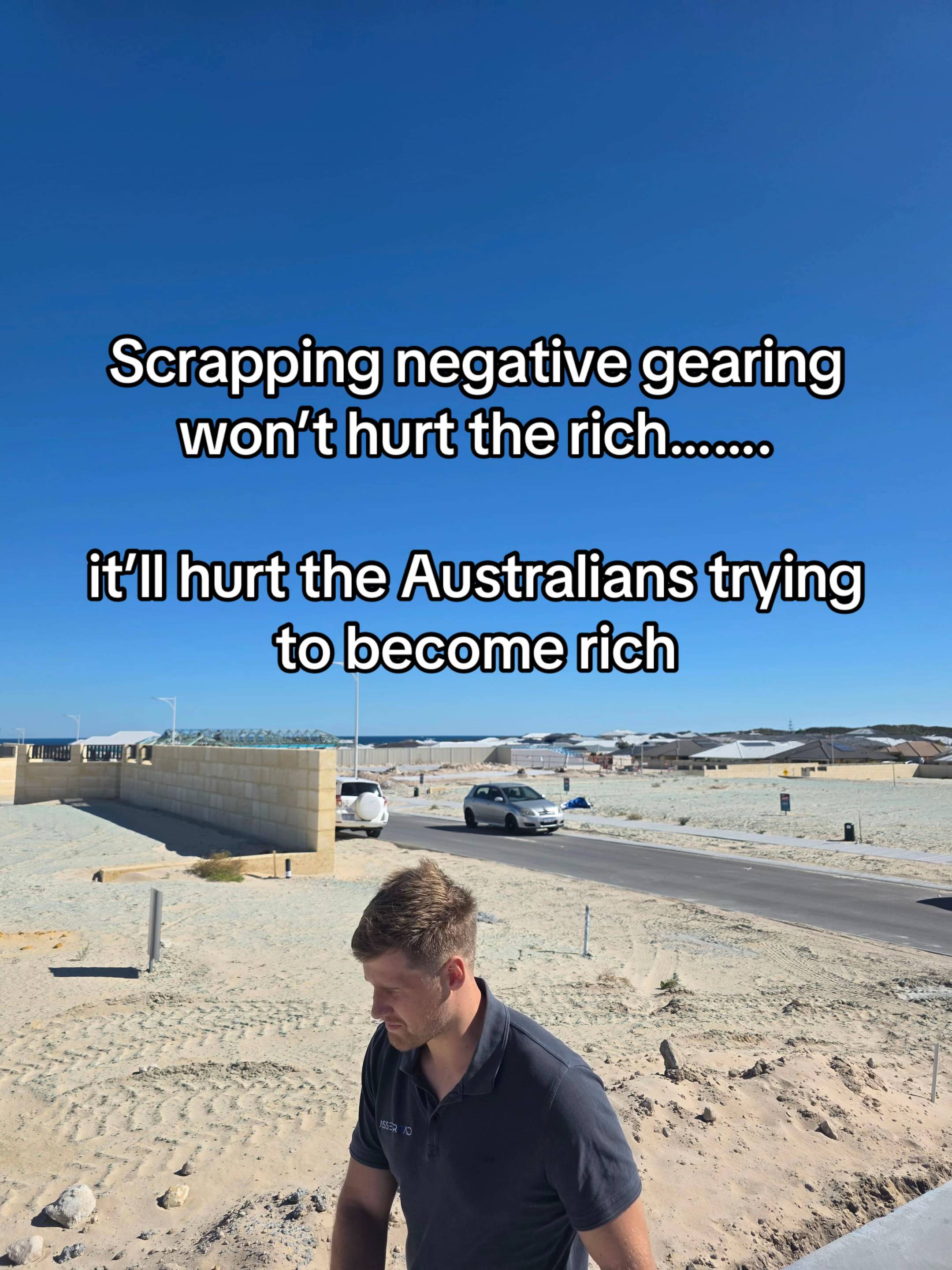
Scrapping negative gearing won’t hurt the rich.......
@oscardonproperty
9.7K followers · usually 2.1K views a post
Views
75.7K
Likes
1.4K
Comments
226
Shares
166
Why it worked
The post taps into a highly relevant and contentious political and economic issue in Australia, framing it in a way that resonates with the concerns of 'everyday Australians' rather than just the wealthy. The use of relatable scenarios and clear, concise text on visually appealing backgrounds makes the complex topic accessible and shareable.
Summary
This slideshow argues that scrapping negative gearing in Australia would hurt everyday Australians trying to build wealth, rather than the ultra-rich. It explains how negative gearing supports 'mum and dad investors' and how its removal could worsen the housing shortage and concentrate wealth at the top.
Structure
- 1Introduction: Scrapping negative gearing won't hurt the rich, but everyday Australians.
- 2The myth of wealthy investors vs. reality of 'mum and dad' investors.
- 3Negative gearing's role in helping people hold property through tough times.
- 4Consequences of removing incentives: smaller investors pull out, rental supply tightens.
- 5The wealthy continue acquiring assets, exacerbating housing shortage.
- 6Conclusion: Scrapping negative gearing may not make housing affordable, but makes wealth building harder.
Product placement
The video discusses the concept of 'negative gearing' in Australia, which is a tax strategy related to property investment. It does not promote a specific product or service, but rather discusses a policy and its potential economic impacts.
Original caption
There’s a growing conversation around scrapping negative gearing in Australia. And on the surface, a lot of people think it sounds like a good idea. “Make housing more affordable.” “Stop investors buying property.” “Help first home buyers.” But the reality is probably far more complicated than that. Because the people most affected likely won’t be the ultra wealthy. It’ll be everyday Australians trying to build wealth for the first time. The nurse who bought one investment property. The tradie trying to create a better future for his family. The young professional who stretched themselves into the market hoping long-term sacrifice would eventually pay off. A lot of Australians don’t realise that over 70% of property investors own just ONE investment property. Most aren’t massive developers or billionaires with 20 properties. They’re regular people trying to get ahead in one of the most expensive countries in the world. And if negative gearing disappears, what most likely happens? A lot of mum & dad investors pull out. Some stop buying entirely. Others sell because the numbers no longer make sense. That means fewer rental properties entering the market. At a time where vacancy rates are already critically low. At a time where migration is rising. Construction is slowing. And rental demand is already through the roof. So if supply tightens even further… what usually happens? Rents rise. Meanwhile, the wealthy continue buying anyway because they still have the structures, capital, and cash flow to keep acquiring assets. Which creates an uncomfortable reality: Policies designed to “hurt investors” often end up hurting smaller investors the most… while larger players adapt and grow stronger. Australia absolutely has a housing affordability problem. But does punishing everyday Australians trying to build wealth actually solve it? Or does Australia simply need more housing supply? Curious to hear both sides of the argument below 👇 #property #wealth #realestate #australia #invest
More from @oscardonproperty
More breakout videos from this creator.