Loading video…
All breakouts 20 videos17 creators
43.6App DemoOther hookEducation
Hook
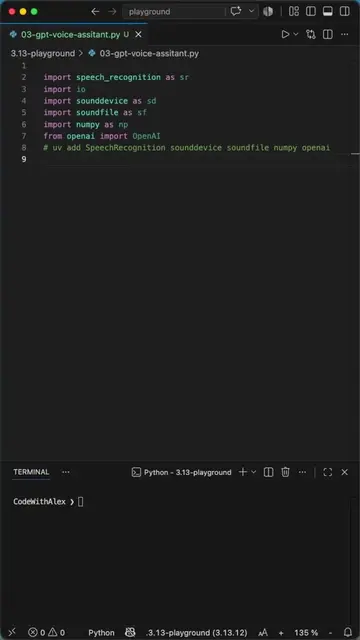
from openai import OpenAI
@code_with_alex
31.5K followers · usually 6.3K views a post
Views
200.2K
Likes
7.2K
Comments
148
Shares
375
Promoted product
OpenAI
OpenAI is a company that develops AI technology and offers an API for developers to interact with its models.
Why it worked
The video provides a concise and practical demonstration of building a functional AI chatbot with minimal code, appealing to viewers interested in AI and Python programming.
Summary
This video demonstrates how to build a basic ChatGPT bot using Python and the OpenAI API. It covers initializing the client, sending messages, and implementing a conversation loop with memory.
Structure
- 1Install OpenAI package
- 2Initialize OpenAI client
- 3Create a simple API call
- 4Add user input
- 5
Original caption
Build Your Own ChatGPT Bot in Python (in 60 Seconds) #python #coding #programming In this video you'll build a fully working ChatGPT bot from scratch using Python and the OpenAI API. Starting from a single API call, add user input function and then a full conversation loop with memory, all in under thirty lines of code. You'll learn how to initialize the OpenAI client, send messages to gpt-5.4-mini, and structure a growing message history so your bot actually remembers the conversation. All you need is Python and an OpenAI API key.
More from @code_with_alex
More breakout videos from this creator.