Loading video…
All breakouts
80.5Text-HeavyLifestyle
Hook
ZWS
@zerowastestore
55.3K followers · usually 2.8K views a post
Views
288.1K
Likes
21.1K
Comments
494
Shares
1.1K
Why it worked
The post leverages relatable frustrations with car dependency and traffic in the US, contrasting it with idealized visions of efficient public transport elsewhere. The use of strong, often humorous, statements and visually striking comparisons across multiple slides creates a compelling narrative that resonates with audiences interested in urban planning and sustainability.
Summary
This slideshow contrasts public transportation infrastructure and usage in the US with other parts of the world, highlighting the perceived inefficiencies and car dependency in America. It uses various tweets and images to illustrate points about train capacity, high-speed rail, bike infrastructure, and the space taken up by highways compared to cities.
Structure
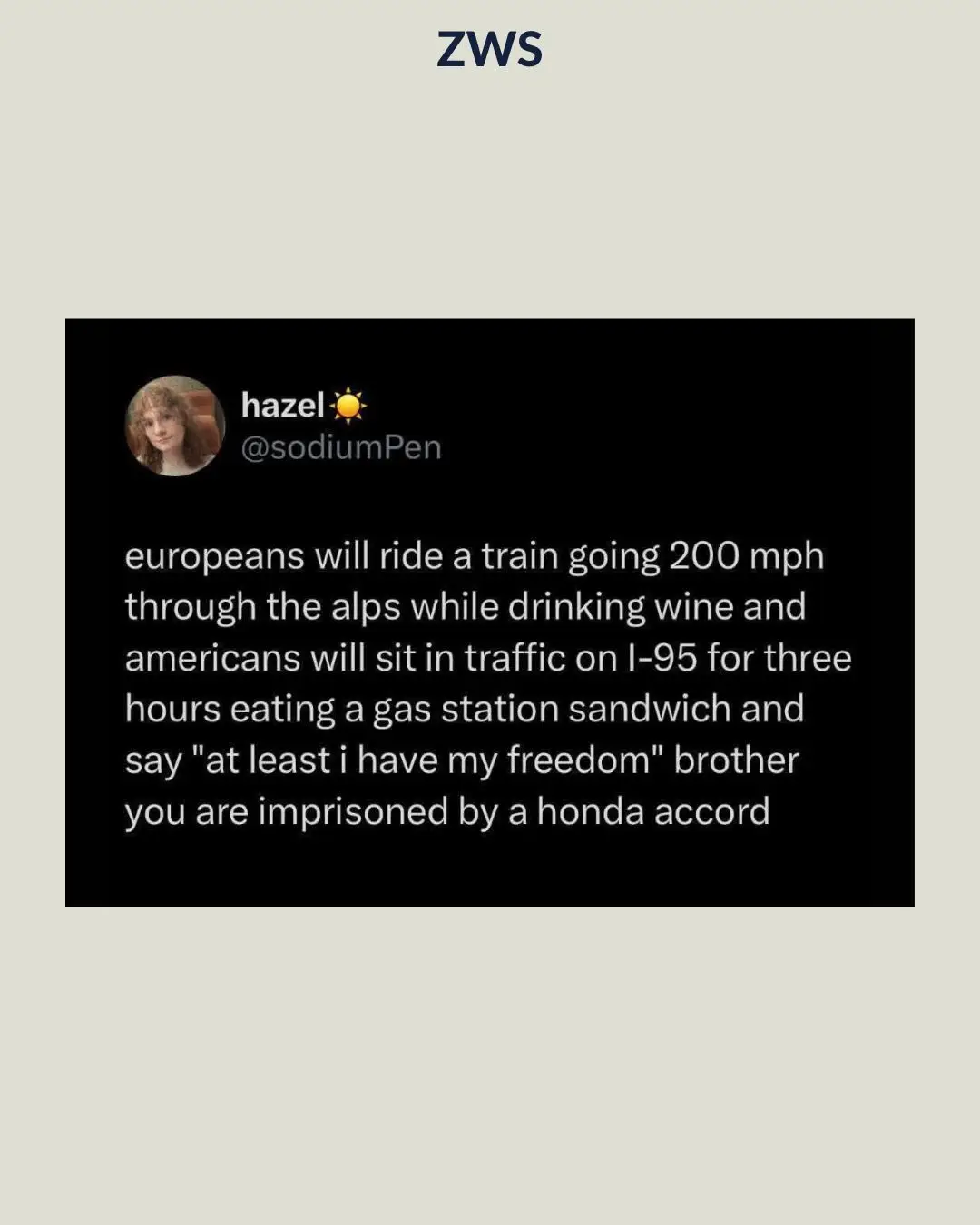
- 1European train travel vs. American traffic
- 2Subway capacity vs. freeway capacity
- 3America's supposed lack of bike infrastructure
- 4High-speed rail comparison: China vs. USA
- 5Public transit connectivity: America vs. Europe
- 6Highway interchange size vs. city size
- 7Definition of a developed country based on public transit use
On-screen text
ZWS
hazel☀️
@sodiumPen
europeans will ride a train going 200 mph
through the alps while drinking wine and
americans will sit in traffic on I-95 for three
hours eating a gas station sandwich and
say "at least i have my freedom" brother
you are imprisoned by a honda accord
ZWS
YIMBYLAND 🇺🇸
@YIMBYLAND
The capacity of subways is unreal. The
capacity of the widest freeway on earth
doesn't even come close to touching
even a single line in NYC.
Katy Freeway: 300k
Lexington Ave Subway: 1.3M
ZWS
“America has no bike infrastructure” yeah? then
explain this,
ZWS
thetransitguy 🔵 12/27/25
@threads
China now has 50,000 km of high speed rail. The USA
has 49 km.
ZWS
gaut 🫂
@0xgaut
Public transit connectivity in America vs Europe
ZWS
THIS INTERCHANGE IN ATLANTA, USA
TAKES UP THE SAME SPACE AS THE
ENTIRE CITY OF FLORENCE, ITALY
source: originalgreen.org
ZWS
"A developed country is
not one where everyone
owns a car, but rather one
where even the rich use
public transportation."
Original caption
You’re not stuck in traffic in your car, you are the traffic #publictransportation #walkablecity #urbanplanning #Sustainability
More from @zerowastestore
More breakout videos from this creator.