Loading video…
All breakouts
4.4Talking HeadStory Open hookFinance
Hook
How Goldman Sachs and Elon Musk Pulled Off the "Perfect" IPO of SPACEX
@thewallstreetskinny
69.7K followers · usually 8.6K views a post
Views
36.9K
Likes
2.5K
Comments
7
Shares
115
Summary
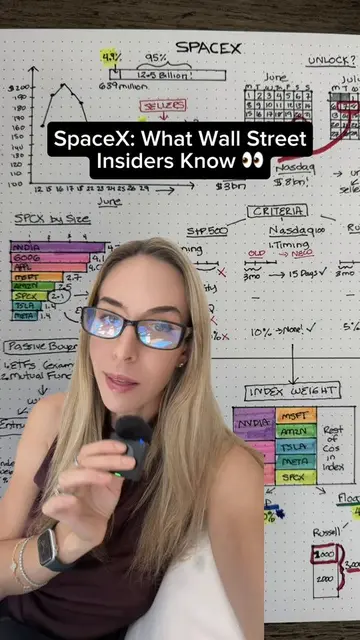
This video explains the unique IPO structure of SpaceX, highlighting how it differed from traditional IPOs by being a 100% primary raise, meaning all funds went directly to the company. It details the stock's pricing, initial surge, and subsequent decline, emphasizing the limited float and staggered unlock of shares for insiders.
Transcript
Most people have no idea how a traditional IPO works and therefore don't understand why this one was so different. I'm gonna try to break it down for you in less than three minutes. The first thing the bankers and investors need to figure out is what is the company actually worth. And when we talk about equity, there is the pre-money valuation, which is the value of the equity before the equity raise. And so in this case, let's assume that equity is worth $95. Next, the company and the bank will determine how much money they want to actually raise. This is called the float and is typically going to be anywhere from 10 to 20%. But in this case, because we're going to assume that it's 5%. The key question though, is whether the money that is being raised is going to insiders who are cashing out, that will be called secondary proceeds or a secondary sale, or whether the company itself is getting the cash. In SpaceX, it was an 100% primary raise, which means SpaceX got the full amount of proceeds that came into the business. This would result in the equity value going up by the $5, so the 95 + 5 means the post-money valuation is $100. The key here though, while everyone calls an IPO a liquidity event, and while in many cases in IPOs there are secondary sales, in SpaceX, it's 100% primary, which means every single insider is still locked up. So the question becomes, what exactly is it that this shares are going to unlock? Well, let's rewind and talk a little bit about the IPO itself. So it priced on June 11th, which was the pricing date. However, while it priced that day, it didn't actually start trading until June 12th. So again, they priced at $135. It was a take-it-or-leave-it pricing. And then on June 12th, the share price jumped up to $160.95, and ninety five cents. This represented the perfect 20% IPO pop, the exact amount that bankers literally tried to engineer. And then the share price continued to climb. The share price went up to $201. But then we started to see the share price decline. And in fact, yesterday, the share price closed down $154. And remember, this is still based only on the shares that were taken public. So there's only 4.9% of shares that are actually trading. That ties back to the amount of proceeds that were taken public. The remainder of those shareholders are still locked up. So the question becomes, what then? So typical lock up in a normal IPO is about 180 days. And so typically around that time, you might see what's called a secondary offering or a secondary sale. So if we stick with our example of $100 for the value of the entire equity and 5% float in 180 days, all remaining 95% can freely trade. So the bankers often will have something called a secondary offering, which allows for the orderly sale of those secondary shares. Note that when that happens, it is not going to have any impact on the valuation because you're just going to have insiders who are selling their shares to the public, who will now become shareholders in SpaceX. For SpaceX, the lock up is actually significantly shorter than for a traditional IPO. However, because of the size, they aren't letting the full 2 trillion of equity unlock on a single day. Rather, it's going to be staggered regardless, even with the staggered unlock, it is still a significant number of shares that will be coming online.
Original caption
Not sure why we’re giving all this info away for free,::but here it is.
More from @thewallstreetskinny
More breakout videos from this creator.