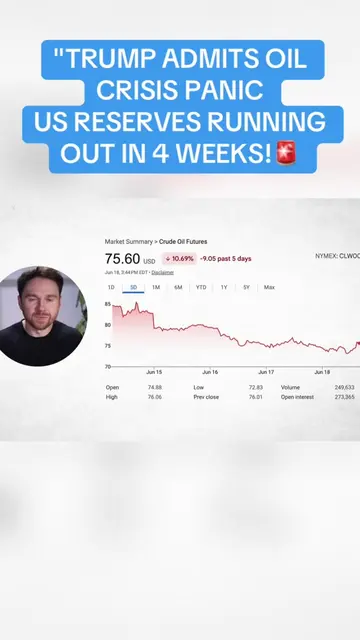
Something very strange is happening on the oil market. The price for a barrel of oil has declined by almost 40% in the past few weeks, taking oil's price below where it was when the war in Iran ruptured. One would think that this means that the street of Humus has been completely reopened and that is sustainable seafire has actually been reached, but the data does not support that. The transit through the trade of Humus remains marginally lower than where it was before the war broke out. The drop in transit at the onset of the war was the very reason for why oil prices spiked in the first place, but this has not been resolved. We saw a temporary improvement in the month of June with transit through the straight picking up a little bit, but it has since already come back down to almost a complete stand-still, and yet oil prices remain at their lows. And that's not the only unusual thing that's happening. Normally you would expect that a sharp move down in the price of oil would be a big positive for the stock market. You would expect that as the fears of an energy shock disappear, The stock market would melt up in response. But if we overlay an index of the top US stocks including Nasdaq, Meta and Apple that have been some of the strongest US stocks in the past few years, well they've actually fallen alongside the price of oil recently. Doing the exact opposite to what you would expect them to do. The truth is this decline in the price of oil is not what most people think it is. It is being driven by much different forces to what is being reported on the media and we happen to think there is a major opportunity right around the corner for investors here, but you'll only see it if you understand what's truly happening with oil right now. Because it's not just stocks and oil over the last few months while oil has declined by 20%, gold and aluminum have also declined by roughly 10%, silver by 20%, not the mentioned Bitcoin that is also dropped by another 20% in the same period of time. Every single asset class has been under pressure in recent weeks. So whether you own stocks, Bitcoin, gold, what's happening right now is going to impact you. Now many will jump to the conclusion that this kind of wide-spread sell-off is a sign that an economic recession is around the corner and indeed there is some logic to this. Whenever the economy enters a recession and growth is slowing down, it can put downward pressure on the price of oil as a result of lower demand for energy while also causing selling pressure on other assets like stocks and Bitcoin that tend to run into trouble whenever growth slows down. Now although this is plausible, we think what's happening today is actually being driven by something in entirely different and that is the US dollar that is literally the one common denominator of all of these assets gold oil US stocks bitcoin these are all primarily priced in US dollars around the world and over 90% of the transaction volume of these are made in US dollars. You can think of the US dollar like the measuring stick that is being used to price these assets. The only difference is that the measuring stick itself so the US dollar can actually get longer or shorter. For example if you're measuring the of the S&P 500 index that are priced in US dollars, a stronger US dollar can make the earnings look smaller. And that's precisely what has begun to happen today. The US dollar has just gotten considerably stronger and so the measuring stick has gotten longer. That is the real story that investors should be paying attention today, not the street of Humus. This is the US dollar index going back to the early 2000s and if we overlay a commodity index on top, which includes things like oil, gold, silver, aluminum, Now we can see it has a perfect inverse relationship with the US dollar. Whenever the dollar weaknesses, commodity prices go up, whenever the dollar strengthens, commodity prices go down. We can see that even more clearly by just flipping around the chart of commodities. The truth is 90% of the time, the dollar is what drives these prices, not supply shocks, not recession, the US dollar. And the same thing can be said about the stock market by the way, whenever the dollar weaknesses, stocks do well, whenever the dollar strengthens, they don't do well with almost all severe market draughtoning taking place during periods when the dollar strength like 2008, 2015, 2020 and 2022. Now, as mentioned earlier, the US dollar has recently begun to appreciate. For now, it might not look like much, but we can make the case that this strength in the US dollar has been single-handedly responsible for the decline in oil, gold and silver. When the dollar was hitting new lows in early 2026, investors were speculating massively on all kinds of assets that would benefit from a weak dollar. is precisely when gold and silver made their Uphoric move up. Oil's move up came shortly afterwards. But now as the dollar has strengthened, all of this has come violently back down. This is the key to understanding what's happening next from here for not just commodities, but for all assets across the financial system. And ultimately, it comes down to the Federal Reserve. The Fed has been responsible for this recent strength in the dollar and they will be the ones who determine where the dollar is going next from here. We can see this by adding something called the real two-year yield on top of the US dollar. This is essentially telling us what the market is expecting the Federal Reserve to do with their interest rate and going back to 2020, it's pretty obvious that this is the single biggest influence on where the dollar goes at any given point. Whenever the Federal Reserve raises their interest rate, like right here in 2022, for example, it tightens financial conditions and so strengthens the dollar, which puts downward pressure on anything that is measured in US dollars. If we zoom in a little bit and overlay the NASDAQ 100 on top, we can can see that the recent period of volatility on the US stock market has coincided precisely with the moment when interest rates began to rise. But it could potentially be much bigger than this. The truth is the entire bull market that we've had in stocks since 2023 has been in great part driven by the Federal Reserve lowering their interest rate and the US dollar weakening. If the Federal Reserve really starts to raise interest rates from here, it could start to look more like 2022 where higher interest rates put considerable downward pressure on the US stock market. If on the other hand, the Federal Reserve flips back down, it would put an end to the US dollar strength and we think that could make the melt up in stocks that we've had, actually continue for the foreseeable future and potentially even accelerate. Ultimately, the biggest reason for why the Federal Reserve might raise their interest rate at any given moment is inflation. And we can see that by simply overlaying inflation expectations on top. This line essentially tells us how the bond market is pricing in inflation. And you can see that these inflation expectations have actually been shifted forward by six months on this chart. So they essentially tell us what the Federal Reserve is going to do next. Whenever inflation falls, it gives the Federal Reserve room to lower interest rates which weaken the dollar and lifts asset prices and commodities back up. When inflation rises, it forces the Federal Reserve to raise interest rates which leads to the opposite outcome. Now, although the Federal Reserve has been concerned about the energy shock recently, which has made them raise their expectations of higher interest The reality is that the bond market is not confirming this. Inflation expectations have not been turning up enough for us to really expect the federal reserve to raise interest rates. In fact, quite the contrary, inflation expectations have stayed remarkably stable despite the recent energy shock. This is very different for example to what we saw with the Russian invasion of Ukraine which caused a considerable jump in inflation expectations. That's not what we're seeing right now. Which for us means the Federal Reserve won't be raising interest rates much here if at all. So that actually means that the spectacular meltup we've had in the stock market in the past few years as a result of a loser Fed and a weaker US dollar could have more room to run. We think any consolidation or correction that is happening in stocks right now due to a stronger dollar is actually a buy opportunity before they resume their run higher. Gold's spectacular ball market was driven by the prospect for the Federal Reserve to lower their interest rate and for the US dollar to weaken. We can see that even more clearly by flipping gold around, the very moment that these expectations of lower interest rates began to reverse, gold peaked and began the very aggressive sell-off that we've had since. So, if the Federal Reserve flips their expectations back lower, well, that could revive gold once again. Speaking of gold, we have a big gift that we have been working on that we would like to give to each and every one of you watching this channel for free. We've actually been working on a longer-term Quant model that automatically allocates to the S&P 500 gold or cash depending on the market environment. This is a model that is purely designed to turn your equity curve from a series of wild swings up and down into something that is much smoother over time. It's really designed to make you avoid wild swings in your portfolio due to recesssions, debt crisis, wars or whatever might come next. We'll be giving this model out completely for free on a live event that will be held on the 14th of July. If you want to attend and get access to the model, you just need to click on on the link below to secure your spot. I look forward to seeing you there. Thank you for watching.