The video uses a high-profile, relatable hook about celebrity-backed startups to draw viewers into a complex, analytical breakdown of a business model failure, providing high-value industry insight.
Summary
The creator discusses the controversy surrounding the AI shopping startup Phia, which is facing allegations of 'cookie stuffing' similar to the scandal that previously affected Honey. The video highlights the importance of thorough due diligence for both investors and founders when evaluating business models.
Structure
1Introduction to Phia and the Bloomberg investigation
2Overview of Phia's rapid growth and high-profile cap table
3Explanation of the 'cookie stuffing' allegations
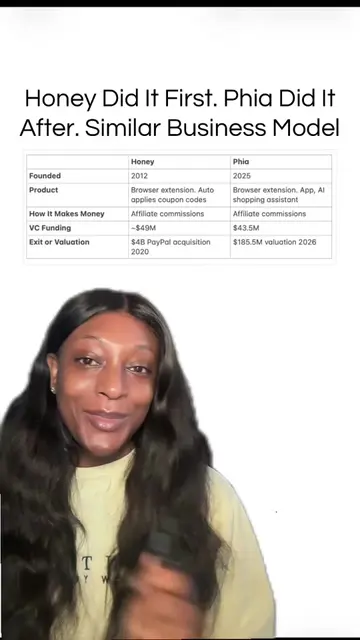
4Comparison to the Honey scandal
5The critical importance of business model due diligence
On-screen text
When Your Cap Table Reads Like A Coachella Lineup The Bar Is Higher
Phia Just Learned That The Hard Way
-INVESTOR ANNOUNCEMENT-
$35.5M Series A
Phia's mobile browser extension compares prices, calculates resale value, tracks price drops, and more. Phia has reached 500,000+ downloads and driven tens of millions in GMV in just four months
Phoebe Gates And Sophia Kiani Raise $8 Million Seed Round To Propel Growth For Phia
Gates Heir's Shopping App Claimed Sales It Didn't Drive
Forced Clicks and Stand-Down Violations by Shopping Plugin Phia
Phia accused of 'cookie stuffing,' taking affiliate credit on purchases it didn't earn
What's Going On At Phoebe Gates' Shopping Start-up?
PayPal + honey
Original caption
When your cap table looks like a coachella lineup, the bar is higher and Phia just learned that the hard way #venturecapital #finance #phia #affiliatemarketing #bloomberg
More from @bryannasamuels
More breakout videos from this creator.
Transcript
When your cap table looks like a coachella lineup, every single business decision is under a microscope. Phia, the AI-powered shopping assistant, just found this out. Bloomberg caught Phia doing the exact same thing that brought down Honey. Let's jump into the story that Bloomberg is reporting and some venture capital history. I have all my notes here, so let's begin. In April of 2025, Phoebe Gates, yes, Bill Gates' daughter, and her Stanford roommate, Sophia Kiani, launched Phia. It's an AI-powered shopping assistant that helps you find the best price on anything that you want to buy. In just six months, they raised $8 million in their seed round led by Kleiner Perkins, one of Silicon Valley's most respected venture capital firms. Chris Jenner, Hailey Bieber, Sarah Blakely, these were just a few more of the notable investors in their seed round. By January 2026, they had closed $35.5 million in their Series A financing round, valuing the company at $185 million, backed by Notable Capital and Costla Ventures. In May 2026, they went on CBS Mornings and revealed the rest of the cap table. Paris Hilton, Sydney Sweeney, Khloe Kardashian, Priyanka Chopra Jonas, Alix Earle, Ice Spice, Jessica Alba, Mindy Kaling, over 30 names in total. Time magazine had named it one of the best inventions of 2025. 1.5 million users, 9,600 retail brand partners, and on pace for nine-figure sales growth. From the outside, this looked like one of the most exciting consumer startups in years. But today, Bloomberg reported an investigation that changes this entire narrative. What makes this particularly significant is that Bloomberg did not find this alone. The report included testing by affiliate marketing researcher Ben Edelman and rival shopping service Capital One Shopping, each of whom allegedly found the same pattern of behavior. The code behind Phia's browser extension was publicly accessible, meaning anyone who knew where to look could read it. And according to this reporting, what they found in that code told a very specific story. The code was allegedly implemented in December, and what it was doing was this: Phia's extension was inserting its own tracking codes into retail websites in the background, even on purchases it allegedly had nothing to do with. And by doing that, it was collecting commissions from retailers for sales these investigators say it never actually drove. Let me explain what this means in plain terms. Every time you click on a link to buy something online, whether it came from an influencer, a creator, or a blog, that click has a tracking code attached to it. That code tells the retailer who sent you and who deserves a cut of the sales. With this report allegedly found was that Phia was quietly replacing that code with its own in the background, so the person who actually brought you to that purchase allegedly got nothing. Based on these reports, Phia collected the commission instead. In other words, they are allegedly getting paid for work that they did not do. Now here is where it gets interesting. Phia has acknowledged the issue and says it is currently investigating itself. The code has since been changed, but the question that remains is how long was this allegedly happening and how much was collected in commissions that were not earned? Now I need to take you back to December of 2024, because this story did not start with Phia. There was a free browser extension called Honey, and if you were on the internet in the last five years, you have seen it promoted by Mr. Beast, hundreds of influencers. The pitch was simple: download this free tool and it will automatically bind you the best coupon codes while you shop. Sound familiar? Honey was also venture capital backed. They raised approximately $49 million from investors including Mucker Capital, Anthos Capital, City Ventures, Ludlow Ventures, before PayPal came along. And in 2020, PayPal acquired Honey for $4 billion. 4 billion. Those venture capital investors made extraordinary returns. But in December 2024, a YouTuber named MegaLag dropped a video called Exposing the Honey Influencer Scam. It got 13 million views in nine days. What MegaLag's investigation alleged was this: when you had the Honey extension installed and click through to buy something, Honey was allegedly replacing the tracking code of the influencer or content creator who originally sent you there and collecting the commission instead. The creator who spent their time building trust with their audience and driving you to that purchase, allegedly got nothing. According to MegaLag's investigation, Honey got paid. A class action lawsuit was filed against PayPal seeking over $5 million in damages. Creators publicly walked away. Legal Eagle sued PayPal directly for fraud. The reputation that took years to build collapsed in weeks. Now I want you to hold both of these stories side by side for a second. Honey, venture capital backed, raised $49 million, browser extension that promised to help you shop better, allegedly replaced other people's tracking codes in the background, allegedly collect commissions it did not earn, exposed by an independent investigation. Phia, venture capital backed, raised $43.5 million, browser extension that promises to help you shop better, allegedly replaced other people's tracking codes in the background, allegedly collected commissions it did not earn, exposed by independent investigators. The funding structure is the same, the business model is the same, the mechanism is allegedly identical. The only difference is that Phia also has a cap table full of the most recognizable names in the world behind it, which brings me to the most important question in this entire story. This question is not about Phoebe Gates, it's not about the celebrity investors, it's about due diligence. In venture capital, due diligence is the process investors go through before writing a check. You look at the team, you look at the market, you look at the growth metrics, you look at the financials. But there is one area of due diligence that does not get talked about enough, and this story is a perfect example of why it should. Business model due diligence. Specifically, has this mechanism been tried before, and if it has, what happened? Because here is the thing: the Honey scandal did not happen last week, it broke in December of 2024. 13 million people watched MegaLag's video, a class action lawsuit was filed, the specific mechanism of a browser extension allegedly replacing affiliate tracking codes to collect commissions it did not earn was documented in extraordinary detail and reported by every major publication. Phia's Series A closed in January of 2026, a full year later, which means every investor who wrote a check into Phia in that round had 12 months of publicly available information about what allegedly happens when a browser extension based shopping tool builds its revenue model around affiliate commissions and tracking codes. The history was not hidden, it just was not looked for. And that is the lesson here, not just for investors, but for founders too. If you are building a company in a space where a predecessor failed for a specific and documented reason, you have a responsibility to study that failure deeply, to understand exactly how your business model is different, and to be able to explain that difference clearly to every investor at your table. Because when your cap table reads like a Coachella lineup, the magnifying glass is not coming, it is already there.