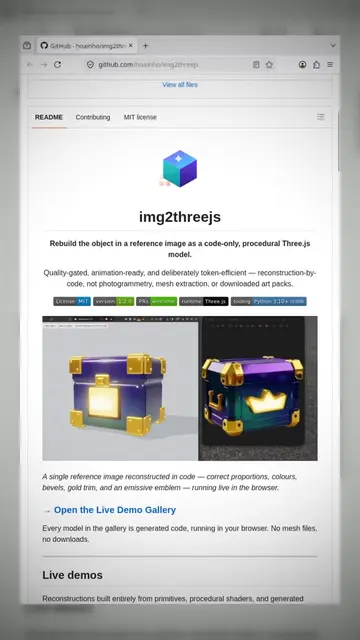
The video effectively demonstrates a novel and complex process (image to 3D model generation) with clear visuals and concise explanations. It highlights the unique selling proposition of using AI and code instead of traditional methods, appealing to developers and 3D artists looking for efficient workflows.
Summary
This video showcases the Three.js Object Sculptor, a tool that transforms flat images into interactive, animation-ready 3D models using procedural code. It highlights how the tool analyzes images, plans structure, and generates code for 3D assets, offering an alternative to traditional mesh files and photogrammetry.
Structure
1Introduction to Three.js Object Sculptor
2Explanation of its capabilities and workflow
3Demonstration with Tower Ship and Ancient Autumn Tree examples
4
Original caption
Three.js Object Sculptor You can now transform flat images into interactive, animation-ready 3D models using pure code. Instead of relying on heavy mesh files or photogrammetry, the three.js-object-sculptor-codex-plugin uses a brilliant AI-guided workflow to analyze an image, plan the structure, and write a procedural Three.js factory in TypeScript. It blocks out the shapes, layers realistic physical materials, and sets up real pivots and joints so the object is ready for physics and motion. It even compares browser screenshots against the original image to auto-correct itself, giving web developers lightweight, highly customizable 3D assets directly from a reference photo. Open source: vinhhien112/three.js-object-sculptor-codex-plugin Follow for more open source project drops. #Coding #TechTok #ClaudeCode
More from @github.signals
More breakout videos from this creator.
Overview of 'At a Glance' features
5Detailed 'What It Does' section
6Exploration of 'Use Cases'
7Explanation of 'Why This Exists'
Product placement
The video demonstrates the "Three.js Object Sculptor" tool, showing its interface and output. The tool is presented as a plugin for rebuilding 3D objects from images using code.
On-screen text
Three.js Object Sculptor
YOU CAN NOW
TRANSFORM FLAT
IMAGES INTO
INTERACTIVE
ANIMATION-READY
3D MODELS
USING PURE CODE
INSTEAD OF RELYING
ON HEAVY MESH FILES
OR PHOTOGRAMMETRY
THE 3JS OBJECT
SCULPTOR CODEX
USES A BRILLIANT AI
GUIDED WORKFLOW
TO ANALYZE AN
IMAGE, PLAN THE
STRUCTURE, AND
WRITE A PROCEDURAL
3JS FACTORY IN
TYPESCRIPT.
IT BLOCKS OUT THE SHAPES,
LAYERS REALISTIC
PHYSICAL MATERIALS,
AND SETS UP REAL
PIVOTS AND JOINTS
SO THE OBJECT IS
READY FOR PHYSICS
AND MOTION.
BROWSER SCREENSHOTS
AGAINST THE
ORIGINAL IMAGE TO
AUTO CORRECT ITSELF
GIVING WEB
DEVELOPERS LIGHTWEIGHT
HIGHLY CUSTOMIZABLE
3D ASSETS DIRECTLY
FROM A REFERENCE
Transcript
Three.js Object Sculptor
Turn the object in an attached image into a quality-gated, animation-ready procedural Three.js model built entirely with code.
Three.js Object Sculptor is a Codex plugin for rebuilding the visible object in a user-provided attachment image as a code-only Three.js model. It does not try to do photogrammetry, download an art pack, or extract a perfect mesh from one image. Instead, it guides Codex through a sculpting workflow: validate the image, describe the object precisely, decompose it into geometry and material systems, build from blockout to detail, wire an animation-friendly hierarchy, then compare the browser render against the original reference.
Demo
Tower Ship
Open the live tower ship demo
Ancient Autumn Tree
Open the live ancient autumn tree demo
At A Glance
• Name: Three.js Object Sculptor
• Category: Codex plugin for image-to-procedural 3D workflows
• Input: an attached object image, reference screenshot, or local image path
• Output: a code-only procedural Three.js object factory, backed by an objectsculptspec
• Primary goal: recreate the target object's silhouette, component structure, materials, lighting response, and action-ready hierarchy in browser-friendly Three.js code
• Best for: animation-ready real-time props, game objects, scene dressing, destructible objects, product-style objects, botanical objects, mechanical parts, and stylized reference reconstructions
• Not for: photogrammetry, exact mesh extraction, scanned assets, downloaded art packs, or guaranteed production-perfect geometry from one image
What It Does
• Validates whether an image is suitable for procedural 3D reconstruction.
• Creates a pre-spec complexity assessment before code generation.
• Writes an objectsculptspec with component hierarchy, materials, lighting, pivots, sockets, animation anchors, destruction anchors, and quality targets.
• Enforces a staged build pipeline: blockout, structural pass, form refinement, material pass, surface pass, lighting pass, interaction pass, and optimization.
• Generates a code-only Three.js factory skeleton from the current unlocked sculpt pass.
• Designs the generated object as an action-ready hierarchy, so later animation, transformation, physics, or destruction requests have real pivots and attachment points to use.
• Packages reference/render screenshots into one comparison sheet for AI vision review.
• Records self-correction reviews with overall, layer, and critical feature scores.
• Supports reference-derived procedural PBR evidence: albedo, roughness estimate, height, normal, and AO maps.
Use Cases
• Convert an attached object image into a procedural Three.js model generated entirely with TypeScript and geometry code.
• Build animation-ready Three.js props with meaningful pivots, sockets, parent-child hierarchy, and transform anchors.
• Recreate reference objects as browser-friendly procedural assets without relying on downloaded meshes or external art packs.
• Generate a structured object spec before implementation, so Codex understands geometry, materials, lighting, local surface features, and interaction readiness.
• Create destructible or transformable objects by planning detachable parts, fracture seams, colliders, and effect emitters before the model is coded.
• Compare the rendered model against the original attachment with AI vision and block progress when critical features do not match.
• Produce reusable procedural object factories for Three.js games, WebGPU demos, interactive prototypes, and visual experiments.
Why This Exists
Procedural 3D generation can fail in a very specific way: the silhouette is "kind of right", but the object loses the details that make it recognizable. This plugin is designed to slow Codex down at the right moments:
• First understand what object class and complexity tier it is dealing with.
• Define what "good enough" means for this specific object.
• Build from coarse structure to fine surface response.
• Fail a pass if an identity-defining feature is wrong, even when the overall score looks acceptable.
The result is less "one-shot generated mesh" and more "Codex as a procedural sculptor with checkpoints": block out the form, attach the moving parts, layer the materials, then keep refining until the model reads like the object in the attachment.