Loading video…
All breakouts
3.6Talking HeadProblem Callout hookB2B
Hook
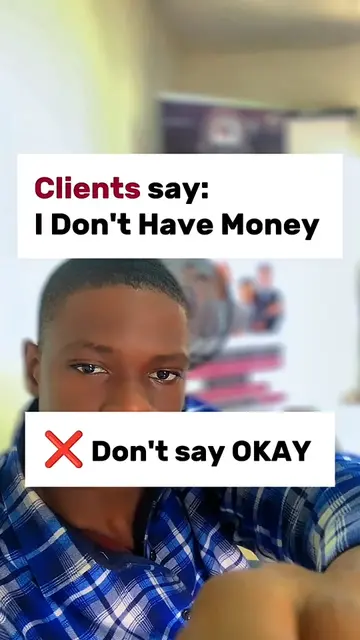
Client says: I don't have money
@c.e.o_eddy
47.3K followers · usually 3.3K views a post
Views
18.1K
Likes
543
Comments
16
Shares
58
Why it worked
The video taps into a common pain point for freelancers and business owners, offering a concise and actionable tip that encourages engagement by directing viewers to the caption for more detailed advice.
Summary
The video presents a common client objection: "I don't have money." It advises against simply accepting this statement or arguing, suggesting instead that the client's true concern might not be the money itself. The video prompts the viewer to read the caption for further advice.
Structure
- 1Client states "I don't have money."
- 2Advice: Don't say okay, don't argue.
- 3Instruction: Read the caption for what to do.
- 4Hint: The statement "I don't have money" is often not the real problem.
On-screen text
Client says:
I don't have money
Don't say okay
Don't argue with them
Here's what to do
Read Caption
Original caption
Client says “I don’t have money.” Don’t say… “Okay.” Don’t argue. You will lose that deal. Here’s what to do. Here’s the twist 👇 When a client says, “I don’t have money,” many business owners believe the conversation is over. But most of the time, that sentence is not the real problem. People rarely make decisions based on money alone. The brain first asks, “Is this worth it?” before it worries about the price. Think about it. Someone may say they cannot afford a service today, then spend even more money on something else tomorrow. Why? Because their brain believed the second thing was more important. This is why you should never argue or immediately accept the answer. Instead, stay curious and help them explain what they mean. A simple example. Imagine a child says, “I’m not hungry.” Five minutes later, that same child is happily eating ice cream. The problem was not food. The child simply did not want that particular meal. Our brains work in a similar way. Sometimes “I don’t have money” really means something else. What they really mean 1. “I’m not sure this is worth the money.” 2. “I like it, but this is not the right time.” 3. “I still have questions before I feel comfortable making a decision.” What you should do instead 👇 Do not try to prove them wrong. Create a safe conversation where they can explain the real issue. You can reply: “I understand. Can I ask, is it mainly about your budget right now, or are there other concerns I can help clarify?” Why this works 👇 This removes pressure. The brain feels safer when it is not being forced to defend itself. People become more honest when they feel understood instead of challenged. That gives you the real reason behind the hesitation. Another stronger version 👇 “I completely understand. Many people say money first, but sometimes another concern is holding them back. If the budget was not an issue today, is there anything else that would stop you from moving forward?” Why this works ✅ 1. It shows respect instead of pressure. 2. It helps uncover the real objection instead of guessing. 3. It builds trust because you are listening before responding. 4. It gives the client confidence to speak honestly without feeling judged. The real game you’re playing 👇 Your job is not to argue about money. Your job is to understand what the client’s brain is protecting. People protect their money when they are uncertain. When you reduce uncertainty with clear answers and honest conversations, better decisions become easier. The best business conversations begin with curiosity, not assumptions. If this helped you, comment “Script” and I’ll send you more client response ideas like this. #BusinessTips #SalesPsychology #ClientCommunication #Entrepreneur #freelancing
More from @c.e.o_eddy
More breakout videos from this creator.