Loading video…
All breakouts
10.9App DemoHow-To hookEducation
Hook
how to ace any exam in med school
@ey.okorie
2.2K followers · usually 2.1K views a post
Views
22.3K
Likes
2.6K
Comments
43
Shares
183
Promoted product
NotebookLMhttps://notebooklm.google/ ↗
Summary
The creator demonstrates how to use NotebookLM, an AI tool, to create a comprehensive study guide for medical school exams. The process involves uploading relevant documents and prompting the AI to generate a detailed, organized, and visually appealing study guide with mnemonics and charts.
Transcript
I'm going to show you how to ace any exam you take in med school.nStart off by opening up Claude and then gathering all your resources. This includes lecture slides, text look readings, practice problems, and anything else that you've learned or used for learning like osmosis notes. Very clearly prompt Claude to create a high-level NBME-style study guide for Back Anatomy using information from these PowerPoints and case studies. I would like the study guide to include mnemonics and charts whenever useful for comparison of similar pathologies. The study guide must be accurate, organized, detailed, and visual. DO NOT USE ANY OUTSIDE SOURCES OF INFORMATION! ONLY UTILIZE THE PROVIDED SOURCES. I also would like some color coding if possible. Focus on the following topics: Quiz - Thoraxn1. Neck Stabbing Scenario / Thorax Area / Lung Apexn2. Diaphragm / Phrenic Nerven3. Heart Supply / Coronary Artery, Heart Supplies itself, then rest of bodyn4. Removal if Internal Thoracic Artery / Using this artery for a bypass / Anastomosesn5. Stethoscope if over right 5th intercostal space / which lobe / auscultationn6. Pt with chest pain worsening with deep inspiration, suspected for pleuritis / which nerve explains pt symptoms/ phrenic nerven7. Innervation of lateral and medial brachial plexus (muscle) - pectoralis majorn8. SA node blood supply / lack of blood supply / which arteryn9. Thoracentesis / Intercostal nerve blocks / what nerve are you trying to blockn10. Middle posterior axillary line / what artery is posteriornKey Question Types: Those pertaining to # of intercostal space, questions pertaining to the rib # or intercostal nerve / artery #, midclavicular line, medial/lateral to sternal.nI can also leave the prompt with the description. This study guide provides a comprehensive overview of thoracic anatomy, integrating clinical insights from medical textbooks and lecture materials to prepare students for standard medical examinations. The text details the structural organization of the chest, focusing on critical surface landmarks, the classification of ribs, and the distinct layers of the pleura. It emphasizes the neurovascular systems of the heart and thoracic wall, specifically highlighting the arterial supply to the myocardium and the functional innervation of the diaphragm. Furthermore, the source offers practical clinical correlations, such as the proper placement for needle procedures like thoracentesis and the auscultation of heart valves. To assist with high-yield retention, the material utilizes mnemonics and rapid-review tables that connect anatomical facts to common diagnostic scenarios. This synthesis serves as a targeted resource for mastering the complex relationships between internal organs and the musculoskeletal frame of the thorax.nHow do clinical landmarks help identify underlying thoracic structures?nWhat are the common clinical consequences of chronic nerve disease?nI need you to prep me for my quiz using this study guide and the associated quiz questions. Please generate an audio overview. These are the quiz topics.nThis audio overview is going to be your holy grail as you can listen to it when you're driving, when you're in the shower, and really when you're doing whatever task to help you learn passively and actively.nThose are pretty much all the steps. If you have any questions, please let me know but yeah, happy studying.
Original caption
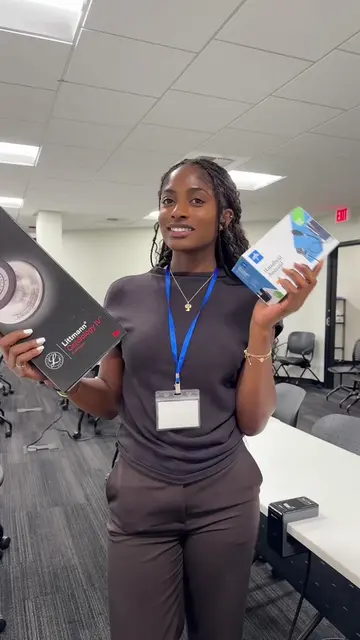
These are personally some of my favorite study tools which help me to save so much time and study effectively!! #medschool #StudyTips #step1 #notebooklm #claudeai @Claude @Google @googlegemini
More from @ey.okorie
More breakout videos from this creator.