Loading video…
All breakouts
3.9Text-HeavyListicle hookAI Tools
Hook
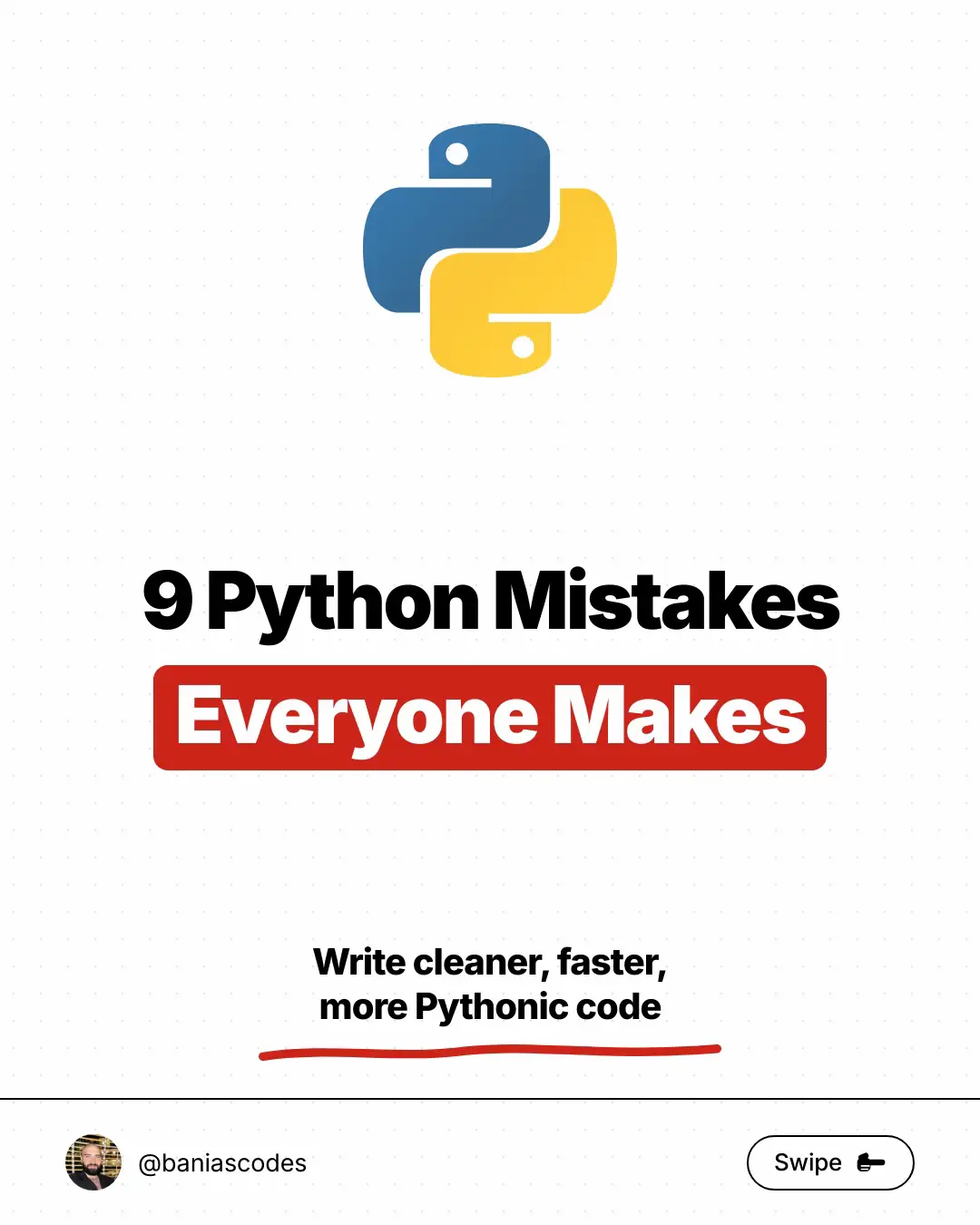
9 Python Mistakes Everyone Makes
@baniascodes
3.3K followers · usually 1.2K views a post
Views
4.8K
Likes
135
Comments
1
Shares
9
Why it worked
The content addresses common pain points for a large audience of developers, providing clear, actionable solutions in a concise, easy-to-digest format. The "mistake/do this/why" structure is highly effective for educational content.
Summary
This slideshow highlights nine common mistakes made by Python developers, offering corrected code examples and explanations for each. It aims to help viewers write cleaner, faster, and more Pythonic code.
Structure
- 1Introduction of the topic: 9 Python mistakes
- 2Mistake 1: Mutable Default Args
- 3Mistake 2: Bare except: Clauses
- 4Mistake 3: Checking == None
- 5Mistake 4: Skipping with Statements
- 6Mistake 5: String += In Loops
- 7Mistake 6: The range(len()) Habit
- 8Mistake 7: Wildcard import *
- 9Mistake 8: Not Using f-strings
Original caption
9 Python mistakes 99% of developers make. Python is an easy language to pick up, but there are differences to „just knowing Python“ and „writing production-grade Pythonic code“. [python, ai engineering, software development, software engineering, coding, data science, data analysis] #ai #coding #python #softwareengineering
More from @baniascodes
More breakout videos from this creator.