Some people never raised their voice.
Never say a harsh word.
Never try to stand out.
And yet, walking into a room.
They make everyone straighten up a little.
If you've ever wondered why people go quiet around you, why conversations feel more careful when you show up, or why someone pulled for reasons you never understood.
Stay with me, because by the end of this video, you might finally understand something about yourself that no one has ever explained to you clearly.
Most people think intimidation is being loud, cold, or aggressive, but psychologically, that's rarely true.
Intimidation is usually not about what you do.
It's about what you represent to someone else.
And the strange part is, the very qualities that make you intimidating are the ones you'd never think to hide, because they don't feel like power to you.
They just feel like you.
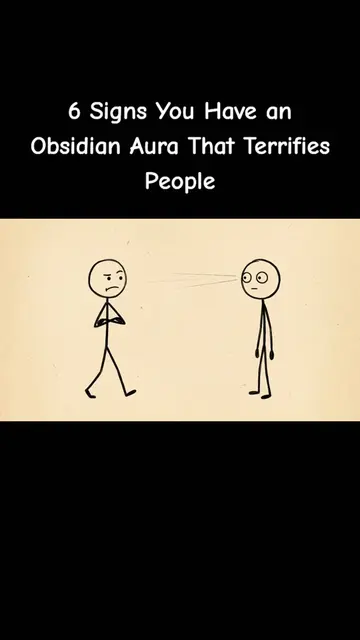
Today, we're going to walk through seven signs that you might intimidate people without ever meaning to.
Some of these will feel obvious once we say them out loud.
Others will surprise you.
But save the last one, because it's the sign almost nobody recognizes in themselves.
The one that quietly pushes people away while you remain completely unaware it's even happening.
If psychology like this interests you, consider subscribing.
This channel is built for people who want to understand themselves a little better every week.
Now let's start with the first sign.
Sign One:
You don't feel silence.
Picture this.
You're in a group conversation and there is a pause.
Everyone shifts, someone laughs nervously.
Someone else jumps in just to say something.
But you just sit there, unbothered.
That comfort is rare and people notice it more than you think.
Most people experience silence as social pressure, that needs to be closed immediately.
Psychologists have long studied how uncomfortable with unstructured social moments, because silence forces us to sit with uncertainty, a subtle kind of anxiety.
When you don't fill that gap, you're not being cold.
You're simply not run by that anxiety the way others are.
But here's the twist.
To someone who is run by it, your calm can look like judgment.
It can look like evaluating them, not because you are, your stillness makes them in their own discomfort.
You're not doing it to them.
You're just not doing what they expected.
And that gap between expectation and reality is where intimidation quietly begins.
That's only the surface, though, because silence isn't the only place it can be misread.
Sign Two:
Your eye contact doesn't waver.
You've probably noticed this in certain people.
Some hold eye contact easily, others glance away, blink more.
Look at their hands.
If you're someone whose eyes stay steady, even during tension, even during disagreement, that steadiness is doing more social work than you realize.
In the animal kingdom, sustained eye contact is often a signal of confidence or dominance.
We are not so different.
Amy Cuddy's research into nonverbal signals showed how small, often unconscious signals, posture, gaze, stillness, shape how much power we unconsciously assign to us, often before a single word is spoken.
You might not be trying to dominate anything, you're just present.
But someone whose nervous system is wired for hierarchy, whether they realize it or not, may read your gaze as a challenge, rather than a connection.
They fill in the meaning you never intended.
Here's where it gets interesting, though, because it's not really about your eyes at all.
It's about what happens next and how you carry the rest of yourself.
Sign Three:
You take up space without trying to.
Some people shrink, arms lower their shoulders, make themselves smaller, and rooms that feel uncertain.
And then there are people who simply exist at full size, not performing confidence, just occupying their own body without apology.
Carl Jung talked about the persona, the mask we build to navigate the world safely.
Many people build a smaller, softer persona, specifically to avoid provoking reactions.
If you never learned to build that smaller mask, if your natural state is simply upright and unguarded, you may look like you're taking up more space than everyone else in the room.
You're standing perfectly still.
Think of confidence like sunlight.
Most people enjoy standing in it, but someone who has learned to protect themselves by staying small, may feel strangely exposed, standing next to something that bright, even if you never asked them to.
You didn't do anything wrong.
You just didn't shrink.
And for some people, that alone is unsettling.
But so far, we've only talked about your body.
The next sign lives somewhere deeper in how you speak.
Sign Four:
You say less and mean more.
They're the ones whose words seem to carry more weight, even when they're saying very little.
This connects to something psychologists call information scarcity.
When something is rare, we instinctively assign it more value.
If you speak less often, but with intention, people start listening more closely, almost involuntarily.
Every sentence feels loaded because there are fewer of them.
You're probably not doing this strategically.
You just don't feel the need to narrate every thought out loud.
But as someone who processes the world through constant verbal reassurance, your quiet can feel like withholding, like you're holding something back that they're not allowed to see.
It's not a wall.
It's just restraint.
But restraint to an anxious mind often reads as distance.
And distance is exactly what the next sign is built on.
Sign Five:
You don't feel the need to narrate every thought out loud.
Sign Five:
You say less and mean more.
They're the ones whose words seem to carry more weight, even when they're saying very little.
This connects to something psychologists call information scarcity.
When something is rare, we instinctively assign it more value.
If you speak less often, but with intention, people start listening more closely, almost involuntarily.
Every sentence feels loaded because there are fewer of them.
You're probably not doing this strategically.
You just don't feel the need to narrate every thought out loud.
But as someone who processes the world through constant verbal reassurance, your quiet can feel like withholding, like you're holding something back that they're not allowed to see.
It's not a wall.
It's just restraint.
But restraint to an anxious mind often reads as distance.
And distance is exactly what the next sign is built on.