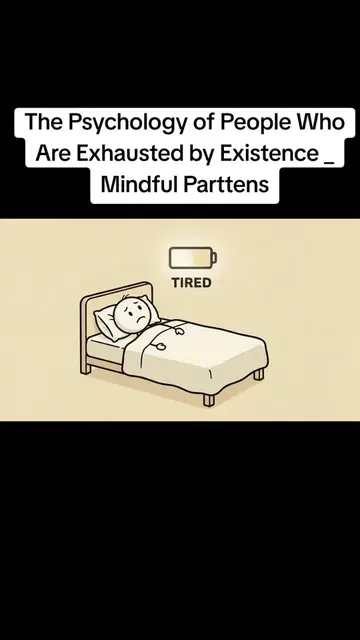
Have you ever wondered why you suddenly stop having the energy for your friends... even when they haven't actually done anything wrong? Psychology explains why you can genuinely care about people while feeling emotionally exhausted by friendships, conversations, and socializing. Sometimes it's not that you stopped caring. You may simply have nothing left to give. If you've been quietly pulling away from people lately, this might explain why. Here's the strange part: you probably haven't stopped caring about these people. You may have stopped having the emotional capacity to keep showing up for them. And there's an actual psychological reason that happens. It has nothing to do with how much you love your friends. You might assume you're antisocial, or that you're a bad friend, or that something is wrong with you. But before you land on any of that, it's worth asking a different question. Why does one simple text, "Hey, are you free this weekend?" sometimes feel like a full task? Not a hard task, not a scary one, just heavy. Here's what's actually happening in that moment. You get home after a day where you've already answered 100 small questions, solved problems, made decisions, dealt with people who needed something from you. Then your friend's message shows up, and your brain doesn't read it as "a friend cares about me." It reads it as one more decision. Am I free? Do I want to go? If I say no, will they think I'm avoiding them? If I say yes, will I regret it Saturday morning? Should I explain why I've been distant? One message, five decisions. And your brain was running on empty before it arrived. Psychologists sometimes call this cognitive load. Basically, the amount of mental effort your brain is already juggling at any given moment. It's not infinite. And when work, money, unfinished tasks, and background stress are already taking up most of that space, even something good, like a friend reaching out, has to compete for room that doesn't exist. That's layer one. But it's not the whole story. Because here's a question that probably feels familiar: Why do you sometimes feel relief when a friend cancels plans you were looking forward to? That reaction confuses people. If you love someone, shouldn't you want to see them? This is where it helps to stop thinking of emotional connection as something that's either "on" or "off" and start thinking of it like a phone battery. You can love someone deeply and still be sitting at 3%. Love doesn't recharge the battery. Rest does. And if you've spent the day giving your attention to responsibilities, to everyone else's needs, there might genuinely be nothing left to give. Not because the love ran out, but because the capacity did. That's the part almost nobody explains to you growing up. That caring about someone and having the energy to show up for them are two separate systems. You still care. You're just tired. And those are very different things. So if it's just tiredness, why does it feel so specific to relationships? Why does it seem to hit hardest with the people you're closest to? This is where it gets a little more uncomfortable to look at. If you're someone who tends to be available, the one who always shows up, always replies first, always checks in first, there's a good chance you have quietly turned your friendships into a kind of unpaid job. Psychologists sometimes call this emotional labor: the ongoing effort of managing not just your own feelings, but everyone else's to keep a relationship comfortable. It doesn't feel like labor while you're doing it. It feels like being a good friend. But labor is still labor, wrapped in affection. And like any job with no time off, it eventually produces the same result: burnout. Not because the relationship was bad, but because it never had a break built into it. If you also tend to be a people-pleaser, someone who feels a flash of guilt saying no, who apologizes for setting boundaries, who worries about disappointing people? This hits even harder. Because now, every hangout, every reply, every "catch up soon" doesn't feel like an option. It feels like an obligation. You're not allowed to decline. And a friendship that once felt effortless can quietly turn into something that feels like it requires constant maintenance, the other person feeling hurt. That's layer two. Here's where it gets interesting, though. Because this isn't just about being tired or overextended. There's something underneath that. Edward Deci and Richard Ryan, decades studying what actually drives human motivation, had this central finding: people have a deep need for autonomy. A need to feel like their choices are actually their own. When you feel like you have to reply, have to show up, have to say yes to keep someone from being upset, something in you starts to resist. Not because you don't want the relationship, but because you don't want it to feel like it's not a choice anymore. That resistance has a name too: psychological reactance. The discomfort, even the low-grade defiance, we feel when we sense our freedom being taken away, even by something as a "hangout invite." So the distance you're creating, it might not be at all about your friend. It might be your mind trying to protect the one thing it feels is slipping: your ability to choose. If you've made it this far, and any of this sounds familiar, you're probably not broken. Definitely not alone. A lot of people carry this exact pattern without ever having language for it. Stick with me, because the next part actually starts to make sense. So here's the layer most people never get to. Withdrawal isn't always rejection. Sometimes it's your nervous system asking for recovery. Physically, for a second, think about it. If your body is exhausted, it doesn't ask your permission before it slows you down. It just does it. Heavier eyelids, slower thinking, less patience. Your emotional system works the same way. When it's overloaded, it starts limiting input, whether you consciously decide to or not. That's not a character flaw. That's regulation. That's your mind trying to keep you functional. The problem is friendships with a visible low battery warning. So when you go quiet, your friends don't see exhaustion. They see silence. And silence left unexplained tends to be interpreted as rejection. Even when it's the opposite. Which brings up the deepest layer of all this. The real issue usually isn't that you have too many friends, or that you don't care, or that something is fundamentally wrong with you. The real issue is often that you've been maintaining friendships in a way that requires you to constantly override your own needs to keep them going. Always available. Always want to seem difficult. Always saying yes a beat before you've actually checked in with yourself. That's not sustainable for anyone. Eventually, something has to give. And usually, it's not the caring that goes first. It's the capacity. Now, to be clear, something important: Occasionally losing your social energy is completely normal. Everyone needs stretches of quiet. Everyone needs distance sometimes to recharge. But if this withdrawal has been going on for a long time, or it's started affecting how you function day to day, that's worth paying closer attention to. Maybe even talking to someone about. Not because you're broken. Because you deserve support in caring, whatever this actually is. If you've ever gone through a period where you genuinely loved your friends, but simply didn't have the energy to show up for them, tell me about it in the comments. There's a decent chance someone reading it has been trying to put that exact feeling into words for a long time. So if you take one thing, let it be this: Losing the energy to maintain friendships doesn't mean you've become cold or selfish or incapable of love. It might just mean that actually needs repairing right now. It's the one between you and your own limits. You still care. You were just never given permission to rest. Maybe that's the permission this video just gave you. And if this kind of content resonates with you, you can stay connected by subscribing and turning on notifications so you don't miss future uploads. See you in the next one.