Loading video…
All breakouts
42.7Talking HeadHow-To hookAI Tools
Hook
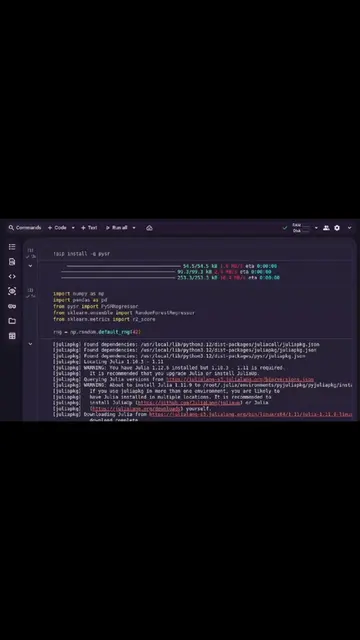
Code a Linear Regression Model with me from scratch in pytorch :3
@lachinemearning.com
31.8K followers · usually 13.0K views a post
Views
546.0K
Likes
55.7K
Comments
803
Shares
4.5K
Promoted product
Free ML/Data Science courselachinemearning.com/course.html ↗
Why it worked
The video provides a clear, step-by-step explanation of a fundamental machine learning concept (linear regression) using practical code examples. The creator's relatable persona and the focus on understanding the 'why' behind the code likely resonated with viewers interested in learning ML.
Summary
The creator explains how a linear regression model works by demonstrating code written in PyTorch. She details the roles of the slope (W) and intercept (B) in determining the line of best fit and how the model iteratively adjusts these parameters to minimize error. The video also contrasts building a model from scratch versus using PyTorch's built-in modules, highlighting the underlying mechanics of optimization.
Structure
- 1Introduction and goal: code linear regression from scratch
- 2Explanation of linear regression: supervised learning, slope (W), intercept (B)
- 3Training loop: guess line, calculate error, adjust W and B
- 4Comparison of W and B learning: W is more costly to get wrong
- 5Two methods of implementation: raw code vs. nn.module
Original caption
FREE MACHINE LEARNING/CODING COURSE IN MY BIO!! Linear regression is a supervised Machine Learning algorithm that predicts a continuous numerical output by finding the best-fit straight line between an input feature and a target value. It relies on key components like the best fit line, slope/weight, and intercept/bias. this video was a way to code it from scratch using a popular machine learning library called PyTorch #programming #computerscience #machinelearning #mathematics #engineering
More from @lachinemearning.com
More breakout videos from this creator.