Loading video…
Sound

original sound - agentic.james
agentic.james · Original audio
0:00–:––
Playing this video’s own audio, so you’ll hear the creator over the sound.
The video addresses a timely and relevant concern for users of AI models like Claude, explaining a complex technical process in an accessible way and offering potential solutions to a perceived problem, which drives engagement and sharing.
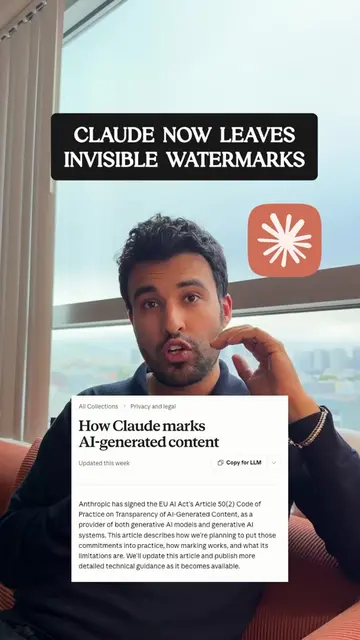
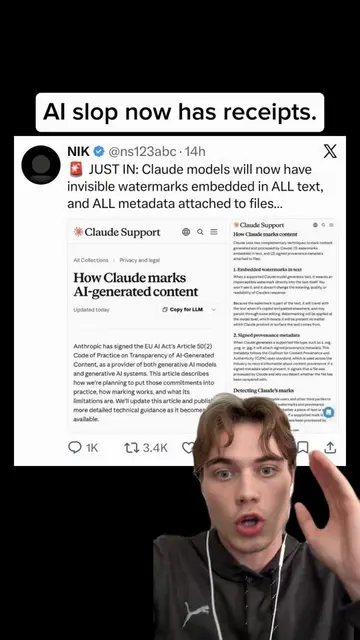
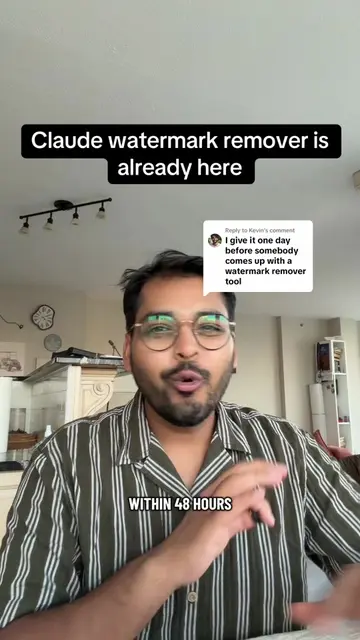
This video explains how Claude AI invisibly watermarks its text outputs by embedding information into the probability distribution of token prediction. While this method is designed to survive copy-pasting, the creator suggests that altering the text's words, structure, or punctuation might be a way to circumvent detection.
No more copy pasting essays…
ALL CLAUDE OUTPUTS ARE MARKED AS AI GENERAYED
Introduction to Claude's AI watermarking
Explanation of how the watermarking works (token prediction, probability distribution)
The KG W method and red/green buckets
How to potentially bypass the watermark
Uncertainty about the effectiveness of bypassing
Claude: an AI model that generates text. It is mentioned as having a new feature that invisibly watermarks its text outputs. This feature is applied at the model level. (ACTS) Anthropic: the company that developed Claude. (APPEARS) OpenAI: a company that develops AI models. Mentioned as having signed an agreement with Anthropic. (APPEARS) Mistral: an AI model. Mentioned as having signed an agreement with Anthropic. (APPEARS) EU: European Union. Mentioned as having regulations that Anthropic is complying with. (APPEARS)
Playing this video’s own audio, so you’ll hear the creator over the sound.
AI assistant for people solving work and creative tasks
Views and creators: posted in the last 30 days (English videos). Videos: all time.
Promotes 7 products. Create free account to see more.
Outliers and viral hits: their videos on Overshot, all time.