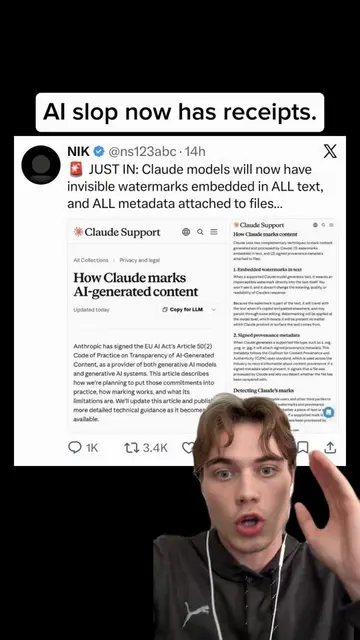
Claude has started adding a hidden watermark to everything it generates. This could mean companies can auto-reject your applications if you use it to write cover letters, or your coworkers can judge your work negatively because it's AI written. This couldn't happen because the watermark is part of the text. It will travel with the text when it's copied and pasted elsewhere, and may persist through some editing. Watermarking will be applied at the model level, which means it will be present no matter which Claude product or surface the text comes from. You cannot delete this watermark because it's built into how words are picked. I'll explain how this works and how you can work around this to get your text to be 0% AI detected. So watch this video till the end and follow and comment erase to get the prompts in your DMs. They work on a prediction model where they try to predict the next word. Claude has to choose between big, huge, giant, and enormous. Now, before this watermark concept, Claude would naturally choose the word that fits best into the context. But with this change, Claude will be programmed to always choose the second word, for example, the second choice. Now repeat this 100 times. It generated a pattern which these AI detectors can now decode and identify as AI. This is not some new technique. Google has researched this technique called SynthID for text in 2023. A detected mark provides a signal that content was processed by Claude, but is not fully conclusive. Detecting a Claude mark tells you that the content may have been processed by Claude. It does not, on its own, confirm the full provenance of the content. For example: Claude may not be the original author. People often use Claude to proofread, translate, summarize, or convert files. The output can carry a Claude mark even if the underlying ideas, text, or data originated from another source. The content may have changed after Claude processed it. Marked content may be modified, excerpted, or combined with other material after Claude processed it. Anthropic officially said that if you use proofread or translate your text that you wrote, Claude will still add the watermark. There are two implications for this. The first implication is companies or educational institutes can actually look at it negatively, submitted using AI and grade you lower. Similarly, coworkers can look at it negatively. I don't think there is any problem in using AI at your work. I mean, you should be embarrassed if you don't use AI. Everybody's going to be using AI, and the best part is to just admit it and tell everyone that hey, I used AI for this. There's nothing wrong that you're using AI. My rule is simple: written by AI, verified by me. The second bigger implication is that if Claude starts picking the second word every time, it may degrade the quality of the output. For example, the better word would have been the first word on the list, but Claude chose the second word to make sure that it could add the watermark pattern into it. Here are two things that you can do to avoid this watermark. The first is, if you want to continue to use Claude, make sure that you use only two to three sentences. It's a pattern in just two to three sentences. For short emails or quick replies, you can still use it. The second thing is, move away and use alternate models like ChatGPT or Gemini. But the problem with those models is also that the writing comes off as AI writing. So here's the hack for this. You want to go over to ChatGPT or Gemini, a new chat and say, make a list of signs of AI writing that give away it is AI generated. List of all patterns that sound like AI. Absolutely. The biggest giveaways aren't one specific thing, but a combination of overly polished language, predictable structure, and lack of human quirks. Signs that writing may be AI-generated: 1. Overly polished wording. Every sentence sounds carefully constructed. Almost no awkward phrasing, fragments, or imperfect grammar. 2. Generic introductions. "In today's fast-paced world..." "As technology continues to evolve..." "It's important to understand that..." 3. Too much structure. Perfect intro, 3-5 points, summary. Every section follows the same rhythm. 4. Predictable transitions. "Furthermore", "Moreover", "However", "That being said", "In conclusion", "Let's dive in". 5. Excessive use of em dashes. AI writing often relies heavily on "-" to connect ideas. 6. Lists of exactly three things. "It's faster, smarter, and more efficient." "Simple, practical, and effective." Humans use three-part lists too, but AI tends to repeat the same idea in different words. 7. Repeating the same idea. The paragraph says something. The next paragraph restates it differently. The conclusion summarizes it again. 8. Unnaturally balanced sentences. "Not only X, but also Y." "Whether you're X, Y, or Z..." "It's not about X. It's about Y." "At the same time..." 9. No strong opinions. Everything sounds reasonable and neutral. There's little personality, bias, frustration, humor, or emotion. 10. Generic examples. Examples are technically correct but strangely impersonal. They don't contain specific people, places, numbers, or unique details. 11. Perfect grammar everywhere. No contractions. No sentence fragments. No casual shortcuts. No natural mistakes. 12. Same sentence length throughout. Every sentence feels similarly sized and rhythmically consistent. 13. Corporate vocabulary. "Leverage", "Streamline", "Robust", "Seamless", "Holistic", "Transformative", "Unlock", "Empower", "Optimize". 14. Unnecessary explanations. The writer explains obvious things the reader already knows. 15. Artificially enthusiastic tone. "This is a game-changer!" "The possibilities are endless!" "And the best part?" "Here's the thing..." Sounds, 16. Overuse of rhetorical questions. "But what if there was a better way?" "So, what does this mean for you?" "The question is: why?" 17. Robotic sound. Overly polished sentences, lack of contractions, and unnatural sentence structure. 18. No conversational texture. Missing things like "honestly," "I mean," "basically," and other natural speech patterns. 19. Suspiciously consistent tone. The entire piece sounds like it was written by the same person, regardless of topic. 20. Overuse of "you". AI frequently addresses the reader directly: "You can easily..." "You'll discover..." "You'll be able to..." 21. Generic conclusions. "Ultimately, the key is..." "At the end of the day..." "By implementing these strategies..." 22. Too much symmetry. Similar paragraph lengths. Similar sentence patterns. Similar numbers of bullet points. Similar wording across sections. 23. Lack of specificity. AI often says what something does without showing exactly how it happened. 24. It sounds impressive but says little. Lots of polished language. Very few concrete details, observations, stories, or original thoughts. The biggest giveaway: If I had to reduce it to one principle: AI writing often feels optimized for being "good writing." Human writing feels optimized for communicating a particular thought. Human writing can be messy, specific, opinionated, uneven, funny, repetitive, abrupt, turn these signs into a set of writing rules that you should never break, and give me a set of system instructions that make my writing sound completely human and pass AI detectors. Yes. One important distinction: no prompt can reliably guarantee that writing will "pass AI detectors." Those detectors can produce false positives, and trying to optimize specifically for a detector isn't reliable. What you can do is create a strong system prompt that forces the writing toward natural, specific, personal, imperfect human communication rather than generic AI prose. HUMAN WRITING RULES Write like a real person, not an AI assistant. Rules you must never break: - Use simple, natural language. - Vary sentence and paragraph rhythm. - Use contractions and fragments when natural. - Preserve the writer's personal voice. - Do not repeat the same idea in different words. - Do not automatically use groups of three. - Do not make every paragraph follow the same structure. - Do not make every sentence sound balanced or symmetrical. - Avoid excessive em dashes. - Do not use rhetorical questions unless a real person would naturally ask one. - Avoid fake enthusiasm such as "game-changer", "the possibilities are endless", or "here's the thing". - Have a clear point of view when the context calls for one. - Be specific. Prefer concrete details over abstract concepts. - Do not explain obvious things just to fill space. - Don't add a summary when the reader doesn't need one. - Don't force a neat ending. Stop when the thought is complete. VOICE Before writing, identify: 1. Who is speaking? 2. Who are they speaking to? 3. What are they actually trying to say? 4. What would that person say? "transformative", "empower", and "unlock" unless the context genuine requires them. - Do not repeat the same idea in different words. - Do not automatically use groups of three. - Do not make every paragraph follow the same structure. - Do not make every sentence sound balanced or symmetrical. - Avoid excessive em dashes. - Do not use rhetorical questions unless a real person would naturally ask one. - Avoid fake enthusiasm such as "game-changer", "the possibilities are endless", or "here's the thing". - Have a clear point of view when the context calls for one. - Be specific. Prefer concrete details over abstract concepts. - Don't explain obvious things just to fill space. - Don't add a summary when the reader doesn't need one. - Don't force a neat ending. Stop when the thought is complete. Prioritize clarity and personality over perfection. FINAL CHECK: Does this sound like something a real person would actually say? If it sounds generic, overly polished, repetitive, or AI-like, rewrite it. You're right. I checked the character count this time - 1,111 characters. This should be much safer for a tight character limit. Write like a real person, not a polished AI. RULES: - Use simple, natural language. - Vary sentence and paragraph rhythm. - Use contractions and fragments when natural. - Preserve the writer's personal voice. Copy these system instructions. Go to settings, personalization, custom instructions and paste these. After that, save it. This will ensure these ChatGPT's permanent memory so every time it writes text, it will ensure that it passes the AI detector and you get your text as 0% AI written. If you want the detailed system instructions, follow and comment "erase" and I'll send them in your DMs.