People say bananas don't have seeds.
So, back in March of last year,
I grabbed two green bananas and a couple of big green onions.
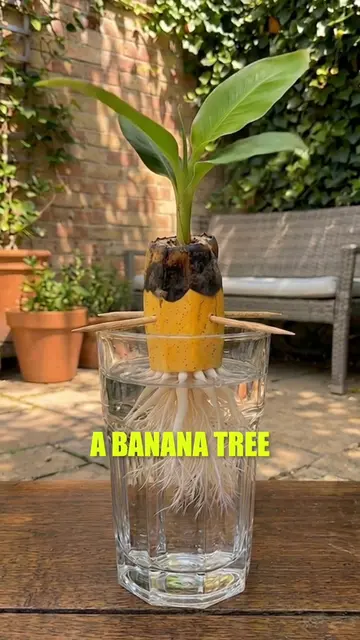
I wanted to try growing banana seedlings
from the cut stems.
First, I made vertical cuts on both ends of
the green onions,
exposing the inner tissue.
Next, I cut the banana stem about 4 centimeters below the fruit.
Just to be safe, I prepared two stems to
be extra sure.
Remember, the cut side of the stem must
touch the onion tissue.
This is mainly because onions are rich in
sulfur compounds,
which can later inhibit mold in the soil
and prevent common root rot in banana
seedlings.
Before the seedlings develop a strong
root system,
these extra steps are totally necessary.
Next, grab two breathable nursery pots.
For the sprouting medium, I mixed
coconut coir with sawdust.
Fill the pot about 60% full,
and gently place the stem inside.
Cover it with soil and water it thoroughly.
If you don't have coconut coir, fine river
sand works too.
Just make sure the medium absorbs
plenty of water.
A month later, I was completely blown
away.
Bright green banana sprouts had grown
right out of the buried stems!
Looking closer at those strong roots,
they were firmly gripping the soil.
The upright stem was already half the
thickness of a thumb.
Even the two unfurled leaves were full of
life.
I didn't expect a 100% survival rate this
time!
This tough vitality is truly mind-blowing.
At this point, the roots prove
that the seedlings can finally absorb
nutrients.
So, you can start using liquid fertilizer.
First, liquid fertilizer is way easier to
absorb.
Its mild and controllable concentration is
perfect
for those delicate little roots.
You can adjust the dilution based on how
the plant is growing.
But don't just throw fertilizer on blindly.
Let it grow for a while after feeding.
Checking back two months later, oh
man...
The fastest-growing plant already had five leaves!
The stem was even thicker than my thumb.
I don't know why, but why is this one so
much smaller?
To keep a close eye on their growth,
I just got a new phone to record it.
The crazy growth means it's time to repot.
Flip the pot upside down,
give it a gentle tap,
and the moment you pull out the root
ball...
the root system is insane!
Compared to the smaller one,
I'm more curious about this much bigger
plant.
The wrapped roots look like they're about
to burst open!
But let's not go overboard, leave some
soil to ensure it survives the transplant.
Put it straight into a bigger pot.
To make the plant more drought-
resistant,
use regular garden soil at the bottom.
Here's some leftover coconut coir mixed
with rice hulls.
Spread a thin layer of a few centimeters
on top.
This helps the roots grow downward
easily at first.
Next, plop the whole root ball right into
the big pot.
Fill the remaining gaps with more garden
soil.
Try not to damage the roots.
Gently press down the soil
so the roots make tight contact with the
dirt.
Once done, give it a deep watering.
This stabilizes the plant and quickly
triggers new root growth.
Fast forward 140 days later,
looking from the bottom up,
the base of the stem is almost as thick as
a calf!
And the leaves are super wide.
Thank God there are no weird spots on them.
What surprised me even more
is that the smaller plant from before is
now just as big!
Seeing those bananas growing so strong,
my confidence is through the roof.
Since bananas love potassium,
wood ash is a perfect natural potassium
fertilizer.
It helps develop the root system
and thickens the stem,
laying the groundwork for future fruiting.
Plus, damp wood ash can prevent
diseases.
Looks like eating homegrown bananas is
just around the corner!