Loading video…
All breakouts
2.5Text-HeavyOther hookEducation
Hook
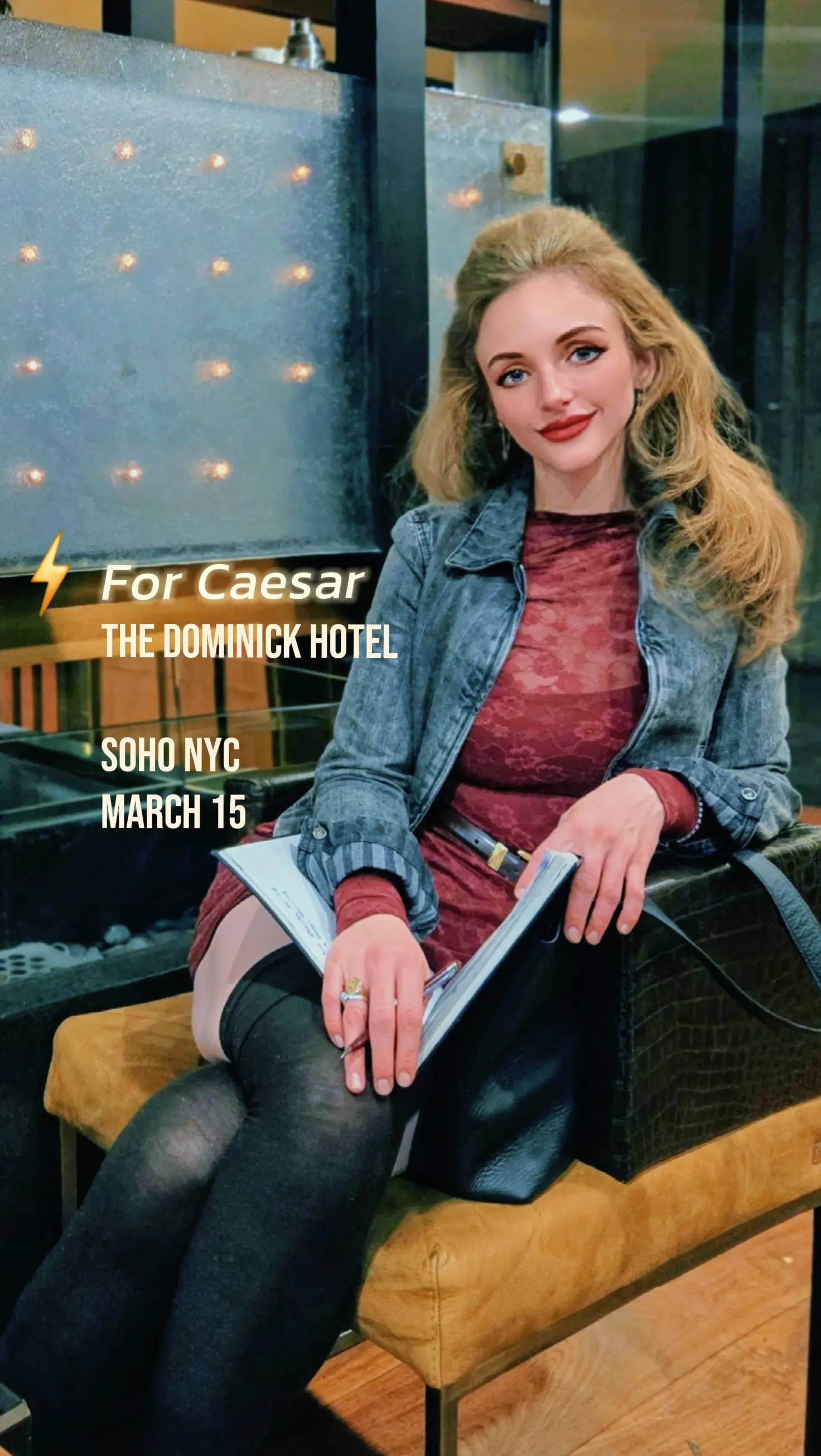
For Caesar THE DOMINICK HOTEL
@houseofreyn
21.1K followers · usually 87.9K views a post
Views
210.2K
Likes
6.6K
Comments
85
Shares
44
Why it worked
The post likely resonated due to its intellectual depth, combining historical analysis with personal experience and artistic appreciation. The curated visuals and text create an aspirational narrative around creativity and cultural exploration.
Summary
The creator shares a series of images and text related to their trip to New York City to write a character study on Julius Caesar and view The Unicorn Tapestries. The post details their stay at The Dominick hotel and their visit to the Met Cloisters, connecting these experiences to their broader work on systems of power and narrative.
Structure
- 1Introduction of the trip's purpose: Caesar study and Unicorn Tapestries.
- 2Details of the stay at The Dominick hotel in Soho, NYC.
- 3Visit to the Met Cloisters to see 'The Unicorn in Captivity'.
- 4Connection to the creator's brand, House of Reyn, and their ongoing work.
- 5Presentation of the character study title and subtitle.
Product placement
The Dominick Hotel: it APPEARS as the location of the creator's stay. Removing it would not change what happens in the video.
House of Reyn: it APPEARS as the creator's brand, mentioned in the caption and implied by the creator's handle and bio. Removing it would not change what happens in the video.
The Unicorn Tapestries: it APPEARS as a work of art the creator visited. Removing it would not change what happens in the video.
Met Cloisters: it APPEARS as the location where the creator viewed The Unicorn Tapestries. Removing it would not change what happens in the video.
Julius Caesar: the Builder-Leader: it APPEARS as the title of the creator's character study. Removing it would not change what happens in the video.
Original caption
On the Ides of March, I went to New York specifically to write my character study of Julius Caesar & see The Unicorn Tapestries. I booked a corner suite at The Dominick for the occasion, & also visited the Met Cloisters to see The Unicorn in Captivity. A favorite of mine for years, the Unicorn now wanders its way into House of Reyn & appears during most of our Lives. This = from the larger essay which began there: Julius Caesar | Builder-Leader | Conditional Authority. THE RUBICON The climax of societies is designed, assigned, and prescribed in time and space’s strange, sloping valleys, that liminal vortex in which humanity constructs its collective memory. Lying in anticipatory repose within these shadowed regions are the narratives that define the rise and fall of civilizations. Here, in the sprawling, opulent, and often bloody fields of conquest and recapture, it is Ancient Rome that remembers the Ides of March. Many prefer to funnel the actual facts of history into tidy, simple dramas. This can be easier than acknowledging the layered complexities that explain the motives and actions of men as complex as Gaius Julius Caesar. Few others have managed to disrupt the Western world’s status quo within a single lifetime as profoundly as Caesar did in his own. Was he a tyrant? A true populist? The world’s first great propagandist and autobiographer? Can one man truly occupy so many roles at once, and remain legible to the system that produced him? The Republic did not die in the Senate chamber alone when Caesar fell beneath the blades of men he once trusted in 44 BCE. Its integrity died years earlier, its decay revealed by an act of stunning defiance on the quiet banks of a shallow Roman river. In January of 49 BCE, Caesar led the Thirteenth Legion across the Rubicon, the legal boundary separating his provincial command from Rome. Roman law forbade any general from entering Italy with an army. To cross under arms constituted open rebellion against the Republic. But Caesar crossed anyway. A BOUNDARY THE REPUBLIC COULD NOT DEFEND So famous that it risks sounding theatrical to modern ears, Caesar’s decision violated a constitutional boundary so blatantly that no negotiation or quiet repair could reverse it. It forced Rome to confront a harsh reality: the Republic no longer possessed the capacity to manage the scale of power created by its own expansion. In Conditional Authority, the Rubicon marks Caesar’s most archetypal Builder-Leader moment. Builder-Leaders emerge when the inherited establishment no longer metabolizes the scale of the world it governs. The system still exists, but sags beneath accumulated contradictions. Decisions migrate outward, and authority shifts to individuals willing to accept the consequences of structural change. Rome had grown from a city-state into a Mediterranean empire without developing an administrative structure capable of governing that expansion. Provincial wealth flowed through patronage rewarding personal loyalty over institutional accountability. Private fortunes financed public power. Elections became aristocratic proxy battles. Military commands ballooned in length and autonomy. None individually destroyed the Republic. Combined, they produced a system struggling to translate victory into stability. Rome did not lack intelligence or capable leadership, but an apparatus capable of absorbing the consequences of its own success. Caesar did not create Rome’s structural problems; he confronted the same structure he ultimately chose to defy on the Rubicon’s shores. The Senate demanded Caesar surrender his command and return as a private citizen. Yet the implication carried far greater weight: Could the Republic still govern the scale of power that men like Caesar now possessed? The Crossing of the Rubicon answered that question, not with argument, but with action. Images: The Met, The Unicorn in Captivity, c. 1500 | A.-B. Glaize, The Gallic Women, 1851 (detail) #LearnOnTikTok #HistoryTok #Philosophy #writer #rome
More from @houseofreyn
More breakout videos from this creator.