Loading video…
All breakouts Locked — upgrade to Pro to open.Open on TikTokPro
No preview available · watch on TikTok below
1.9Other
Post
Post by @hobbyist_edits_
@hobbyist_edits_
9.8K followers · usually 11.4K views a post
Views
21.0K
Likes
1.4K
Comments
18
Shares
23
We’re still analyzing this post.
Original caption
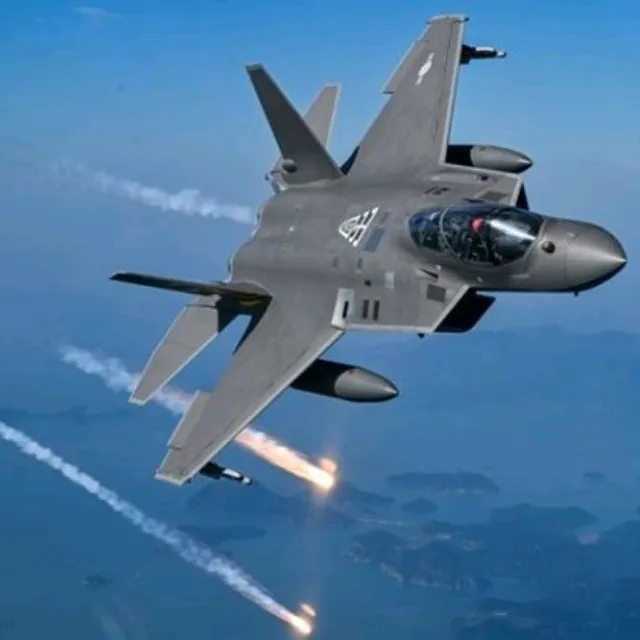
FINAL TESTS FOR THE SUPERSONIC AIR-TO-GROUND MISSILES OF THE KF-21 BORAMAE AND FA-50 BLOCK-70 FIGHTER JETS TO BE CONDUCTED IN OCTOBER AND DECEMBER 2026. THE MISSILES WILL BE LAUNCHED BY AN FA-50 BLOCK-70 FIGHTER JET, IN THE FINAL TESTS. 🇰🇷🇵🇭 | The final tests for the supersonic air-to-ground missiles to be mounted on the KF-21 Boramae and FA-50 Block-70 fighter jet will be conducted in October and December of this year, 2026. During the final tests, the missiles are scheduled to be launched from the air, while mounted on an FA-50 (Block-70) fighter jet. Development of the supersonic air-to-ground missile began in 2022 under the leadership of the Agency for Defense Development (ADD). It is a next-generation air-launched cruise missile designed to precisely strike key enemy ground targets from a long distance by being launched from a fighter jet. A test model was first unveiled at the 2024 Sacheon Air Show, and the missile aims for a maximum range of approximately 300 km and a top speed of 3,000 km/h (Mach 2.5). The most significant feature of this missile is that, unlike existing representative long-range air-to-ground missiles such as the German Taurus or the domestically produced Cheonryong, which typically fly at subsonic speeds (700–1,100 km/h), it approaches its target at supersonic speeds. The most important technical feature of this missile is its propulsion system. The Agency for Defense Development (ADD) is reportedly applying a ducted ramjet-type propulsion system suitable for supersonic flight. The guidance and search system are also significant advantages of this missile. According to the ADD, the supersonic air-to-ground missile employs a multi-mode seeker that utilizes RF (Radar), IIR (Infrared Imaging), and EO (Electro-Optical) rather than a single search method. This allows for the use of different sensors depending on the characteristics of the target and the battlefield environment, thereby enhancing precision strike capabilities. Stealth design has also been applied. This involves designing the missile's exterior to be difficult to detect by radar and reducing its Radar Cross Section (RCS), making it difficult for enemy air defenses to detect. Korean industry analysts predicted since the Philippines already purchased the Korean-made FA-50, with an additional purchase of 12 FA-50 Block-70 light fighter jets in 2025, the Philippines may show interest in air-to-ground missiles equipped with stealth capabilities that can reach speeds ranging from approximately 3 to 4.3 times faster than subsonic speeds, alongside Poland, and Malaysia. The Philippine Air Force is set to receive the FA-50PH Block-70 light fighter jets starting in 2028, and currently negotiating for KF-21 Boramae for the Multi-Role Fighter Acquisition Project. This supersonic air-to-ground missile for the FA-50PHs, and future KF-21s will boost the strike capabilities of the Philippines, once the PAF decides to acquire it in the future to give the FA-50s and it's future MRF a stand-off capability. https://m.news.nate.com/view/20260826n34446
More from @hobbyist_edits_
More breakout videos from this creator.


