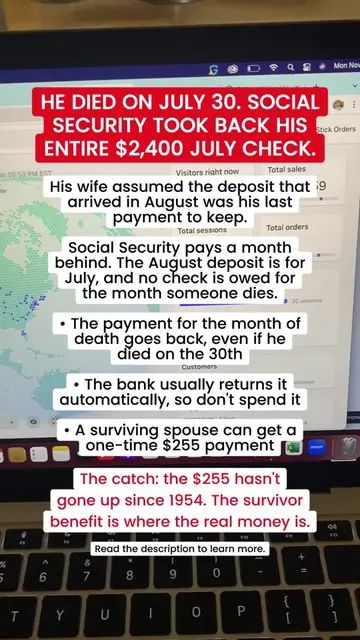
If your husband dies on a Tuesday, the joint account does not freeze. The money is yours that same afternoon with no court, no lawyer, and then it is taken back out. Then the government reaches into that same account and pulls a payment back out of it. It does not ask which half was yours. If you have already spent that money on the electric bill, you now owe it personally. That is what nobody explains. The account survives him. Four other things do not. Three of them gone before the first month is over. His last social security payment, the credit card in your purse, his pension, and one word on a paper you signed at the bank years ago which decides whether anything I just said about the account is even true for you. Four things. And how few days you have on each. Thing 1 of 4. His last social security payment. Start rule because it is the opposite of what almost everyone assumes. Social security is paid a month behind. The payment that arrives in August is the payment for July. So people treat it like money already earned and already theirs. The law says something else entirely. A person must be alive the entire month to be eligible for a benefit for that month. Dies on the 28th, owed nothing for that month. Not a share of it. Not 28 days of it. Nothing. It is an overpayment and it is going back. Now the part that turns a rule into a problem in your kitchen. There is no "his half." The money does not come back out of his half. The bank takes what it is told, no matter whose name put it in. The money. Her first weeks alone. What actually happens. He dies at the end of the month. The payment arrives a few days later. The payment that has arrived for 20 years. She pays the bills with it. The phone bill and the grocery bill because those bills do not stop for a funeral. And the balance is thin. Then the bank pulls it back. The money she spent. Overdrawn on money she never knew she could not keep. And if the balance is thin, and it usually is in those weeks, she never knew she could not keep. The file does not close. If it is already spent, the bank cannot reach it. Social security asks the bank. Because it is already spent. The debt moves to her. Now it asks her. And the first she hears of it is in the same month she buried him. She now owes the government directly in the same month she buried him. There is a second payment. And it goes the other way. There is a one-time death payment of $255 for a surviving spouse who was living with him. It does not arrive by itself. Somebody has to ask for it. And there is a two-year limit on asking. The money you were never owed. Taken automatically. Claimed by hand. The money you are owed has to be claimed by hand. That is the shape of this whole video. Thing 2 of 4. The credit card in your purse. Take it out and look at it. Whose name is printed on it. The company has a word for it. What that makes you. 1 His name is on the card. 2 Your name is not on the account. 3 You are an authorized user. And why that does not matter. Why it feels like yours. 1 You have carried it for years. 2 You have paid the bill from the joint account. 3 In every practical sense it is yours. It is your card. The account belongs to him alone. When he dies, the company closes it. None of it. What you cannot do. 1 You cannot take it over. 2 You cannot have the name changed. 3 You cannot leave it open while things settle. The account ends with the account holder. Every card attached to it stops working. Including the one in your hand. Now the second half. Worse, and slower. What that card has been doing. 1 Years of on-time payments. 2 Years of history. 3 All on an account in his name. That history stops helping you. When it closes. Years of history. Picture the position she is in. All at once. 1 Half the household income, gone. 2 Funeral costs in front of her. Declined. Because a company was told he died. She applies for one of her own. Almost no credit record in her own name - because everything was in his. One more thing worth knowing. Where the fear usually sits. Authorized users and a deceased account holder. I was an authorized user on my deceased relative's credit card account. Am I liable to repay the debt? No, being an authorized user generally does not obligate you to pay the debt. The debt belongs to his estate. One exception. A small group of states treat marital debt as shared. If you live here. 1 Arizona, California, Idaho. 2 Louisiana, Nevada, New Mexico. 3 Texas, Washington, Wisconsin. 4 Ask about that specifically. Free of the debt is not the same as having a card. And that is the whole of number two. Two different problems. Only one solves itself.