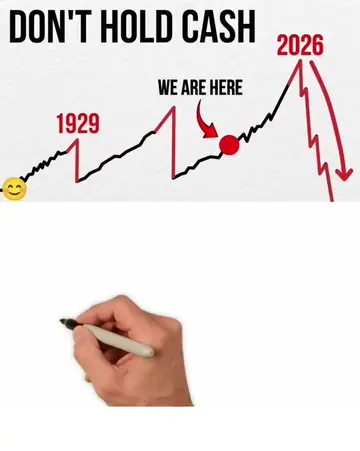
The stock market has only been this expensive twice before, in its entire history. Once in 1999, right before the dot-com crash wiped out half of the Nasdaq. And right now, in 2026, we are sitting at almost the exact same level. But here's the part that should really worry you. This time, it's not just stocks that look dangerous. The bond market, the part of the financial system that's supposed to be the safe one, is showing cracks we haven't seen in decades. And when both of these break at the same time, that's not a normal correction. That's the setup for something much bigger. By the end of this video, you're going to understand exactly why so many investors, including some of the most well-known names on Wall Street, are quietly preparing for a crash. You'll see the exact numbers behind the debt problem nobody wants to talk about, the valuation levels that have only ever ended one way, and the one date on the calendar that could decide which way this all goes. Stick around because the last part of this video is the one that actually tells you what to do about it. Leave a like and let's start with the part most people are ignoring: the debt. As of this year, the United States government owes more than $40 trillion. Just to put that number in perspective, 10 years ago, that number was under $19 trillion. It has more than doubled in a decade, and it's not slowing down. The government is currently running a deficit of almost $1.8 trillion this year alone. That means for every dollar the government spends, a huge chunk of it isn't coming from tax revenue, it's coming from borrowed money. Now here's where it gets serious. To borrow that money, the government has to sell something called Treasury bonds. Basically, it's an IOU. You give the government your money and in return, they promise to pay you back later with interest. For decades, these bonds were considered the safest investment on the planet. Every bank, every pension fund, every country in the world holds them. They are the foundation the entire financial system is built on. But right now, something strange is happening to these bonds. Buyers are demanding a lot more interest to hold them. The yield on the 10-year Treasury bond just hit 4.74%, the highest level in almost two years. And the 30-year bond, the one that funds long-term government spending, just crossed 5.25%. When yields go up like this, it means investors are getting nervous. They want more compensation for the risk of lending the government money for that long. And who's been selling? This is the part that should really catch your attention. Japan, historically the largest foreign holder of US debt, sold off billions of dollars worth of Treasuries earlier this year. China did the same thing, continuing a trend that's been building for years. China's holdings have dropped from a peak of over $1.3 trillion to somewhere around $700 to $750 billion today. That's nearly half of what they used to hold. In a single month earlier this year, foreign investors dumped more than $138 billion worth of US Treasuries. And total foreign holdings, which hit a record high back in February, have already started slipping since then. Why does this matter so much? Because when the biggest buyers of US debt start pulling back, the government has to offer higher interest rates to attract new buyers. Higher interest rates mean higher borrowing costs, not just for the government, but for everyone. Mortgages get more expensive, business loans get more expensive, credit card rates climb. And on top of that, the government now spends more than $1.1 trillion a year just paying interest on the debt it already has. That's more than it spends on national defense. Interest payments have quietly become one of the largest expenses in the entire federal budget, right behind Social Security. So you have a government that needs to borrow more money than ever before at the exact same time that the buyers who used to fund that borrowing are stepping back. That is not a small problem. That is a structural one. And it's been building for years while most people were focused on something else entirely: the stock market rally. There's another piece of this puzzle that almost nobody outside of finance talks about, and that's why foreign countries are pulling back in the first place. For decades, China quietly built one of the largest stockpiles of US Treasuries in the world, but over the past several years, that trend has reversed hard. Instead of parking their money in US government debt, countries like China have been buying gold at a pace we haven't seen in decades. Central banks around the world have been stacking gold reserves at record levels, quietly replacing dollars with something they see as more stable. At the same time, the US dollar itself has been weakening against other major currencies for years now. When the world's biggest economies start diversifying away from your currency and your debt at the same time, that's usually a sign that trust is eroding, slowly but surely. And trust is the one thing the entire system depends on. The moment large holders of US debt genuinely believe they might not get the same value back later, they stop showing up to the auctions, and the government is forced to pay even more to convince anyone else to lend it money. There's also a newer piece of this story worth understanding. A big chunk of the demand that's replaced some of these foreign government buyers has come from an unexpected place: stablecoin companies. These are firms that issue digital dollars used across crypto markets, and to back those digital dollars, they hold enormous piles of actual US Treasury bills. One of the largest stablecoin issuers alone holds over $120 billion in short-term government debt. On paper, that's new demand stepping in to fill the gap. But it's also a completely different kind of buyer than a national government. It's demand tied to the crypto market, which can be incredibly volatile. If that market ever cools off sharply, that source of Treasury demand could shrink just as fast as it appeared, right at a moment the government can least afford it. Which brings us to the second half of this story, and honestly, the part that worries a lot of professional investors even more. Right now, the S&P 500 is trading at a valuation level that has only been seen one other time in the last 150 years. The measure we use to track this is called the CAPE ratio. Without getting too technical, it basically compares stock prices to average company earnings over the past 10 years, which smooths out short-term noise and shows you where the stocks are actually cheap or expensive compared to history. The long-term average for this number is around 17. Right now, it's sitting above 41. The only other time it ever got close to this was in 1999, right before the dot-com bubble popped, when it peaked at 44. Let that sink in for a second. We are currently more expensive than we were before the 2008 financial crisis, more expensive than before the 1929 crash. The only period in history that beats where we are right now is the exact top of the dot-com bubble. And just like back then, almost all of this run-up has been driven by one theme: artificial intelligence. The seven biggest tech companies now make up roughly a third of the entire S&P 500's value. Think about that. One-third of the index that represents the largest and most successful companies in America is riding on the performance of just seven stocks. If those companies keep growing into their valuations, great. But if AI spending slows down even a little, or if the profits don't show up as fast as investors expect, that concentration becomes a massive risk for the entire market, not just for tech investors. It's also worth understanding just how much money has been pouring specifically into the companies building out artificial intelligence infrastructure. Spending on AI-related data centers, chips, and power infrastructure has become so large that some economists now estimate it's directly adding more than 1% to the entire country's economic growth number, all on its own. When one narrow slice of the economy is contributing that much to growth, any slowdown in that spending doesn't just hurt tech investors, it can drag down the whole economy's growth rate with it. And a lot of that spending isn't coming from cash sitting in the bank. Companies are increasingly issuing debt of their own to fund it, adding another layer of leverage on top of an already leveraged system. And there are real signs that some very smart money is already worried. Michael Burry, the investor who famously predicted and profited from the 2008 housing crash, has been warning his followers that he thinks a 1987-style crash is a real possibility right now. To put that in perspective, on October 19th, 1987, known as Black Monday, the Dow Jones fell 22.6% in a single day.