Loading video…
Sound

original sound - tradex_labs
tradex_labs · Original audio
0:00–:––
Playing this video’s own audio, so you’ll hear the creator over the sound.
The video provides actionable advice on a specific problem faced by a niche audience (prop traders), using clear visual aids and a logical explanation of a complex concept (sequence of returns and path dependency). The creator's personal experience and demonstration of results lend credibility.
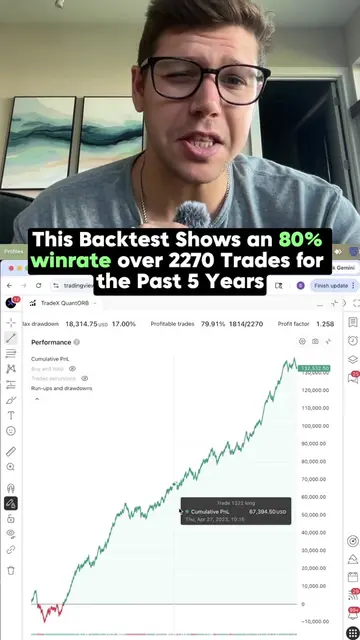
The video explains how to beat prop firm trading challenges by focusing on the sequence of returns rather than just the total profit. It highlights the importance of clustering winning trades and keeping losing streaks shallow to avoid hitting the drawdown limit before reaching the profit target. The creator suggests combining different trading strategies to create a smoother equity curve and reduce reliance on a single market regime.
Name of the game: Hit the profit barrier before the drawdown barrier. That makes prop firms a path-dependency problem. If the target is +$3,000 and the failure barrier is -$2,000, I care heavily about the sequence of returns: Winning clusters need to be frequent enough to push the account into the profit target, while losing clusters need to remain relatively shallow so the drawdown barrier isn’t reached first. This is why I look beyond total return and study: • Winning-streak distributions • Losing-streak distributions • Maximum adverse sequences • Time-to-target • Probability of hitting TP before DD • Monte Carlo barrier-crossing simulations Technically, a strategy does not have to produce an incredible long-term equity curve to occasionally pass an evaluation. Even a weak or roughly flat process can experience favorable sequences. But positive expectancy makes the entire process significantly more repeatable. Instead of relying primarily on favorable sequencing, you now have both the path characteristics and the underlying drift working in your favor. And this is where portfolio construction becomes much more interesting. Rather than depending on one strategy and one market regime, I can combine systems that generate returns differently. A momentum ORB can capitalize on expansion and directional conditions. A mean-reversion model can potentially perform during completely different environments. And yes… aggressive prop strategies can involve account churn (thats normal you noobs). As the famous saying goes “CHURN AND BURN!” So those with a heavier bank roll most likely will do better both psychologically & financially (if math is understood)…but that still doesn’t make this equivalent to a drunk monkey sitting at a casino with a billion dollars.
Propfirms Might Take This Video Down
Introduction to prop firm challenges and path dependency
Explanation of profit target vs. drawdown limit
Importance of winning streak distribution and shallow losing streaks
Demonstration of combining momentum and mean-reverting strategies
Showing the improved equity curve of a combined portfolio
Conclusion on reducing reliance on a single market regime
TradeX: The platform used to display trading performance and analysis. It ACTS as the interface for viewing and analyzing trading data. Removing it would change what happens in the video. TradingView: The platform used to display trading charts and data. It ACTS as the interface for viewing and analyzing trading data. Removing it would change what happens in the video. QuantORB 1.1: A specific tool or strategy within TradeX, shown to be used for trading analysis. It ACTS as a tool for analysis. Removing it would change what happens in the video.
Playing this video’s own audio, so you’ll hear the creator over the sound.
Outliers and viral hits: their videos on Overshot, all time.
Quantitative trading system for prop firm traders
All time.