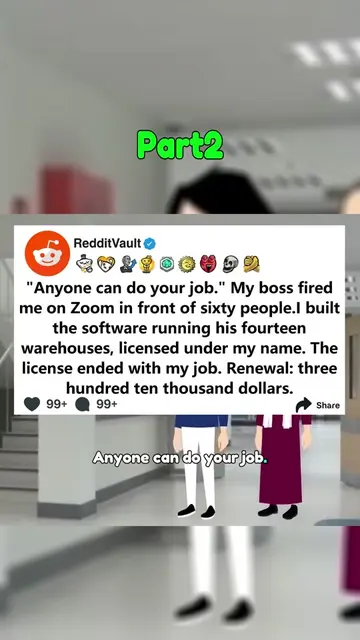
Anyone can do your job. My boss fired me on Zoom in front of sixty people. I built the software running his fourteen warehouses, licensed under my name. The license ended with my job. Renewal: three hundred ten thousand dollars. It was 9:03 on a Friday morning and I was at my kitchen table with a cold piece of toast, looking at 60 faces and little squares on my laptop. Friday operations call is the big one. Every site manager from all 14 warehouses dials in, plus the shift leads, the office. My boss, Brett Coil, runs it from a standing desk with a ring light. He had me pinned to the top of the screen that morning, which should have told me something. Before we get into numbers, Brett said, a personnel update, part of streamlining our technology function, we're eliminating Teo's position, effective today. Teo, thank you for your contributions. HR will be in touch about your equipment. I didn't understand it at first. I looked at my own face in the square, and I looked the way you'd expect. Brett said, today, I'm in the middle of the peak season prep. At least let me stay two weeks and hand things over properly. I'll write it all down for whoever's next. He smiled at the camera. That won't be necessary. We've got a consultant starting Monday. Honestly, Teo, the platform's mature. It runs itself. At this point, anyone can do your job. He glanced off-screen. Security will box your desk. 60 squares, and nobody said a word. Down in the third row, I saw Donna Peoples, who runs nights at the Doc 4 building, leaned toward her camera with her mouth open. Then she looked at her mute button and closed it again. She has a mortgage, and I don't blame her for staying quiet. Understood, I said. Brett waited a bit. I think he wanted a from me. A speech, or something. The room could watch. When it didn't come, his smile flickered. He adjusted his ring light. Great. Okay, team, week over week throughput. My screen went gray. The host has removed you from the meeting. I sat there with the toast on the chair beside me was an old brown clipboard with a cracked corner, which I keep by my desk the way some people keep a photo. I picked it up and held it for a while. I should tell you where the clipboard came from, because it's the only thing I had left after that call. 11 years ago, I drove on the night shift at Dock 4, which was the company's first building. At the time, it's only on my name, I was 26, a high school diploma, a bad back, and I was working 10 at night to 6 in the morning pulling pallets for a regional distributor called Rosenthal Freight. The place ran on paper. Pickers walked the building with printed lists, and printers spat them out. I watched men walk from a two-ton pull 40 and back to all three, all night, every night. It drove me crazy. So I started drawing routes on the back of my pick sheets during lunch. Then I taught myself to write code. I did it at home, on my own second-hand laptop from library books, videos, over two winters. I built a program that took the night's orders and them into a walking path that made sense. It was ugly. It worked. I tested it on my own picks and beat my numbers by a third. One morning at shift change, I got up the nerve to show it to the owner. Ike Rosenthal was 70 then, a short man in a cardigan who still walked all of his building that brown clipboard. He watched my laptop screen for about 10 minutes. He asked me three questions, and they were good ones. Then he said, what do you want for it? I didn't want money. I wanted a job where I could sit down. He gave me the job. But he did something else, too, that I didn't understand for years. He sent me to his own lawyer, on his own dime, and had an agreement drawn up. The program stayed mine. It was in my name because I'd written it on my own time, on my own machine, before I ever worked in his office. The company got the right to use it for as long as I was employed there, and for 30 days after, so nobody got the lurch. After that, if they wanted to keep it, they'd have to renew with me at whatever outside price would be. I told him it seemed a lot of fuss. He tapped the clipboard against his chest. Teo, I'm an old man. Someday I'll be dead, and somebody with a nicer watch will be running this place. He won't know you drove a forklift. He won't know what it cost you. Keep your name on it. He put one more thing in the agreement. Every year, whoever ran operations had to sign a one-page acknowledgement that the license existed and who owned the software. I excited himself until he retired. Over the next 10 years, that ugly program grew into everything. It does receiving, picking, inventory, truck scheduling, and the scanners on every forklift. The company went from one warehouse to 14, and everyone runs on it. I never stopped when it broke. Donna alone has called me at 2 in the morning 140 times. She countered once. I picked up 140 times. If you work in a warehouse long enough, you learn on above all. You don't stand in the aisle arguing whether the pallet's there. You scan the location, and the bin either has it or it doesn't. Opinions don't move freight. Ike died four years ago. He left me the clipboard. His first-hand drawn map of Dock 4 is still on it in pencil. His daughter Miriam took over as chief executive. She's fair, but she's finance, she's mostly at the head office. A year after Ike passed, she hired Brent to run operations. Brent came from a big national outfit. I'll say this for him, he's sharp, he hits his numbers, and the board loves him. In his first month, he had my name taken off the login screen. It used to say, built by Teo Bielski, Doc 4, Knights. He had insisted on that. Brent changed it to Operations Platform. He said the old one wasn't professional. In his second year, he presented at an industry conference what my team built under my direction. I wasn't invited. I saw the slides afterward. One of them bragged about how much the in-house platform saved the company, compared to what an outside vendor had quoted to replace it. Last November, a network vendor's bad update took down scanners in six buildings the week of Thanksgiving. I worked 19 nights in a row. I slept on a cot in the Doc 4 break room. When the bonuses came out, Brent's email thanked leadership. I got a $50 gift card to a steakhouse. Every March, the acknowledgement page came around, and Brent signed it. He signed it three times. I know, because I get a copy. He signed 40 things a day by clicking a yellow button, and I'm sure he read a line of it. I'll take my share of the blame. I liked being the sys system. My documentation was thin. Part of that was being busy, and part of it, if I'm straight with you, was vanity. It's a nice feeling to be the man they have to call. I'm not proud of that. After the call ended, I phoned a lawyer named Lucinda Oaks. She read Ike's agreement and told me three things. Don't log into anything, if an old password still works. Don't contact Brent. And send one letter to the company's legal address, saying exactly what the agreement says, and nothing more. I mailed it Monday. On Thursday night, my phone rang. It was Miriam Rosenthal. Teo, she said, I just read something my father wrote. Can you be on tomorrow's operations call? As my guest. Don't tell anyone. Friday at nine, I clicked the link.