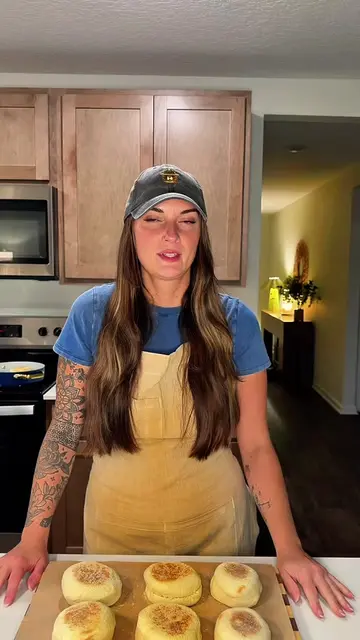
Loading video…
All breakouts Locked — upgrade to Pro to open.Open on TikTokPro
No preview available · watch on TikTok below
39.2Lifestyle
Post
Post by @clearlynotkelsey
@clearlynotkelsey
74.6K followers · usually 10.6K views a post
Views
406.1K
Likes
62.2K
Comments
304
Shares
3.1K
We’re still analyzing this post.
Original caption
✨Homemade Bagels✨ Ingredients Bagel Dough: * 520 g (about 3 1/2 cups) bread flour * 300 g (1 1/4 cups) warm water, about 105–110°F * 15 g (1 tablespoon) brown sugar * 7 g (2 1/4 teaspoons / 1 packet) instant yeast * 11 g (about 2 teaspoons) kosher salt For Boiling: * About 2 quarts water * 30 g (about 1 1/2 tablespoons) honey * 1 tablespoon baking soda Optional Toppings: ** 1 whisked egg for egg wash * Everything bagel seasoning * Sesame seeds * Poppy seeds * Flaky or coarse salt * Shredded cheese * Jalapeños Instructions: 1. Add the warm water and brown sugar to the bowl of a stand mixer and stir to dissolve. Sprinkle the active dry yeast over the water and let sit for 5–10 minutes, until the mixture looks foamy. Add the bread flour and salt. Using the dough hook, mix on low speed until a rough dough forms. Increase to medium-low and knead for 8–10 minutes. *or hand knead for 10-12 minutes. The finished dough should be smooth, elastic and quite firm. Bagel dough is intentionally much stiffer than regular bread dough, so resist the urge to add additional water unless the dough truly will not come together. 3. Form the dough into a ball and place it in a lightly greased bowl. Cover and allow to rise in a warm place for approximately 60 minutes, or until noticeably puffy and about 50–75% larger. It does not need to fully double in size. 4. Turn the dough onto a clean work surface and divide into 8 equal pieces, approximately 105 g each. Shape each piece into a tight, smooth ball. 5. Rest the dough Cover the dough balls and allow them to rest for 10 minutes. This gives the gluten a chance to relax and makes the bagels easier to shape. 6. Using your thumb, poke a hole through the center of each dough ball. Gently stretch and rotate the dough until the opening is approximately 1 1/2–2 inches wide. Make the hole larger than you think you need because the dough will expand during proofing, boiling and baking. 7. Place the shaped bagels on a parchment-lined baking sheet and cover loosely. Allow them to proof at room temperature for approximately 20–30 minutes, until slightly puffy. They should not double in size. Overproofing can give the bagels a fluffy, bread-like texture instead of a dense, chewy crumb. Meanwhile, preheat the oven to 450°F. 8. Bring about 2 quarts of water to a gentle boil in a wide pot. Carefully add the honey and baking soda and stir to dissolve. Add the baking soda slowly, as it can cause the water to foam up temporarily. 9. Working in batches so you don’t overcrowd the pot, carefully lower the bagels into the simmering water. Boil for 1-2 minutes, flip, then boil for another 1-2 minutes on the other side. The longer you boil them, the thicker and chewier the finished crust will become. I like a thicker crust, so I boil for 2 minutes, you could boil for as short as 30 seconds per side for a thin crispy crust. 10. Drain and add toppings Remove each bagel with a slotted spoon or spider and allow the excess water to drain. Return to the parchment-lined baking sheet. While the surface is still damp, gently brush with an egg wash and generously sprinkle with your desired toppings. 11. Bake at 450°F for approximately 18–22 minutes, rotating the pan halfway through. The bagels are finished when they’re deep golden brown with a firm exterior. Don’t pull them when they’re merely pale golden—the deeper color means better flavor and crust. 12.Transfer the bagels to a wire rack and allow them to cool for at least 20–30 minutes before slicing. Tips for the Best Bagels Don’t add extra water too quickly. Bagel dough should feel noticeably firmer than sandwich bread or cinnamon roll dough. The lower hydration helps create that characteristic dense, chewy texture. Knead thoroughly. A strong gluten network is especially important for bagels. The finished dough should be smooth, strong #creatorsearchinsight #worththesearch #bagels #homemade #homemadebagels
More from @clearlynotkelsey
More breakout videos from this creator.