Loading video…
All breakouts Locked — upgrade to Pro to open.Open on TikTokPro
No preview available · watch on TikTok below
65.8Health
Post
Post by @drjoedamiani
@drjoedamiani
609.5K followers · usually 18.4K views a post
Views
1.2M
Likes
15.0K
Comments
141
Shares
2.3K
We’re still analyzing this post.
Original caption
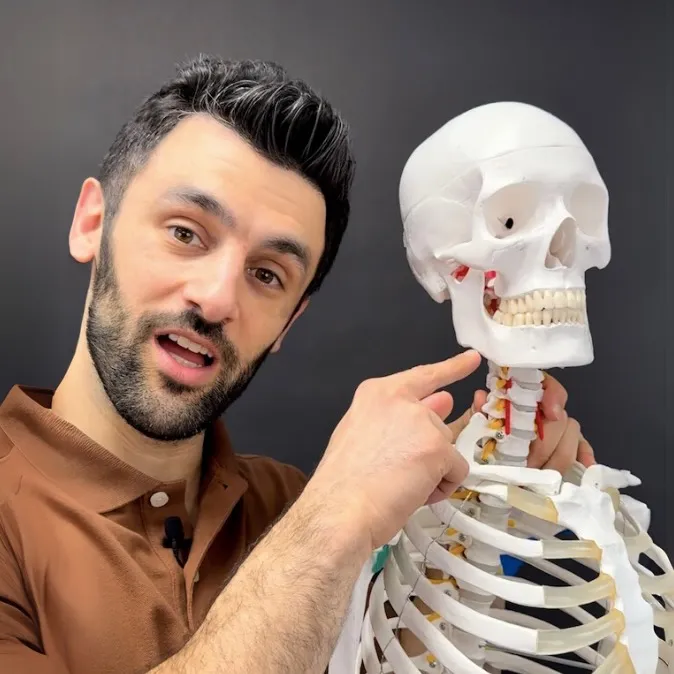
🔥 Jaw clicking, popping, or pain when you eat or yawn? The lateral pterygoid may be worth looking at! Deep inside your jaw, the lateral pterygoid helps control jaw movement and works closely with the TMJ and its articular disc. 💡 Here’s what may be happening: ⚡ Your jaw needs muscular balance Different muscles coordinate to open, close, and stabilize your jaw. The lateral pterygoid plays an important role in controlling the jaw as it moves forward and side to side. ⚡ Clenching can overload the system If you’re constantly clenching, your closing muscles are repeatedly producing force around the TMJ. This can increase demand on the muscles responsible for controlling and stabilizing the joint. ⚡ Poor coordination can create shifting The lateral pterygoids work on both sides of your jaw. If the two sides aren’t coordinating well, your jaw may deviate or shift instead of opening and closing smoothly. 🛠️ So what can you work on? ✅ STEP 1: Lateral pterygoid release Carefully go along the outside of your upper teeth toward the very back of your mouth and gently work the deep area shown in the video. Keep the pressure comfortable—this is a sensitive region. ✅ STEP 2: Retrain coordination Slowly shift your jaw side to side, focusing on smooth, controlled movement in both directions. ✅ STEP 3: Add resistance Use your hand to provide gentle resistance as you shift your jaw from side to side. This increases the muscular challenge while maintaining control. ✅ STEP 4: Reduce clenching At rest, think: Lips together → Teeth apart → Breathe through your nose Temporarily reducing very hard or chewy foods may also help if your TMJ is irritated. If you grind at night, a properly fitted splint may be worth discussing with your dentist. 🔥 The goal is to reduce unnecessary loading and improve the strength, coordination, and control of your jaw. #TMJ #JawPain #JawClicking #JawPopping #PhysicalTherapy
More from @drjoedamiani
More breakout videos from this creator.


