Loading video…
All breakouts
127Text-HeavyStory Open hookEntertainment
Hook
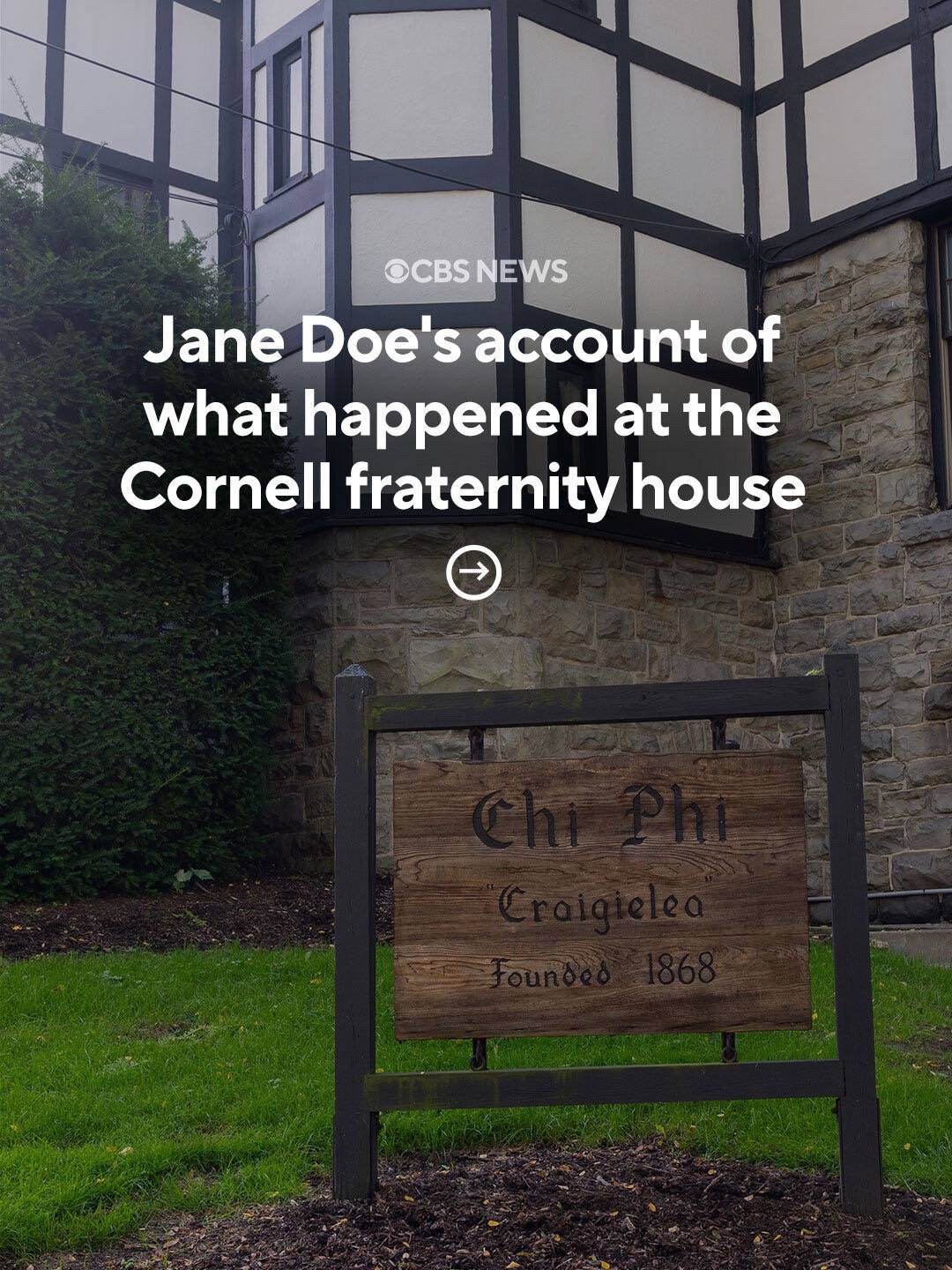
Jane Doe's account of what happened at the Cornell fraternity house
@cbsnews
13.1M followers · usually 30.0K views a post
Views
7.7M
Likes
332.0K
Comments
2.5K
Shares
27.2K
Why it worked
The post leverages high-stakes investigative journalism and a sensitive, compelling narrative to provide a clear, chronological breakdown of a complex legal case, keeping viewers engaged through the swipe-through format.
Summary
This slideshow presents a detailed timeline of a sexual assault allegation made by a former Cornell student against members of the Chi Phi fraternity. It documents the sequence of events, the subsequent university investigation, and the filing of a civil lawsuit two years later.
Structure
- 1Introduction to the case and timeline of the night
- 2Details of the alleged assault and initial police interview
- 3The aftermath, medical visits, and realization of the assault
- 4Reporting to the university and police investigation results
- 5Filing of the civil lawsuit and legal developments
- 6State government intervention and commitment to further investigation
Product placement
CBS News (appears as a watermark and source of the reporting; removing it would not change the video's content as it is the publisher). Snapchat (appears in a screenshot of a chat; it is the platform where the message was sent, not the product being promoted). Uber (spoken; it is the service used for transportation, not the product being promoted).
On-screen text
Jane Doe's account of what happened at the Cornell fraternity house
The night of Oct. 19, 2024: Jane Doe said she drank vodka until she was intoxicated at a sorority house, according to the lawsuit she filed last month. At 8:30 p.m., she said she and the sorority's “house mother” took an Uber to a bar near the Cornell campus. By 10:00 p.m., she and other sorority members went to another bar. At 11:00 p.m. she went alone to meet up with a friend at the Chi Phi fraternity house.
At the Chi Phi house: By 1:42 a.m. on Oct. 20, one of the defendants in the lawsuit sent a message in the fraternity chapter's Snapchat group saying there was a woman upstairs for “free” sex, according to a screengrab included in the lawsuit.
Jane Doe told police she initially had a consensual sexual encounter at the frat house with two men she knew, which she said she was “OK with.” “Yeah, as much as I can be because, again, I was super drunk when I got there. ... But I was pretty OK with all of this,” she said in an interview conducted on Nov. 14 with a Cornell police investigator, victim's advocate, university Title IX investigator and Jane Doe's adviser.
In documents from Cornell's Title IX investigation, Jane Doe described hiding under the covers in a bed as more men came into the room. “I was like literally cornered,” she said. She lost consciousness around 5:45 a.m., according to the lawsuit.
“I had become extremely uncomfortable with how this night was turning out, so my thought was, if I do ketamine again, maybe I will pass out. My thought was that if I passed out and these men have sex with me, then they could have been charged with rape at this point,” she said in a sworn six-page statement to Cornell police.
The days after: Jane Doe said she awoke later and returned to her room at the sorority house. She talked about it with roommates that morning, according to documents from Cornell's Title IX investigation. One roommate said Doe was laughing but seemed to be in shock. The roommate said Doe did not call it rape or assault that morning. A second roommate said Jane Doe told her, “I wasn't comfortable.”
Oct. 22: Medical clinic visit. Jane Doe went to the medical clinic on campus, to address a urinary tract infection and was tested for sexually transmitted diseases, her lawyer, Thomas P. Giuffra, said. “Ms. Doe disclosed to the treating health care professional that she contracted the UTI in a 'traumatic way,'” Giuffra said in the statement.
Late October: Online comments about assault. About a week after the incident, Jane Doe says she saw comments on an online forum about Greek life on campus, in a section on Chi Phi, referring to “terrible people” who had “gang raped a sophomore.” “And that's kind of when I came to the realization that I had been gang raped,” she said, according to the Title IX investigation documents.
Nov. 3 text: “Not consensual”. Jane Doe continued texting with two of the Chi Phi members. She wrote, “let's be clear that 90% of what happened that night was not consensual,” according to the investigation report.
Nov. 7: Sexual assault forensic exam. Jane Doe requested a rape kit, but by that time, any potential DNA evidence was gone, her lawyer said.
Nov. 8: Reporting it to police. Jane Doe went to the Cornell University Police Department to report. The same day, the Xi Chapter of Chi Phi was placed on suspension and the seven men later named in the lawsuit were temporarily suspended.
Nov. 14-15: Jane Doe's police interview. According to the transcript, she described drinking and using drugs that night and said she had gaps in her memory.
Nov. 14-15: Jane Doe's police interview. “I can say with 100% confidence I was raped,” she told police, according to a transcript obtained by CBS News New York. She described feeling coerced and tired and giving in, and said she was “completely and totally incapacitated.” She said she didn't remember the end of the night “where I was raped” and didn't know how many people had sex with her.
Nov. 14-15: Jane Doe's police interview. “And then, of course, I was being hit at the same time. Physically hit very, very hard,” she also said, according to the transcript. When she returned for a second day, Jane Doe reviewed the revised six-page statement. Before signing, the transcript shows Jane Doe said, “I'm very confident about this.”
No criminal charges were filed against the seven men accused by Jane Doe in the investigation. Cornell conducted an internal review and hearings. The school said two of the men were expelled, two were suspended for at least two semesters, one had already graduated before any punishment could be handed down, and two were found not to be responsible for sexual misconduct. Her lawyer says Jane Doe dropped out of school after the incident.
September 2026: Lawsuit filed, investigation reopened. Jane Doe filed a civil lawsuit against the seven former fraternity brothers, Cornell University, Chi Phi and others nearly two years after the alleged attack. Lawyers for two of the men have provided statements to CBS News denying the accusations. Others have not made public statements.
FILED: NEW YORK COUNTY CLERK 09/16/2026 07:05 PM... (excerpts from legal filing)
October 2026: New York governor steps in. New York Gov. Kathy Hochul says Cornell agreed to hire outside counsel for an independent investigation, and she appointed state Attorney General Letitia James to serve as special prosecutor in the case.
“No institution gets to protect its reputation at the expense of a young person seeking justice. No public official gets to look the other way when the system breaks down and fails our young people. And as governor I will not allow anyone to sweep this case under the rug.” New York Gov. Kathy Hochul
Original caption
Text messages and documents from the investigation are providing new details about the night a then-20-year-old Cornell student known as Jane Doe says she was raped by multiple men at a fraternity house in October 2024. This timeline of her account is based on messages obtained by CBS News, a lengthy interview transcript with campus police and documents from Cornell's Title IX investigation in the months that followed. #cornell #ny #investigation
More from @cbsnews
More breakout videos from this creator.