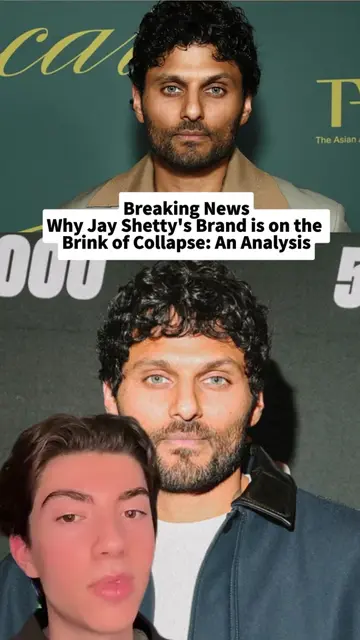
I spent like six years in business school and it's all prepared me for this moment to finally talk about the downfall of Jay Shetty, why I personally believe this is going to be one of the biggest scandals we've ever seen in our entire lives, and also a really interesting question about if people can be canceled because we actually have a lot of data that shows that people don't get canceled. A lot of times these scandals just serve to increase their name recognition over time. However, I am going to make the argument that this is going to be one of those unique cases where he does in fact get canceled and I believe this might be the end of his career. So, what's going on? Jay Shetty, for those that don't know, is a podcaster, an author who wrote this book, Think Like a Monk, about his experiences being a monk in India for a few years and sort of taking these Eastern spiritual principles to the Western world. He has an extremely popular podcast where he's interviewed very high-profile celebrities like Kendall Jenner, I think even Joe Biden, Michelle Obama, like very high-echelon people. And basically, he's currently being accused of a lot of things. He's being accused of making doing very strange things during his live shows, taking advantage of people, creating a course that is extremely overpriced for life coaching that is not actually an accredited school, and also associating with different schools that did not give him permission. And worst of all, he's being accused of fabricating his entire life story of being a monk in India because they have now uncovered evidence that he was not in in India in the timeline that he sort of laid out in his book and throughout his career and that he was really in the UK the whole time, possibly in a mansion, making YouTube videos, and he was never really a monk at all. He was really just somebody that wanted to be famous and utilized the story as a method to get there. So, first of all, this story is a little bit frustrating for me because I read his book and originally when I first read it, I thought it was fine. I did feel like it really lacked a lot of spiritual depth and I'm somebody that I love spiritual books. I don't really read fiction books anymore. I like to learn when I'm reading just personally. Not that you don't learn from fiction books, but you know what I mean, just my preference. And I'm a really big fan of Marianne Williamson. I've always felt like I get a lot of spiritual knowledge from her. When I read this book, it felt very shallow. It didn't feel like there was a continuity to it. I didn't really get a sense of his life story. It really just felt like a collection of Pinterest quotes. That was just my opinion. I wasn't completely turned off by him at this point, where I started to distance myself from him and not want to engage in his content is when I saw just the way he was so obsessed with celebrity culture really rubbed me the wrong way personally. And I don't obviously know all of the tenets of being a monk in India, but I did visit Mount Athos in Greece, which is one of the most famous sites and one of the most famous monastic communities in the world. And one of the biggest tenets of being a monk, no matter what religion you're in, is you essentially renounce the material world. You change your name, you give up all of your belongings, you completely separate yourself physically, mentally, emotionally, spiritually from this physical world. They don't have phones, they don't have internet, they don't obsess over money, they don't have money. So the entire point of it is in order to gain spiritual enlightenment, you give that away, you give away the prestige of the world, you give away your degrees, you give away your desire to climb the ladder of popularity and money and all of these material things. So to me, there was a very stark contrast to what his beliefs were when he was a monk to now being somebody that seemed to be very obsessed with Hollywood, elite celebrity culture, very obsessed with money, having an app that was valued at like $2 billion and charging extremely high prices for life coaching, going on these tours where the tickets were very expensive, which is why me and my friend didn't end up going because it was like paying this go to like a Taylor Swift concert, it was ridiculous. So to me, it was a little bit of a red flag because as somebody that had spent time with monks, they really do have the most deep, they have the deepest integrity. It's not a part-time thing. You don't go to a monastery and like dabble in it and then leave and like go on a TV show and talk about it. Like it is a very serious commitment. When you become a monk, you literally have a marriage ceremony where you become married to God and that's why monks are celibate. They are literally in a relationship with God and with the spiritual world, not the physical world. So the reason that I'm bringing this up is I sort of started to see these red flags and I think a lot of people did. So I think that it really does bring up an interesting question, which is can he be canceled? Well, it depends. When we're looking at personal brands, I believe that the extent to which somebody can be canceled is going to depend on the nature of the personal brand. Let's use Ellen DeGeneres as an example. Her entire personal brand was built upon this idea of kindness. After every single show, be kind to one another, be kind to one another. So then when we started seeing those cracks, it seemed very authentic and it was in stark contrast to the foundation that she built. So because that was the nature of her personal brand, she was one of those situations where she did get canceled, her show did decrease in popularity and ultimately she had to step down because the allegations, even though they weren't so severe like Harvey Weinstein level, they were enough to really poke holes and collapse the foundation of her personal brand, at which point it was way too late to already rebuild.